Ask and you shall receive!

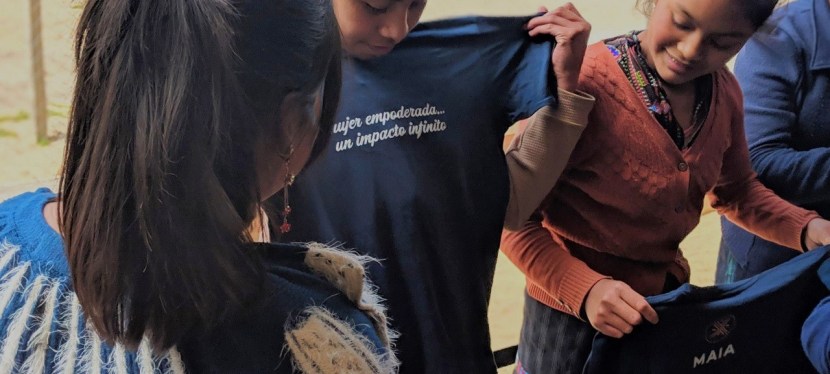
Nick Kristof has made his way to Guatemala! I don’t actually think this is because of my post the other day, but I am still thrilled!

The focus of this piece, published in today’s NY Times (June 6, 2019), is on climate change driving migration…do you know what Project Drawdown says is the top solution to climate change? Combined, it’s girl’s education and family planning.  And so I circle right back to MAIA. This is extremely important stuff, folks. Educating girls in Guatemala has incredible trickle down impacts on so many issues, from simply the humanity of alleviating  the suffering of other human being’s day to day survival to creating opportunity and hope to reducing the impacts of climate change. 

Nicholas Kristof and the Power of Hope

It’s not just me. Nicholas Kristof, the renowned New York Times journalist and two-time winner of the Pulitzer Prize, also believes there is power in hope. He published an article in the NY Times opinion section on May 29, 2019, entitled Cash, Food and Health Care All Help the Poor, but Something’s Still Missing. It’s about poverty within the indigenous population in Paraguay, and how opportunity (also known as HOPE) can be a transformative force in substantively changing the trajectory of people’s lives.

Hope doesn’t mean just an idea and a good feeling. It means a pathway to something new and the supports to get there. The program in Paraguay references mental health support in addition to guidance on how to grow a small business. No one goes it alone. The notion that anyone is successful completely alone and in a vacuum is one of the biggest fallacies ever promoted.

As I read Mr. Kristoff’s article, I found myself thinking about the MAIA Impact School in Guatemala and the similarities between what he observed in Paraguay and what I have seen happening in Guatemala. The MAIA school, led by courageous and empowered Mayan women, sees hope in the form of providing a real, robust education to young girls with the potential to succeed but no opportunity to do so. These girls are rural, poor, indigenous, and female, four major challenges in a country where machismo is the norm and racism against the indigenous population is severe (of the 200,000 people killed during Guatemala’s 36-year civil war, 93% were indigenous). MAIA provides not only academic opportunity for these girls, but also the mentoring and support that they and their families need to navigate the extremely demanding road before them. This road begins with these girls beginning to build a path for their families out of systemic poverty. Imagine the trickle-down generational impacts when empowered, educated girls become empowered, educated mothers. The possibilities for change spread like the roots of a strong tree.

MY HOPE is that Mr. Kristoff finds his way to Sololá, Guatemala, as he winds his way back north…this story, the incredible work being done by this school in Guatemala to create hope and an actual opportunity for a viable future needs to be broadcast more widely. The little news we hear about Guatemala in the U.S. fixates on negative imagery from illegal border crossings and migrant caravans to drug cartels and political instability. What if the news focused more on what kind of hopelessness would compel someone to make that fraught journey to an uncertain and antagonistic future? What if they presented solutions that would help people build a future that would be a reason, a means, to stay?

Pulitzer committee, I’ll be awaiting your call ;-)!


True Confessions of a Mom Set Loose

October 31, 2018

On the plane from Miami to Guatemala City. This is my first extended solo excursion since having children, my first trip to Central America, my first trip to the developing world in a very long time. It’s a lot of first’s and with that comes excitement and joy and a re-awakening of my spirit or some part of me that’s been quiet for some time…as well as a visceral, biological longing and sadness that I can’t control and didn’t expect. It’s hard to say goodbye to my family and, much as I am sometimes desperate to bust out of the routine and the daily grind, it’s also incredibly difficult to break away.

By chance, the man who drove me to the airport this morning grew up in Guatemala. He was stunned that that was where I was headed. It feels like the universe conspired to cross our paths. I told him (between sniffles) that I hadn’t really done much for myself in 11 years and that I wanted to soak in the moment. He said, “You are like a comet, passing through so rarely but shining so brightly.” I like that idea!

So, here I am, halfway to Guatemala with my journal out and two books sitting beside me – Open Veins of Latin America (by Eduardo Galeano) and Less (by Andrew Sean Greer) – that I might actually be able to read with all this uninterrupted time. For the time being, though, my mind keeps jumping between thoughts of travel past and the younger me; about my kids, already anticipating our reunion; and imaginings about what this trip will be like! And this tells me that maybe I should take a couple minutes to just sit and be, quietly…but, first, a haiku:

Mundane and routine

Break the mold of must and should

Rare delight, bright light.

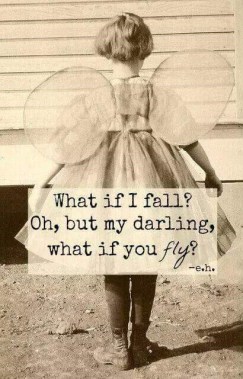
What if I fall quote


Notre Dame and our common humanity

Why is it that tragedy unites us but otherwise we spend our time picking each other apart and spreading divisiveness?

I don’t want to launch into a synopsis on modern politics or the state of the world today. Most people are pretty up-to-speed on the general dark cloud hanging over the western hemisphere without my rehashing it…so I’ll be short and sweet here for the sake of all of our sanity and won’t delve into things about which I know (too?) little.

What I know is this: Notre Dame cathedral burned yesterday and it stopped everyone in their tracks. Suddenly people of all stripes are united in their grief. Facebook posts display picture after picture of individuals’ experiences at Notre Dame, plus stories of longing and sadness from those who hadn’t had the chance to go there and see it in person.

The notion that this monument anchoring the skyline of Paris for centuries is in peril defies belief. This human construct, a display of the beauty that man is capable of creating, has for centuries drawn pilgrimaging Catholics, as well as millions of tourists of other religious and agnostic persuasions, to stand in awe of its majesty. It has survived so much history, so much destruction, from the French Revolution to the two horrific world wars of the 20th century. But in mere hours yesterday it literally went up in flames.

It’s like the smack across the face that the world needed. I hope it is, anyway, and that some long-term good will come of it. Historic monuments like Notre Dame are an investment. They represent hope, connect us to our past, and guide us toward the future. They are an incarnation of what binds us to each other and to our common good. They are a symbol of the best in human civilization – architecturally, culturally, and artistically –  and a beacon when we have lost our way.

We have been living in a period of neglect of community, faith, and hope. We have literally let historic buildings crumble and decay before our very eyes due to a lack of funding, indifference, and disinterest. In our lives, the virtual becomes ever more confounded with reality. We intentionally, or through the magic of algorithms and our personal data, surround ourselves only with like-minded individuals.

Today we must acknowledge these failings and renew our faith that we are more alike than we are different. It’s well beyond time to restore global sanity, to find common ground, and to chart the course forward with an intact moral compass by investing in what really matters. The investment required is not exactly in our history or our future, per se, but both together manifested in how we treat our fellow man today. Words like honor, dignity, respect, integrity, patience, and hope swirl through my mind. The restoration of the building is a worthy aspiration, but those values are what urgently need restoring.

In Honor of the Extraordinary W. S. Merwin

W.S. Merwin, United States Poet Laureate and winner of 2 Pulitzer Prizes for Poetry, author of The Wonder of the Imperfect (among many, many other poems), and founder of the Merwin Conservancy passed away on March 15, 2019.

I admit quite readily that I am no poetry expert, and I have only been to Hawai’i once. I cannot possibly honor the full depth and breadth of Mr. Merwin’s life and works, so today I am posting a collection of tributes and poems by those who knew him best.

What captured my attention and admiration was Mr. Merwin’s authentic, genuine approach to life. He lived his life his way, with a gentle, persistent faith in the renewal of a forest, and of humanity; with a constant striving and belief in his art, his work, the natural world, even or especially when it was contrary to the mindset of the day. He modeled for us what happens when you find your passion and you stick with it. He lived his values with integrity.

The most healing thing you can do for your mind and your soul is to become more aware of your surroundings, to take a deep breath and appreciate what’s around you, to care about the world we live in, and to be uniquely and passionately you. W.S. Merwin lived that ethos his entire life. Take some time to get to know him and the incredible legacy of  his poetry and his palm forest. Today, in his honor, let the antidote to the ridiculous pace of life, the absurdity of the political shenanigans we are subjected to daily – to whatever ails you – be gratitude and moments of joy for this life, for this day, for being authentically you, having hope, and following your passion.

Rest in Peace, Mr. Merwin. With sincere gratitude for your example and your teachings,

Meg

Garden photograph credit to Mr. Larry Cameron

https://merwinconservancy.org/2019/03/poem-of-the-week-for-the-anniversary-of-my-death/

https://merwinconservancy.org/2019/03/pulitzer-prize-winning-poet-w-s-merwin-passes-away-at-91/?fbclid=IwAR1tTYbgyRPbAD_GBhLdM5issWC1Jvri-lYsFXoasQgYFrtbbCgOQdKMmvU

http://time.com/5555727/poet-w-s-merwin-obituary-by-rita-dove/

https://www.theparisreview.org/blog/2019/03/18/poem-for-merwin/?fbclid=IwAR3uvgYWLxMaloO4kl6o-SVu5rvb7fUYGOFYDwDKjK90Ms0YnYWKX6Ynfag


The Untold Story of a Little Town with a Big Heart and a Lot of Sole

Rural communities are suffering. Highways bypass historic downtowns, big box stores cannibalize revenues from local retailers, and there are limited employment options, forcing young people to leave in search of opportunity. These issues are not unique to rural areas, but are exacerbated there by the lack of a critical population mass, and more piecemeal and sporadic services and resources. In some places, “homecomers” have led the way back to the rural communities where they were raised. Many communities are expanding high speed broadband and e-connectivity resources to improve education, health care, and business opportunities. And some communities band together to painstakingly plan for renewal by focusing on the vital role of their most historic structures in anchoring their past while launching a new future.

The Industrial Revolution spurred the creation out of farmland or forest of many of our nation’s cities and towns. Factories sprung up along the shores of powerful rivers to capitalize on the harnessed hydropower. Immigrants in search of work flocked to what, at the time, were outposts of civilization, eventually building homes and a community around their livelihoods. Homes, churches, performance halls, and other civic institutions emerged from the wildlands.

For a time, the paper industry of Millinocket, ME; the appliance and railroad industries of Fort Wayne, IN; the textiles of Lawrence, MA; the shoes of North Brookfield, MA; and the steel, textile, and tanneries of North Philadelphia, PA, to name just a few, thrived. But then manufacturing practices became more mechanized. Companies found cheaper labor in the southern U.S. or abroad. Demand for paper declined. More modern manufacturing facilities evolved and the original production methods and buildings became obsolete.

Slowly, insidiously, the industries that had built these cities, towns, and neighborhoods shuttered their doors, moving elsewhere or closing entirely. What remains are vacant mill buildings, deteriorating opera houses, empty storefronts – the dilapidated, decaying nucleus of the country’s manufacturing communities. What happens when the primary source of employment evaporates but a community has set down roots and traditions; has built ornate civic structures, but doesn’t have the resources to maintain them? When the city or town itself loses its spark and stagnates? And when it barely recovers from the last recession before the next one begins?

According to the Economic Innovation Group’s 2018 Distressed Communities Report, recovery from the most recent recession has been unevenly distributed. Since the 1990s, there has been an “intensifying ruralization of distress,” said John Lettieri, EIG’s president. The challenges facing rural America are complex and stubborn and difficult to solve. At the same time, our current “period of national prosperity is our chance to reinvest in communities and rekindle the economy’s dynamic forces.” (EIG report)

A new future requires some sort of catalyst to forge forward out of stagnation. What is it that finally ignites revitalization in some communities, while others continue to languish? I have a few theories after two decades working in real estate analysis and community development. One is an engaged and competent local government. Another is a devoted group of local citizens with a strong leader. A cohesive vision and implementable plan, both with short- and long-term goals, is critical. Usually success takes years of coordinated effort between local and state government and committed volunteers. Surely sprinkled in there is a bit of luck and good timing.

In North Brookfield, MA, a rural community of 4,800 people about 25 minutes from Worcester and 60 miles west of Boston, residents and town leaders have rallied around the historic Townhouse as the focal point for their community’s redevelopment efforts. Designed by Eldridge Boyden, a locally accomplished architect, the Townhouse was one of the first public spaces in this country built in the French Second Empire and Italianate styles. The building was constructed in 1864, and served as a hub of political, cultural, and community activity for the broader region.

Then times changed. The Batcheller Shoe Company closed in the early 1900s, and with that and the evolution of retail towards big box stores and online shopping most of the family-owned businesses in downtown North Brookfield also eventually closed. Currently, the almost 14,500 square foot Townhouse is vacant, and the main street is quiet. The Bell Tower was damaged in Tropical Storm Irene in 2011 and determined to be structurally unsound.

But North Brookfield is a small, tight-knit community with a ton of heart. Manufacturing continues on a smaller scale, with Vibram, the Italian shoe sole company, operating the former Quabog Corporation rubber manufacturing plant across the street from the Townhouse. The Friends of the North Brookfield Townhouse, a non-profit group brimming with volunteers, ideas, and passion, was organized over a decade ago with the mission of preserving and renovating the Townhouse to re-establish it as the center of civic, political, social, and cultural activities. The Friends and the town have worked arduously to preserve the building, hiring a local craftsman to replace the Bell Tower in 2014 and, in 2015, thanks to state funding, securing the building from water infiltration by replacing the roof, windows, dormers and gutters.

Among many other initiatives, including applying for and being awarded an allocation of historic tax credits to help finance a renovation, in the fall of 2018 the Friends facilitated the painting of the building’s exterior. They collected donations for all of the supplies, and brought in lunch daily for the workers, a number of whom were prisoners from the Worcester County Sheriff’s office work release program. Townspeople passing by would see what was happening and stop to ask how they could help. Some literally picked up a paintbrush and worked for a couple of days, some gave money for supplies, while others brought chocolate chip cookies, brownies or homemade pumpkin bread to share. There was no cost to the town. The results speak for themselves.

The Townhouse is a building with high emotional content. It has the capacity to stir one’s soul. In the traditional metrics of market conditions, it’s a challenge and the Friends will need financial support from grants to private donations to pull it off. But not everything that is worthwhile in life is quantifiable. In fact, I would argue, that the things that matter most have no intrinsic monetary value – like community, integrity, hard work, passion, and hope. The town of North Brookfield has these in spades. The Townhouse is a center piece of the town architecturally and a vital link between its past and its future. That future is being constructed with vision and dedication, strong leadership, and a plan based in solid fundamentals that will capture the imagination of the town and the region. Maybe sprinkled with a bit of luck for good measure.

Welcome to North Brookfield – the heart and sole of Massachusetts!

“Though nothing can bring back the hour
Of splendor in the grass, of glory in the flower;
We will grieve not, rather find
Strength in what remains behind;
In the primal sympathy
Which having been must ever be…”
― from William Wordsworth’s Ode: Intimations of Immortality

“Let me tell you the secret that has led to my goal. My strength lies solely in my tenacity.” – Louis Pasteur 

The Unsung Solution to Climate Change

The top solution for reducing climate change probably isn’t what you think. I am an avid outdoorsperson and have been a proponent of sustainable development and living lightly on the land for decades. But I missed one big factor in considering our environmental impact entirely until relatively recently. During all my years thinking about environmental issues and solutions, I thought very directly and narrowly about the more obvious aspects of the environment from pollution to deforestation.

I have had an epiphany in my thinking about environmental priorities lately, as well as long-term solutions. Project Drawdown, founded by author, entrepreneur, and environmentalist Paul Hawken in 2014, maps, measures, and models the most substantive solutions to stop global warming, and communicates those findings to the world. Project Drawdown researchers published a list of their top solutions to climate change. It’s not recycling more and it’s not riding your bike everywhere or giving up your car – though doing more recycling and less driving aren’t bad ideas either.

What is it? It’s educating girls. If you look at their list of solutions, you will see Educating Girls listed as number 6 and Family Planning listed as number 7. If you combine the total atmospheric CO2-EQ reduction (GT) of these two solutions, which has been arbitrarily split in half by the list-makers, it climbs to the top of the list.

By chance, at the same time this solutions list came across my plate, I had just read The Education Crisis: Being in School is Not the Same as Learning. To quote the article, “Global experience shows us that countries that have rapidly accelerated development and prosperity all share the common characteristic of taking education seriously and investing appropriately.”

This data amplifies the power and importance of what I witnessed at the MAIA Impact School in Sololá, Guatemala. MAIA is an incubator of best practices in education from all over the world. The approach is community-based and culturally appropriate. And they are completely open source, sharing their knowledge and experience with 30 local organizations per year.

I am a little late to the party in figuring this out, but it is abundantly clear that education is the fundamental tool to unlocking the chains of systemic poverty and catalyzing positive, long-term change in communities across the world. Incredibly, by investing in something that is intrinsically good, we simultaneously reduce our impact on the environment. For $250 per month (or about $8 per day), a Guatemalan girl can attend the Impact School, becoming a stronger, more empowered and more self-sufficient individual, while leading the way towards a stable and sustainable future for both her country and our world. That is a transformative, life-altering and life-affirming impact. That is the kind of investment that makes the world a substantially better place – for everyone.

“The schools of the future are being built today. These are schools where all teachers have the right competencies and motivation, where technology empowers them to deliver quality learning, and where all students learn fundamental skills, including socio-emotional, and digital skills. These schools are safe and affordable to everyone and are places where children and young people learn with joy, rigor, and purpose.” – World Bank

#maiaimpact #educationmatters #investinpeople


Can Your Skin Cream Transform Your Mind?

“Our teachers weren’t kidding when they said we’d take lots of walks and that people in the villages are very content to do nothing. No plans, nothing. I thought I’d handle that well because I, too, like to do nothing. But I only really do nothing for brief interludes during the day, in between finding something else to do. When I sit and knit, read, write letters, make necklaces, etc., I consider that pretty much doing nothing. Here they just sit. It’s not an easy lifestyle to adjust to.” – me, March 2, 1996

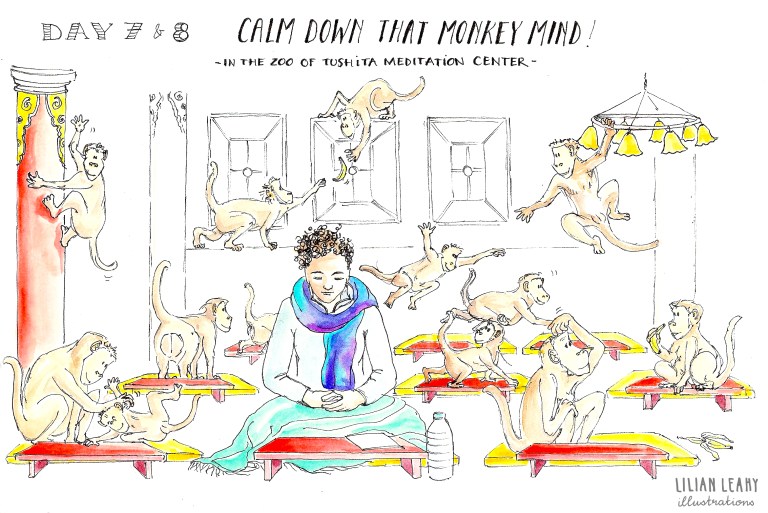
I had to laugh when I read this journal entry from my village homestay in Madagascar. In the U.S. we live in a culture that is so go-go-go that I didn’t even recognize that my doing nothing was still doing something. That was true 20 years ago, and it remains true today. I just happen to be more aware of it now. Doing nothing and remembering to breathe are literally things I need to practice. Five minutes sitting still without my mind wandering to a hundred different items on my to-do list is impossible. Truly. Try it and you’ll see it’s not just me! “Monkey mind” is the Buddhist term for the incessant chatter and sense of unsettledness in one’s mind. It looks like this:

Monkey Mind image
This is what a monkey mind looks like; illustration by Lilian Leahy

That phrase evokes images that just crack me up, quite like this Lilian Leahy illustration. The ring-tailed lemurs shown in the following photos that I took in Madagascar also crack me up. They are very Zen. This is NOT what having a “monkey mind” looks like.

When I was diagnosed with Rheumatoid Arthritis, and finally accepted it (that’s another story altogether), I considered all options for how to live my healthiest life given the cards I had been dealt. Besides doing all the regular stuff my doctor asks – take all the prescribed medications, see her every three months, have bloodwork done at the lab regularly, get exercise – I wondered if there was anything else that would help. I had two very little kids when I was diagnosed. And I love leading a busy and active life. I want to be as healthy as possible and have left no stone unturned in my quest.

Having RA has taught me many, many philosophical but also practical things about life. My diagnosis and subsequent eventual acceptance was like a massive 2×4 smacked across the head saying, “ummm, hellooooo, for real, you need to pay attention.” It has taught me about cherishing the little things in life, and not taking any day or any thing for granted. It’s like a constant anatomy lesson – yes! that pain I was wishing could be solved by a root canal is in fact a jaw joint (too bad for me). It has taught me about control, and that it turns out I am not in it. And, it has taught me about how stress and my monkey mind can be implicated in RA flares and general feelings of being overwhelmed.

After a bit of research and a lot of finagling of schedules, five years ago I enrolled in an 8-week course at the Benson Henry Institute for Mind Body Medicine (BHI) at Massachusetts General Hospital. This course introduced me to the term “monkey mind,” not to mention to the fact that I have an extremely active monkey. You may have already figured that out from the sheer breadth of subjects I write about. I am not exactly focused on one thing, rarely one thing at a time, and I am passionate about many!

For the record, I am not one to buy into the concepts of meditation and relaxation easily. The term self-care makes me cringe, as do the words snuggle and cuddle (but that’s an aside). Bluck. All that touchy-feely stuff gives me the shivers. So you could say that I entered BHI skeptical at best. But I figured since I had devoted my time to this, I might as well go all in and have an open mind (pun intended).

Did my life change overnight and was my RA banished for good? No. It takes a long time to learn new habits, and the brain tends to tack back to its well-trod neural pathways. It takes effort and practice to become aware of the mind’s motivation. For me, sitting still and doing nothing were bad words. My inclination is still more towards whirling dervish than calm Buddha.

But I learned an incredible amount about how important the act of doing nothing and sitting still is for the brain. It’s a biological reality that is now backed up with MRI studies and scientific data. The scientifically validated benefits of mindfulness include: decreased stress; reduced symptoms associated with depression, anxiety disorders, pain and insomnia; an enhanced ability to pay attention; and a higher quality of life. Don’t believe me? Check out Harvard researcher Sara Lazar’s TEDx talk on the effect of meditation on the brain.

Or Dan Harris, the ABC anchor who had a panic attack on live television that led him to meditation and eventually to writing the book 10% Happier.

Personally, my most notable takeaway from the course happened on the first night. The instructor flashed a powerpoint slide that read, “If you can’t make room for exercise now, you’ll have to make room for illness later.”

I was already making room, lots of room, for illness. But I wasn’t prioritizing myself. AT ALL. This one quote completely changed the way I viewed my calendar and what was and was not negotiable on it. I began swimming and made it a permanent item on my calendar. I trained myself to take a deep breath every time I come to a stop sign or stoplight. I downloaded a million mindfulness apps (still working on pausing long enough to actually use them).

My message to you is this – skin creams may help with wrinkles and dry skin, but meditation enhances a wrinkled mind. 

Breathe. Deeply. And often. It helps.

Serenity Prayer

Grant me the serenity to accept the things I cannot change,
Courage to change the things I can,
And wisdom to know the difference.

Reinhold Neibuhr

Vanilla, Powerfully Plain

I mentioned that my family has bit of a love affair with the chocolate chip cookie. You know what the smallest make or break ingredient in a chocolate chip cookie is? The vanilla. The difference in taste that a single teaspoon of vanilla makes is astounding.

But I have often heard vanilla used as a synonym for plain. In fact, Merriam Webster dictionary defines vanilla as, “lacking distinction : plain, ordinary, conventional.” And, yet, a world without the vanilla bean would be flavorless and bland.

Where does the majority of the world’s vanilla grow, you ask? In one of the least plain, ordinary, or conventional places on Earth. That’s right, my old love, Madagascar.

Madagascar boasts more than 75% of the world’s vanilla fields. All of Madagascar’s vanilla is grown in the SAVA (Sambava, Antalaha, Vohemar and Andapa) region in the country’s northeast. Vanilla is Madagascar’s largest export, which is pretty remarkable given that the plant, which was introduced from Mexico during the French colonial period, needs to be hand-pollinated.

This CBS video from 2017 discusses the recent vanilla bean shortage, a little about the price fluctuations over the past two decades, and the impact of the shortage on US businesses. What the video alludes to but doesn’t dive into, is what life is like for vanilla farmers in Madagascar now that vanilla is second only to saffron as the most expensive spice in the world.

Used to flavor so many sweet treats in the west, with the US, France, and Germany being the primary importers of its vanilla, vanilla beans in Madagascar are labor-intensive to cultivate. In a developing country like Madagascar, where the rule of law is flimsy at best, corruption is rampant, poverty is beyond most westerners’ comprehension, and cyclones can wreak havoc on a crop that takes three years to be marketable, sustainable livelihoods are elusive.

When Madagascar was a French colony, the French government set prices for vanilla producers. Madagascar gained its independence in 1960, after which the Malagasy government set the vanilla prices. During both of these periods, prices were low and predictable. In the mid-1990s, however, just about when I arrived in Madagascar, the Malagasy government de-regulated vanilla prices because of pressure from global financial institutions. This was the beginning of the dramatic vanilla bean price fluctuations that have been on-going ever since.

Increased demand and higher prices would, ostensibly, seem to be a good thing for Madagascar, one of the world’s poorest countries by GDP (the 10th poorest according to the World Atlas). Global vanilla prices were hovering at about $450 to $500 per kilogram as of August 2018, with the expectation that this year the prices would decline somewhat due to increased production. For context, this is about the same as the price for silver.

Demand pressures, however, have led to farmers harvesting beans too early to prevent theft; increased need for security at vanilla fields; and generally more dangerous conditions for vanilla farmers. Much of the vanilla profits go to middlemen, though the SAVA region has also benefited from this boom period. For vanilla farmers, it has been documented that they typically don’t know what to do with the windfall. In the context of rural Madagascar, where the closest bank is often a day’s walk along routes patrolled by armed bandits, long-term savings are not realistic. A large influx of cash in rural Madagascar turns into a liability pretty quickly.

Because of the vanilla boom, in addition to demand for rosewood, protected rainforests in the northeastern part of Madagascar, like Masoala National Park, have been illegally cut to create more vanilla fields. It makes logical sense from the perspective of the local population, the majority of whom are barely surviving on a daily basis, with absolutely no social safety nets. No one wants to miss the opportunity to become a “vanillionaire”, and the long-term implications of their actions on the island’s unique flora and fauna, like the use of its vanilla beans, are luxuries that appeal to those who live in another world. They are irrelevant to day to day survival.

Except that, in the end, it isn’t irrelevant at all.

For the long-term sustainability of the region, of the very vanilla plant that is the source of such demand, it makes no sense at all (check out this 10-minute BBC documentary to learn more, starting around minute 7:30). Other aspects of the local economy benefit from tourists interested in seeing lemurs, wild orchids, and rosewood trees in their natural habitats. Even more esoteric to the rural population, but still meaningful, is the potential for medicines cultivated from plants that grow in Madagascar’s forests, such as from the Madagascar periwinkle, which is an ingredient in leukemia treatments. These are much the same issues I observed in 1996.

Where do we go from here? Trust me, this is a question I have been asking myself for over 20 years, since I first set foot in Madagascar. There are no easy answers. Education has to be one component. Functional government is inevitably another. There aren’t short-term solutions for long-term, sustainable outcomes. For creative ideas, I like this World Bank blog that reports on initiatives happening in Madagascar, and also Madecasse’s efforts to establish bean-to-bottle production within Madagascar. As in so many aspects of life, I also think it’s a good idea to have small, specific, achievable goals that can be accomplished in the short-term, but that begin to establish the path toward a larger, long-term goal.

So, for now, the next time you buy vanilla extract or vanilla ice cream or almost any sweet treat, think about that little dab of vanilla and what a difference it makes to your taste buds, but also what an impact it has on a little country way on the other side of the world. The story of vanilla is more complex that it appears, and it is far from plain.

Pictures courtesy of Madecasse and National Geographic


The Void

Have you ever felt like you were being chased by silence? Or felt the weight of nothing?

The sudden loss of someone you love does that. There’s this constant sensation that something is missing, this echoing emptiness enveloping you. In quiet moments, the sadness creeps in, sneaks up behind you and surprises you with its tenacity. It’s still here…

My mind searches and searches for answers, attempting to fill this void, but the result is always the same. She is gone and it’s incomprehensible. She was so vibrant and full of life one minute (actually for 71 years of minutes!), and then she was gone. Who knew that the absence of someone could take up so much space in a room? Who knew that silence could be so loud? That emptiness could be so heavy?

Everywhere I look I see the negative space in the composition of my life with Nancy. Where once the space around her defined her physical presence, now the space where she isn’t defines her absence. I first learned the concept of negative space in 11th grade art class. I am not 100% sure I am interpreting it accurately, but this abstract way of thinking resonates with where my grieving mind keeps landing.

We went skiing last weekend, one of Nancy’s favorite activities. When I opened the door to the condo, I expected her to be there, as if maybe our paths just haven’t crossed this past month. Her smile and her voice are so vivid, my mind insists that she’s here somewhere. Out at dinner, the lack of a chair reserved for her made my chest ache. Her absence weighs on us and fills the space between us. I thought I saw her walk by the ski lodge when I was waiting in line inside to get lift tickets. My heart leapt and I almost ran out to call her name. And then my brain caught up with what my eyes thought they were seeing.

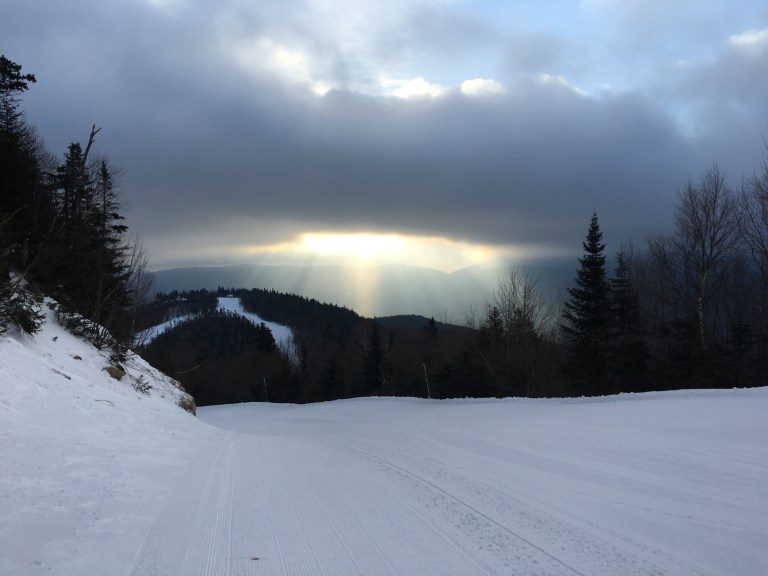
On our first run, laying down the first tracks that day after hitting the chairlift for the opening bell, the sun’s rays shone brilliantly through the clouds. I always call this God lighting. In that breathtakingly magical moment, I knew Nancy was with us, that this was her peeking through to whisper hello and good morning and I love you all.

Sun Rays at first run
Nancy’s Hello

What I wouldn’t give for a hug from Nancy right now. How she would have enjoyed being with us.

It was great to see how much fun the kids had, how life goes on for them with so much less heaviness. They happily and fondly and vocally remember her. We talk about her a lot. She is still very much with us, her positive spirit guiding us and encouraging us onward. She would absolutely be telling us to go, live, and enjoy life. And we are…but, for a while anyway, there’s also this mental leap of loss, this inescapable physical void that accompanies us.

I’ll close with this beautiful Maya Angelou poem that the amazing author, storyteller, life coach, and my kindred spirit Susie Rinehart sent to me recently. It expresses so eloquently what I am stumbling through here. Enjoy. And go out there and live!

They Existed, by Maya Angelou

“When great trees fall,
rocks on distant hills shudder,
lions hunker down
in tall grasses,
and even elephants
lumber after safety.

When great trees fall
in forests,
small things recoil into silence,
their senses
eroded beyond fear.

When great souls die,
the air around us becomes
light, rare, sterile.
We breathe, briefly.
Our eyes, briefly,
see with
a hurtful clarity.
Our memory, suddenly sharpened,
examines,
gnaws on kind words
unsaid,
promised walks
never taken.

Great souls die and
our reality, bound to
them, takes leave of us.
Our souls,
dependent upon their
nurture,
now shrink, wizened.
Our minds, formed
and informed by their
radiance,
fall away.
We are not so much maddened
as reduced to the unutterable ignorance of dark, cold
caves.

And when great souls die,
after a period peace blooms,
slowly and always
irregularly. Spaces fill
with a kind of
soothing electric vibration.
Our senses, restored, never
to be the same, whisper to us.
They existed. They existed.
We can be. Be and be
better. For they existed.”