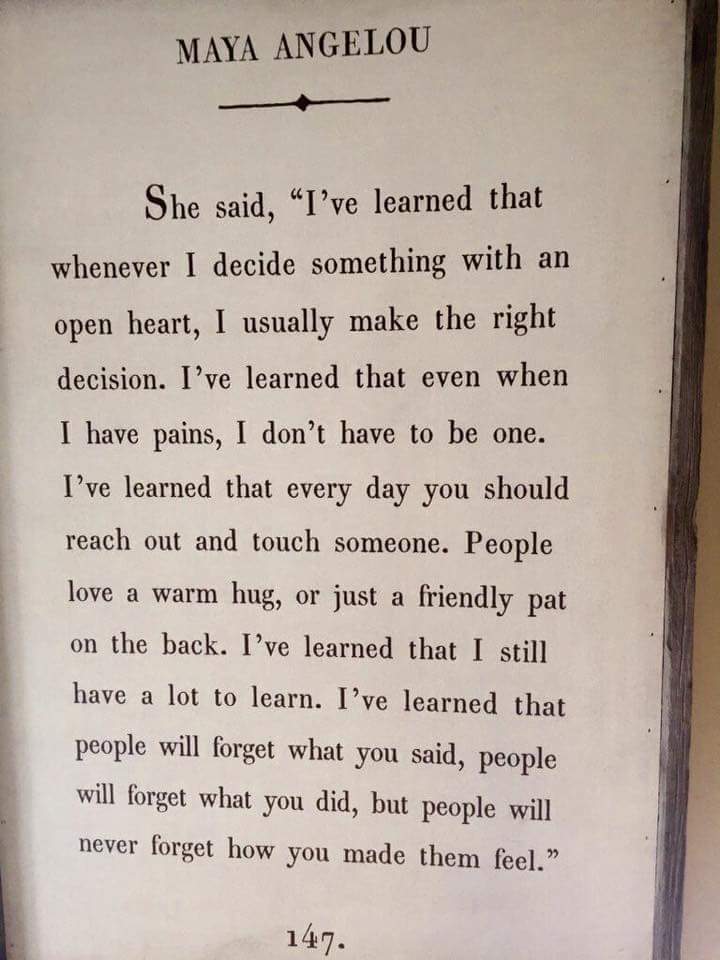
This is a perfect Oxygen Mask Moment that sums up well much of what my recent reflections around caregiving have taught me. Thanks, Maya Angelou.
Put Your Own Oxygen Mask on First
Stories of Hope and Connection

This is a perfect Oxygen Mask Moment that sums up well much of what my recent reflections around caregiving have taught me. Thanks, Maya Angelou.

A wonderful Oxygen Mask Moment in the lyrics, the laughter, the love of life. It looks to me like the key is to just keeping singing and dancing. My mom would agree.
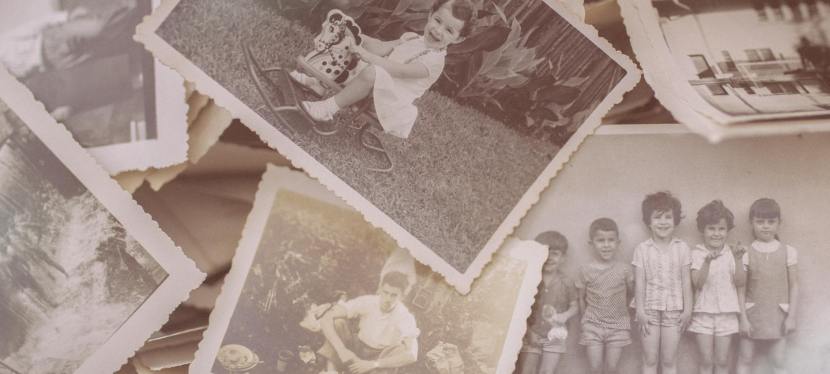
This post follows up on a piece I wrote in November 2019. I asked in that post: what is life without a memory? I didn’t have any good answers at the time. And I still don’t, not really. But I spend a lot of time wondering about this. In fact, I woke up in the middle of the night the other night wrestling with this question. My middle-of-the-night-brain thought I should write about it only to discover when I woke up that I already had. Six years ago. Which just confirms that everything old is new again in my brain.
The big questions I have are what – and who – are we if we don’t have a memory? I also wonder what goes on inside my mom’s head – what is she seeing when she points to things that aren’t there, what is she trying to describe when she can’t find words, is more of her there than I realize, should I be more patient and move more slowly when trying to engage her, what does it feel like to entrust oneself and one’s well-being completely to another person, what is she holding on to this version of life for?
The mom I have now isn’t the mom who raised me, except in glimpses of a smile or a laugh or a familiar look (she was – and remains – a superior eye roller). She has no agency – she has no decision-making or verbal capacity, is completely wheelchair bound, and requires a mechanical lift to transfer her from chair to bed. She is quite literally a body without the instructions that typically come from a mind. But this body of my mom’s and the essence of who she was and who she remains to me are still here on this Earth, a living, breathing human being who exists, who needs food and care and love even though it’s hard to tell what impact any of it has on her. Ah, except for music. If she is awake, she still responds very clearly and enthusiastically to music by tapping her fingers or bouncing her foot.
Prior to my 2019 post, I had read Dr. Atul Gawande’s book Being Mortal: Medicine and What Matters in the End. I was inspired and grateful for the new perspective he presented, appreciative of his recommendations for aging and for dying well, and encouraged to see the emphasis on quality over quantity when it comes to facing terminal illness and one’s mortality. I found myself wondering, though, how one can have a meaningful, purpose-filled life and live life to the fullest until the very end, which are the premises of Gawande’s book, if one has no agency and can’t remember anything. It’s one thing to live in the moment, moment to moment. That’s enlightenment, or approaching it. But isn’t life, ultimately, a collection of memories? The best parts of life are the living of it and then the reliving of our favorite memories through pictures and sharing stories, anecdotes, and things learned along the way. When someone dies we bask in the memories of our times with that person. So many of my conversations start with, “Remember when?” What happens when you don’t? Who are we without our past? Without memories, what does it mean to be alive?
Since 2019, I have tried to connect with Dr. Gawande a couple times to see how he would answer those questions or what he would recommend. I have not had any luck finding a good email address for him so what I have sent has gotten bounced back. Rather than waste more time trying to find his email address, I instead tried to answer my questions on my own by digging around on the web to see what he has said on the subject. The answer isn’t super straightforward – with cognitive issues it seldom is – but it leans on the importance of dignity, joy, and connection, even if they only occur in one moment and then the next moment and then the next.
Gawande challenges the idea that memory alone defines us. Though he doesn’t minimize the loss of being alive without a memory, he invites us to expand our definition of “being alive”:
- It’s not just what we remember, but how we feel, how we’re treated, and how connected we are.
- Meaning can be found not just in grand narratives but in small, sensory moments.
- Even as memory fades, the present self still experiences emotions, relationships, and little pleasures—all of which sustain identity and meaning.
Gawande’s core insight is that:
Memory loss may chip away at the narrative of self, but not the essence of life.
Even without remembering yesterday, living today—with dignity, comfort, connection, and choice—can still be deeply meaningful. The best we can do is to provide as much autonomy, purpose, joy, dignity, and connection as possible. The emphasis becomes the small moments and an identity rooted in feeling versus memory.
It’s surely not the life my mom would have wanted, but by reframing my expectations in this way at least I know that my mom has all of the elements of a quality life.
Considering. I am not so enlightened and rose-colored-glasses that I completely accept this reframe. It definitely feels like a consolation prize, though I do appreciate the perspective shift and the reassurance that what little moments of joy and love and music my mom experiences throughout her days matter.
As to wondering what is actually going on inside her mind, well, that’s actually a WAY more interesting subject I plan to delve into further. A friend recently recommended the Telepathy Tapes podcast, which “explores the potential telepathic abilities of nonspeaking individuals with autism.” That is cool in and of itself. What does this have to do with my particular plight? Well, there’s an episode on telepathic communication with Alzheimer’s patients as well. Woo woo? Perhaps. Worth trying? Abso-freaking-lutely. Imagine what I could learn from sitting quietly a bit more, breathing deeply, and listening. Maybe I’ll hear my mom’s voice and gain deeper insight in our journey together. If nothing else, it’s good practice for putting my own oxygen mask on and finding my peace, quiet, and stillness.
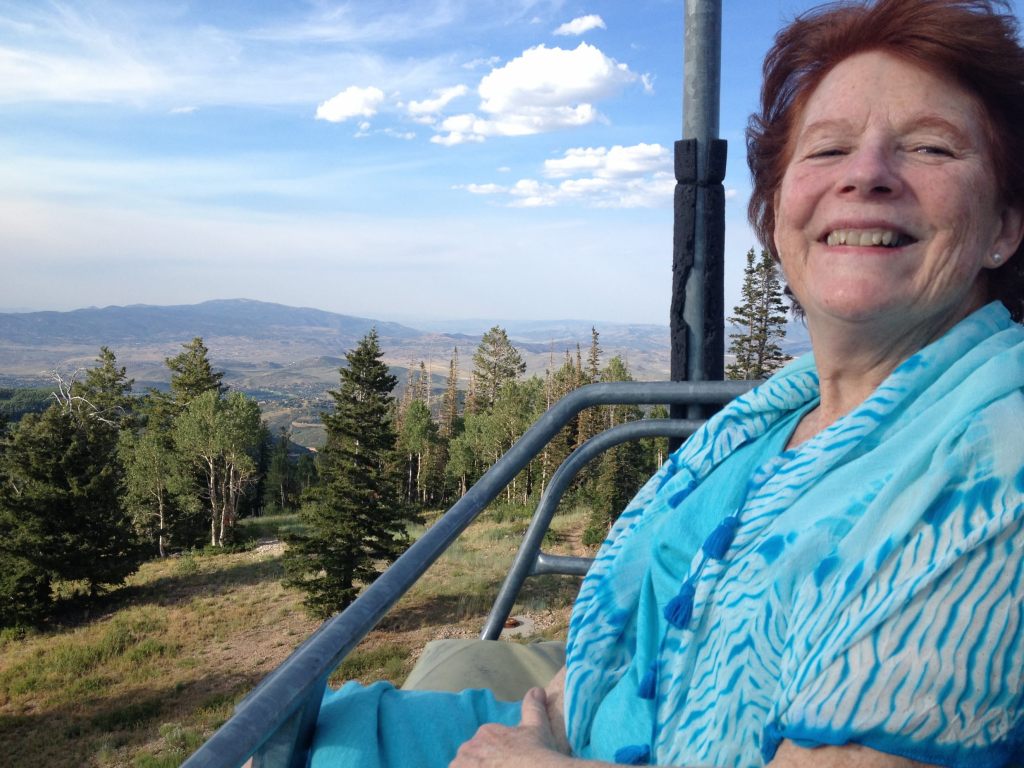
My mom was – and remains – a beautiful and incredible human.

This was just too good and fitting not to share. Deep breath. We got this.

I was listening to Anderson Cooper’s All There Is podcast the other day, specifically the episode Love is What Survives. People called in to share their stories of grief, and one phrase kept coming up again and again: “lean in.” It resonated in my mind because it connected with a funny experience I had had that weekend.
I had spent the weekend in Toronto with four friends. On one evening we were all jammed like sardines in a small SUV, one in front, three in the middle row, my friend’s husband driving us out of the city after a long day out. There were multiple conversations happening simultaneously among us all, a buzz of noise and commentary and general conversation. At one point, the friend sitting up front got her phone out and told us to lean in. Two of us did, looking up and smiling for the camera. Our other friend was either in the middle of another conversation or misheard and called out forcefully, “No!” It was so completely out of context and character that we all broke into instantaneous fits of belly laughs. We laughed so hard we couldn’t speak, until someone wheezed out another “no!” through giggles and laughter would erupt through the car all over again. The rest of the weekend was peppered with a call and response of “lean in!”, “no!”, punctuated with more laughter. We even have a keepsake picture memorializing the moment with three of us gumming it up for the camera and only the left eye and shoulder of our fourth friend in the frame.
I was reflecting on that lean in moment and the weekend full of friendship, rejuvenation, and laughter as I kept hearing the phrase “lean in” while running my errands. And I started to think – that really is the key, isn’t it, to this life? You have to lean into it – to friendship, to love, to taking chances sometimes (like when I got on that plane and flew to Guatemala, which is what started me on this blogging and writing journey and reignited a part of me – through connection and purpose – that had been dormant). You have to lean in to LIFE – to ALL OF IT. Even the hard stuff.
It’s natural to want to protect oneself from difficult feelings, to have the curated instagram version of an emotional life where everything is beautiful and awesome and happy all the time. It can feel better to be numb or to press down hard feelings in the hopes that they will stay quiet or go away. It’s counter-intuitive to face into – to lean into – pain and grief, but that’s actually the recipe for healing. It’s also the recipe for genuine, authentic living.

It took me a long time to learn that, unfortunately, the feelings don’t go away just because you avoid them. In fact, ignored feelings often strengthen and distort, like a crack in the foundation that settles in more deeply as time passes, eventually shifting the structure enough that the walls start to lean. In my early days of grieving my mom’s health and my health while trying to juggle kids and work, I would use the analogy that the wheels were coming off. Maybe a more apt analogy was that I had built a house out of a deck of cards and was spending all my time running around trying to keep the wolf from blowing my extremely precarious structure over versus strengthening it from within.
I can’t help but continue to reflect on the wonderful, cleansing laugh of my recent lean in moment. The whole weekend was a beautiful example of leaning in – of showing up, making memories, standing by your people in good times and bad – and also just because. That’s really the essence of life. We are here so fleetingly in the grand scheme of things. When a group of friends comes together in a circle they lean in while while leaning on each other. It’s a hug that is simultaneously the support we need to hold each other up. So lean in – to it all! That’s what sustains you!


Just a quick note here to say that I have added an entire drop down menu for various types of resources about dementia and caregiving. So check that out from the homepage menu.
Also, I had no idea that Rosalynn Carter noticed and has been addressing the hard work of caregivers for over 35 years. Until she passed away on November 19, I only vaguely knew who she was, and mostly it was as a team with former President Jimmy Carter. Today, as she is laid to rest, seems the best day of all to recognize the incredible contributions she has made to this world.


Can you envision a world renewed by imagination and integrity? This is the vision of the W.S. Merwin Conservancy in Maui, whose mission it is to inspire innovation in the arts and sciences by advancing the ideas of poet W.S. Merwin – his life, work, house and palm forest – as fearless and graceful examples of the power of imagination and renewal.
I am highlighting this specific Merwin poem because anytime someone embraces imperfection, my ears perk up.
Be real, be imperfect, be compassionate, and live with integrity and imagination.
Nothing that I do is finished
so I keep returning to it
lured by the notion that I long
to see the whole of it at last
completed and estranged from me
but no the unfinished is what
I return to as it leads me on
I am made whole by what has just
escaped me as it always does
I am made of incompleteness
the words are not there in words
oh gossamer gossamer breath
moment daylight life untouchable
by no name with no beginning
what do we think we recognize
– W.S. Merwin, from The Moon Before Morning (2014, Copper Canyon Press). Used by permission of the publishers.

Photo from http://welltraveledkids.com/2016/03/6-great-family-beaches-maui-perfect-kids/

What is the saying? “Perfection is the enemy of progress?” Or, in my case, just doneness. I am not even trying for perfection, and yet multiple posts I have drafted linger in draft purgatory as I commit to reading all the news (ugh, why?) rather than work on revisions to what I have written. I mean, I could clean the house or do some laundry, also worthy distractions, but sitting down at the computer is the goal so I get that far and then dive down news wormholes.
But today – TODAY! – I have shown up and re-read what I have written and can confirm that the subject still matters. I remain all tripped up on some enormous lines of thinking, though, so it’s still not quite ready to get out there because it feels long and heavy and more like a treatise in places, a rant in others, and a term paper throughout. Is it a problem that even I am bored by what I have written? Probably.
And, so, cribbing off my monthly writing class that is part meditation, part motivation, and mostly a bunch of pretty talented poets showing me how to see the world and writing in a whole new way, I am aiming to write short, clear and pithy. Not strengths in any way. Here’s what I came up with today :-).
I have been trying to write poetry,
Which appears to require brevity,
A skill set with which I am in short supply.
And, with that, I encourage you to take a deep breath, skip the news, and do something that fills your cup, even just for a couple minutes.


Hello and happy summer!
It’s been ages since I’ve managed to sit myself down and write. Quieting myself and settling into stillness are not strengths of mine, but I am working on it.
My kids have been away for four days, it’s 6:30pm, and this is the first time I’ve really sat and felt settled since they launched. Me thinks it’s not them that causes the whirring frenzy, perhaps, but me. That is good data. And, also, each day presents a new day to practice.
It’s funny because I vaguely remember vowing to myself in those pandemic months that brought the world to a stand still that I’d bring forward into my future life the lessons I learned then about finding quiet (inside me as much as around me) and saying no sometimes to preserve open spaces on my calendar. How quickly old habits return and suddenly life is leading me again versus the other way around.
Today, in this moment, though, I have found my way to quiet. And I am celebrating the calm that is washing over me, even now as I write.
To close I am sharing a poem that resonated deeply with me when its author, Rosemerry Wahtola Trommer, read it aloud to our writing group last week. I have turned to these words daily since. I hope they resonate for you as well.
Take a deep breath in….and then blow it out. That always, always helps. If only I can remember to do it.

How soon I seem to have forgotten
how to be still, how to not plan,
how to step out into the day
and let the world itself write
the story of how a morning becomes
an afternoon becomes a night
becomes a woman.
How soon I seem to have forgotten
the value of not doing,
the gift of unscheduling,
the blessing of dipping my toes into the stream
of no time, then wading in full body,
where I remember I am part of an infinite story
at the same time I relearn how fragile it is,
this life.
How soon I forgot I could change it all.
Even now, I could be still again.
I could choose silence.
Even now.
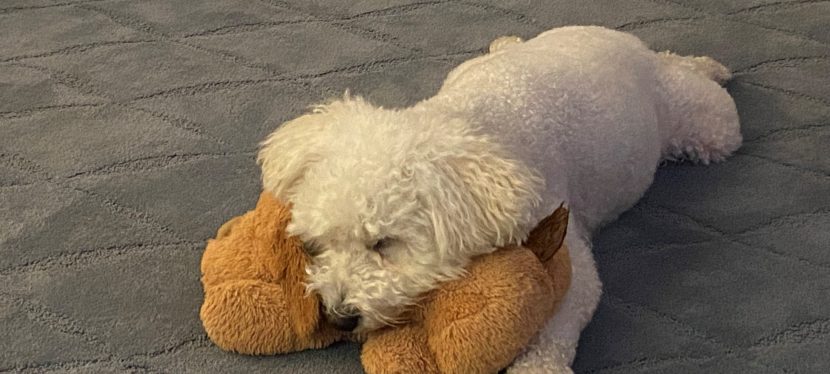
Hi, again, Tucker here.
I’ll be honest, I have been one wound up schnoodle recently. I am still as fluffy and lovable as ever, but my main hooman (the mom one) has been using – ahem – inappropriate language in my company (in fact, directed at ME, I dare say) way more than normal these days.
In my defense, the weather is getting warm and there are SO. MANY. GOOD. SMELLS. Grass growing, bugs flying, flowers blossoming, other animals out and about. A veritable cacophony for the senses. Plus the bunnies taunt me all day long, sitting just outside my window chewing on MY grass. And then the hoomans keep putting meat on the firey thing on the back porch causing these incredible aromas to waft through the air (who am I kidding? Raw or cooked, that meat smells damn fine to me!).

What is a dog to do? I am not a guy to be vague about what I want. Some may say I have a stubborn streak. Perhaps that I am a bit needy. I believe in speaking my truth. And, the truth is, I want their dinner, not mine. Needless to say, whining (on my part) is involved and then cursing (on my main hooman’s part) follows. So undignified.
These episodes always end with me being sent to my Place cot. At first I act like I’ve never heard that word before and I have no idea where I am supposed to go, but then I have a “light dawns on Stonehenge moment” and I leap over there with an expression like, “Here? Is this what you meant?” I do enjoy a bit of improv theatre. Then I am told – quite emphatically, I might add – to SIT. And then to Stay. There are treats involved so I am all in on this game.
What’s really amazing is that within seconds of sitting on Place (aka a forced time out), I feel so much better. Almost like the whining and fussing is some sort of out-of-body experience and Place gives me a moment to pause and reset that puts me back in touch with my inner schnoodle. One minute I am pacing and whining and begging for hooman food and the next I am lying down on my cot and this big, deep sign spills out of me. Ahhh, what a relief. All that frenetic energy just floats away.
It occurs to me in my moments of Zen – is it me that needs Place, or is it my hooman?
Because, if we are being honest, she seems a little wound up, too. It’s, like, way too easy to push her buttons.
My main hooman says I am driving her to drink, but if she would just pay attention she would see that I am showing her the path to inner peace: find a peaceful place, sit still, and breathe. Anxiety melts away and you emerge from this pause with more clarity and more mastery of being instead of constantly doing doing doing.
If nothing else, I am here to teach.
My advice: send yourself to Place and take a deep breath. It takes practice to learn how to do it for yourself, so have someone send you until you figure it out. I highly recommend extorting them for treats as part of your healing process.

 Put Your Own Oxygen Mask on First