Nicholas Kristof and the Power of Hope

It’s not just me. Nicholas Kristof, the renowned New York Times journalist and two-time winner of the Pulitzer Prize, also believes there is power in hope. He published an article in the NY Times opinion section on May 29, 2019, entitled Cash, Food and Health Care All Help the Poor, but Something’s Still Missing. It’s about poverty within the indigenous population in Paraguay, and how opportunity (also known as HOPE) can be a transformative force in substantively changing the trajectory of people’s lives.

Hope doesn’t mean just an idea and a good feeling. It means a pathway to something new and the supports to get there. The program in Paraguay references mental health support in addition to guidance on how to grow a small business. No one goes it alone. The notion that anyone is successful completely alone and in a vacuum is one of the biggest fallacies ever promoted.

As I read Mr. Kristoff’s article, I found myself thinking about the MAIA Impact School in Guatemala and the similarities between what he observed in Paraguay and what I have seen happening in Guatemala. The MAIA school, led by courageous and empowered Mayan women, sees hope in the form of providing a real, robust education to young girls with the potential to succeed but no opportunity to do so. These girls are rural, poor, indigenous, and female, four major challenges in a country where machismo is the norm and racism against the indigenous population is severe (of the 200,000 people killed during Guatemala’s 36-year civil war, 93% were indigenous). MAIA provides not only academic opportunity for these girls, but also the mentoring and support that they and their families need to navigate the extremely demanding road before them. This road begins with these girls beginning to build a path for their families out of systemic poverty. Imagine the trickle-down generational impacts when empowered, educated girls become empowered, educated mothers. The possibilities for change spread like the roots of a strong tree.

MY HOPE is that Mr. Kristoff finds his way to Sololá, Guatemala, as he winds his way back north…this story, the incredible work being done by this school in Guatemala to create hope and an actual opportunity for a viable future needs to be broadcast more widely. The little news we hear about Guatemala in the U.S. fixates on negative imagery from illegal border crossings and migrant caravans to drug cartels and political instability. What if the news focused more on what kind of hopelessness would compel someone to make that fraught journey to an uncertain and antagonistic future? What if they presented solutions that would help people build a future that would be a reason, a means, to stay?

Pulitzer committee, I’ll be awaiting your call ;-)!


Extraordinarily Ordinary

This weekend the skies were clear and blue, the breeze a gentle relief from the heat. You never know what you are going to get around here, the only guarantee is that you can’t count on it. For months the weather has been soggy, gray, cool, and grim. So when the sun is actually shining; when you go outside and don’t have to brace yourself against the chill or run back in for another layer; when your rainboots and umbrella are traded for sunscreen, and the wind isn’t even ruining the moment by blustering on, it feels rather miraculous.

One of the most extraordinary aspects of this weekend, though, was that apart from the weather it was totally ordinary. We didn’t have tickets to a big event. We didn’t go on a trip. No big plans or agenda. We gathered spontaneously with friends. We went to a BBQ. We rode bikes and played in the backyard. There was actual time to pause and reflect and, gasp, relax. It was totally decadent in its simplicity.

It’s one of life’s great ironies that the pursuit of more actually results in less. If you are treadmilling your way through life, manically pursuing more and governed by the next event on your schedule or to-do list, remember this: the deepest and most profound fulfillment doesn’t come from things to do or from things you buy. What matters most, what sustains us through the darkest days, where the real magic lies, is in noticing and cherishing life’s small moments, in teasing them out amid the fray of responsibilities, challenges, and disappointments. They happen organically and in some of the most mundane circumstances (and they are also, usually, free).

Find joy every day.

Delight in the small pleasures.

Be compassionate.

Embrace ordinary.

Live with gratitude.
Eagle with flag Memorial Day

While you are here, check out my Resources page! I have just updated it with a new material!

Setting Goals and Facing Failure

First of all, please excuse my absence on the blogosphere recently. I have been writing and writing and writing, but I can’t put anything I’ve been working on here because I have submitted it all to various journals and newspapers to try to get it published!!! As a result, much of my allotted writing time has been dedicated to that pursuit. Happily, I just received word this week that a creative nonfiction essay I wrote will be published June 15 in Sky Island Journal! Woohoo!

And, with that, let me write about some of the highlights of what has been in my mind – setting goals, and also failure, rejection, making mistakes, and trying anyway.

For some reason, I have a terrible time setting goals. I know the SMART goal recommendations – Specific, Measurable, Achievable, Relevant, and Time-sensitive. I love the list, but I still can’t come up with a goal.

I took a little online blog branding course several months ago after I started this blog. I was trying to figure out if there was some sort of methodology I should be following so you, dear readers, don’t wonder where on earth my head is every single time you read one of my blog posts. In other words, is there some sort of path or a strategy to building a blog that I have as yet not followed? (Answer: yes; but, see, it requires setting goals and focusing…so please proceed to the next paragraph…).

One of the first exercises was to come up with 3 goals. Oh cripe. My crossfit coach is always encouraging us to come up with goals, too. I have dodged that bullet for two straight years now. Both cases have got me thinking about how really and truly awful I am at setting goals and why that might be. I am 100% not awful at all at achieving things, I am just terrible at setting goals and answering questions like “what would success look like?” I don’t like to be hemmed in. In fact, probably if I set some goals I’d achieve them before I even wrote them down. Start a blog. See? That could have been a goal. But I did it already. Figure out how to pitch for publication. Done. I am a do-er. But I am also a planner, so I am slightly mystified about why this task both eludes me and causes me so much agita.

In the end, I’ve decided that my problem isn’t so much the task itself as the destination. I understand full well that if I knew where I was going and took actual concrete steps (i.e.: goals) to get there I might actually get there (or get there faster). I do get places, it just tends to be a more circuitous, scenic route. I’ll be the first to say that there’s a lot to be learned by not going from point A to point B. But if I am being completely honest, there’s also the reality (which I know is real thanks to decades of journaling because I would never remember this) that I re-learn truths I discovered already over and over again. My cousin wrote this great book called Things I Want to Remember Not to Forget (by Chris Waddell). I so thoroughly relate to that title. Is this life (asking for a friend)?

Anyhoo…I suspect my brain block about goals has at least a little to do with the unpleasantness of failure and rejection. If I set a goal and don’t achieve it, well that’s no good. Who wants that? If I set a goal and fixate on achieving it, that wouldn’t be great either, to be fair. Pitching to journals, even blogging, sets me up to be rejected and to push that old fear-mongering anxiety button that says I am not enough – not good enough, not smart enough, not worthy enough, a failure. Jeez. Tough crowd. But here’s the beauty of getting older – I get now that I am the one telling myself all these horrible untruths. Sure, I was helped along with material by the horror of being a rule-following, nerdy kid in middle school (fact: kids at that age are mean). But, ultimately, it’s down to me to face those negative storylines, check the narrative (“the feelings are real, but is the story they are telling true?”), and strive to make great mistakes. Then try again. This is what my husband and I teach our children. My goal is to be a good example. And, FINE, @crossfitlaunchpad, I’ll get my first strict pull-up, too.

Mountain proverb


An Ode to Moms Everywhere

“I See You”

I see you, mom, in pajamas at school drop off. You who could care less about your appearance because the fact that the kids actually made it to school on time is such an accomplishment it hardly matters. Today. This time.

I see you, mom, who can’t say no to volunteering, who says no one else steps up so you have to do it, who feels like life turned into one long tumble in the washing machine, dizzying and cold.

I see you, mom, with your junk drawer completely overflowing with accumulated, well, junk. Like bumper stickers that aren’t car worthy and old iPhone chargers and receipts and spare keys to neighbor’s homes, if only you could remember whose they were.

I see you, mom, who got lost along the way and doesn’t recognize much of who you are anymore, spending all your time in the service of others, so much so that you couldn’t say what stirs your soul if you were asked and you fall into bed so dead tired you don’t have time to think about it. Anyway, no one’s asking.

I see you, mom, with the nice pump on one foot and the mismatched flat on the other. Some days the best you can manage is to show up.

I see you, mom, with spit up dried into your new, dry-clean only blouse. There is officially no dignified way to exit the house when you have a baby.

I see you, mom, on a frenzied mission, scrolling through websites for quick healthy meals for dinner tonight. Guess what? They don’t exist. Especially if it’s 4:30pm and you still have the commute home and day care pick up and you haven’t gone to the grocery store in days. Because, seriously, who has the time? What dimension of hell is this that kids need to be fed three times a day anyway???

I see you, mom, racing away from gas pump with the nozzle still in your car.

I see you, mom, who is starving for intellectual inspiration and adult conversation, but can’t figure out how to balance even part-time work with all the other stuff that needs to get done for the family.

I see you, mom, head throbbing, feverish, body aching while ringing way too loudly in your ears are the repeated and urgent words, “Mooooommmmm, I don’t feel well.”

I see you, mom, at Starbucks, who absolutely knows that this latte is going to be the highlight of your day.

I see you, mom, who tries to do it all, chaperone and sell Girl Scout cookies and make healthy, homemade meals and sign the kids up for all their activities and then actually execute on getting them there. Did I mention the full-time job?

Or the:

Birthday party planning

Dishes

Laundry

House cleaning

Haircuts

Lunch boxes

Homework

Bedtime routine

Sleepless nights

Doctors appointments

Play dates

Sick days

SNOW days

School supplies

Sports equipment

New clothes

New shoes, ideally well before you are leaving for the piano recital and realize that the dress shoes don’t fit. Either kid.

I see you, mom, who is buried under never-ending piles of laundry and groceries to buy and bills to pay and birthday presents to buy and holiday meals to make.

Did someone say decorations? Yeah, I see you, mom, whose holiday lights are still on the tree. In May. Way to plan ahead for next year.

I see you, mom, who wonders why it is that the kids have to be reminded to wash their hands, pack their school bags, unpack their lunches, clean their rooms, practice their instruments…EVERY. SINGLE. DAY. How many years have we been doing this?

I see you, mom, who feels like the trip leader of life, like you are everyone’s guide on this journey and they can’t seem to function without asking you how to do it first. And then they ignore you and do it their own way anyway.

I see you, mom, who is taking care of your mom, and missing her wise counsel and yummy cooking and mom advice. You, who are flooded with memories of the incredibly capable woman she was, and can’t reconcile them with the woman she is now, who barely knows you let alone remembers your birthday or a recipe.

I see you, mom, who lost your mom far too young. And, you, whose mom is alive and helpful and wonderful and still bugs the heck out of you sometimes.

I see the whisper of tears in your eyes that you quickly brush away, when some days it just feels like too much. Strong shoulders, but human shoulders. Vulnerable and tired and overwhelmed by the pace and the volume and the sensation that you are not terribly in control.

I see you, I see you every day, and I know.

I understand. And I am here acknowledging all the little things that just don’t get done without you.

In Solidarity.

Happy Mother’s Day.

In gratitude for moms everywhere and for my village.

It’s a good time to put your own oxygen mask on. This is another writer’s take on why:

https://greatergood.berkeley.edu/article/item/put_your_own_oxygen_mask_on_first

make-sure-your-own-mask-is-secure-before-assisting-others-unintentionally-profound-quotes

True Confessions of a Mom Set Loose

October 31, 2018

On the plane from Miami to Guatemala City. This is my first extended solo excursion since having children, my first trip to Central America, my first trip to the developing world in a very long time. It’s a lot of first’s and with that comes excitement and joy and a re-awakening of my spirit or some part of me that’s been quiet for some time…as well as a visceral, biological longing and sadness that I can’t control and didn’t expect. It’s hard to say goodbye to my family and, much as I am sometimes desperate to bust out of the routine and the daily grind, it’s also incredibly difficult to break away.

By chance, the man who drove me to the airport this morning grew up in Guatemala. He was stunned that that was where I was headed. It feels like the universe conspired to cross our paths. I told him (between sniffles) that I hadn’t really done much for myself in 11 years and that I wanted to soak in the moment. He said, “You are like a comet, passing through so rarely but shining so brightly.” I like that idea!

So, here I am, halfway to Guatemala with my journal out and two books sitting beside me – Open Veins of Latin America (by Eduardo Galeano) and Less (by Andrew Sean Greer) – that I might actually be able to read with all this uninterrupted time. For the time being, though, my mind keeps jumping between thoughts of travel past and the younger me; about my kids, already anticipating our reunion; and imaginings about what this trip will be like! And this tells me that maybe I should take a couple minutes to just sit and be, quietly…but, first, a haiku:

Mundane and routine

Break the mold of must and should

Rare delight, bright light.

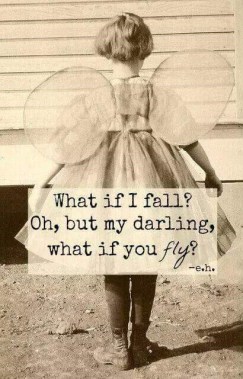
What if I fall quote


The Fixer

Life is such a committed and earnest teacher. Everyone has their stuff. And life dutifully provides opportunities, over and over again, to practice navigating whatever yours might be.

I like to fix things. Not like broken machines, but like broken people or uncomfortable situations or disorder. In fact, now that I think about it, I don’t like the feeling of anything that I feel responsible for being out of place. And I feel responsible for a whole bunch of stuff. That goes for people as well as a leaky faucet. I. Just. Can’t. Ignore. It.

I am experienced enough now (read: old) that I can see it happening, and I actually recognize it for what it is. I discover a “problem,” a switch flips in my mind, adrenaline floods in, and I hone in with laser focus on “solving the situation.” Everything else going on around me becomes annoying distraction. It’s really primitive. And if it weren’t so uncomfortable and I weren’t so focused on whatever the perceived threat might be, it’s also quite fascinating. I know what I am supposed to do here – lots of deep breaths and comforting reassurance to my anxious parts. But my brain keeps tacking back to the VERY BIG PROBLEM THAT NEEDS TO BE FIXED. In those moments, all I really, really want is to fix it so I can put this horrible feeling away and chillax.

The way this manifests when it comes to people who need help is much less obvious than when something breaks in my house. When I say “need help,” I don’t mean like they are hurt or that their house is on fire. Surely I’d go into adrenaline-driven fixer mode in those cases. No, in this case, I mean they need help with something emotional. There isn’t the flood of adrenaline or the laser-like focus, but it’s still a problem to be solved. Internally, it feels like some sort of calling, that it’s my job to fix the bad feelings, or at least temporarily to take away the pain. That’s a lot of pressure and, rationally speaking, it’s totally unrealistic. But who ever said this behavior was rational?

I noticed long ago that very often one’s best attribute or character trait doubles as one’s worst. For me, this is where being reliable and dependable kind of backfires. I am dependable and reliable so people find any number of ways to depend and rely on me. And, of course, then I feel the need to continue to prove my dependability and reliability and to not let anyone down. And it goes on like this in a sort of self-fulfilling cycle for ever and ever…until I crash and burn because I have lent out so much of myself to so many people that I have completely hollowed out my own core. Emotional problems tend to have a longer-running course than physical, house-on-fire problems. They require the pacing of a marathon versus a sprint. But when it comes to fixing things, I have the mindset of a sprinter and, inevitably, I hit a wall and start to get awfully tired…

I think a lot of moms suffer from the feeling of having only so much to give, being needed by many, torn in too many directions, and wanting to fix things that are out of their control. That’s certainly the case for me, and I fully support little getaways here and there to revive oneself and actually be able to think and breathe and just be.

But, for me, this internal fixer is a lifelong pattern. Only after I completely lost myself with the responsibilities of parenting (I don’t even need to explain that kids have needs), childing (also known as: being a reliable and dependable daughter), working (see also: proving I am a productive citizen and “pulling my weight” because, obviously, only a paycheck tells you that), being a good friend (“you can count on me!”), did it become clear to me that the two most-used phrases in my vocabulary are “I’m sorry” and “I should.” I’m either a disappointment/failure/inadequate (“I’m sorry”) and/or I’m driven to prove my worth/worthiness/value (“I should”). Nowhere in there am I thinking, “gosh, I’d love to do that.” It got to the point where I would ask myself, “What stirs your soul?” and I had literally no idea how to answer. Because, I’m sorry, I am so selfish, I should not be thinking about myself when so many people need me.

It turns out that it just isn’t possible to save everyone without totally tanking yourself. Another disappointing life lesson, but a true one. That’s the whole reason my blog has the title it does – it’s a reminder that you can’t run around putting everyone else’s oxygen masks on while simultaneously allowing yourself to be asphyxiated. It won’t end well.

None of this is to say be selfish. Not at all. I certainly struggle with that notion, because that’s how it feels: I am letting people down. I am selfish. I should just try harder. And, of course, there are plenty of things that just need to be done, whether they fill your cup or not. That’s life, and I spend the majority of my day doing just that. Most days, I do much of my to-do list, in all its mundane glory, joyfully. And I admittedly love knowing that people can count on me, and that they know that I am loyal and reliable no matter the circumstances. The trouble strikes when I need a break and don’t know how to say no. It would seem to be such a simple word. Two letters, and virtually the same spelling and pronunciation in multiple languages. And, yet, I am much more apt to say “maybe,” which really isn’t super helpful to anyone involved because it leaves the door open to a road I already know I don’t want to go down. SO, take it from me – when your plate is full and your cup is spilling over with responsibility to and for others, make sure there is a little time carved out in there for you. And if there’s a “no” screaming in your head, say it. It’s not indulgence, it’s self-preservation.

You can be more effective, not to mention more fulfilled, if you actually replenish yourself along the way. Find your inner compass, actually listen to it, and let it guide you. Prioritize. Be in charge of your to-do list, not subjugated by it. Evaluate the opportunity cost of the choices you make – what do you sacrifice by committing to x, y, z? Be intentional with how you spend your time. Think “if I say yes to ‘x’, what will I have to say ‘no’ to?” Say no sometimes. Be true to you. Make sure you are filling your cup. I can assure you, life will provide ample opportunity to practice.


Notre Dame and our common humanity

Why is it that tragedy unites us but otherwise we spend our time picking each other apart and spreading divisiveness?

I don’t want to launch into a synopsis on modern politics or the state of the world today. Most people are pretty up-to-speed on the general dark cloud hanging over the western hemisphere without my rehashing it…so I’ll be short and sweet here for the sake of all of our sanity and won’t delve into things about which I know (too?) little.

What I know is this: Notre Dame cathedral burned yesterday and it stopped everyone in their tracks. Suddenly people of all stripes are united in their grief. Facebook posts display picture after picture of individuals’ experiences at Notre Dame, plus stories of longing and sadness from those who hadn’t had the chance to go there and see it in person.

The notion that this monument anchoring the skyline of Paris for centuries is in peril defies belief. This human construct, a display of the beauty that man is capable of creating, has for centuries drawn pilgrimaging Catholics, as well as millions of tourists of other religious and agnostic persuasions, to stand in awe of its majesty. It has survived so much history, so much destruction, from the French Revolution to the two horrific world wars of the 20th century. But in mere hours yesterday it literally went up in flames.

It’s like the smack across the face that the world needed. I hope it is, anyway, and that some long-term good will come of it. Historic monuments like Notre Dame are an investment. They represent hope, connect us to our past, and guide us toward the future. They are an incarnation of what binds us to each other and to our common good. They are a symbol of the best in human civilization – architecturally, culturally, and artistically –  and a beacon when we have lost our way.

We have been living in a period of neglect of community, faith, and hope. We have literally let historic buildings crumble and decay before our very eyes due to a lack of funding, indifference, and disinterest. In our lives, the virtual becomes ever more confounded with reality. We intentionally, or through the magic of algorithms and our personal data, surround ourselves only with like-minded individuals.

Today we must acknowledge these failings and renew our faith that we are more alike than we are different. It’s well beyond time to restore global sanity, to find common ground, and to chart the course forward with an intact moral compass by investing in what really matters. The investment required is not exactly in our history or our future, per se, but both together manifested in how we treat our fellow man today. Words like honor, dignity, respect, integrity, patience, and hope swirl through my mind. The restoration of the building is a worthy aspiration, but those values are what urgently need restoring.

On Being Creative

There appears to be a creativity gene that runs in my family. One of my brothers, from a very young age, clearly saw the world differently from the rest of us. He would ask questions like, “If I bounced this ball high enough, could it hit a cloud?”, or, “if our dog’s legs were taller, would she have to kneel down to drink out of her water dish?” To which, being the compassionate and loving big sister that I am, I would roll my eyes and give him a curt and possibly slightly contemptuous reply of, “No.” Ironically, I remember sharing these stories with my eleventh grade art teacher in a joking, isn’t that cute tone, and her reply set me on my heels. “Your brother is a genius.” Huh. I hadn’t thought of it that way. Maybe I wasn’t seeing the whole picture here.

This anecdote about sums up the way I view the world and the way he does. For me, the world is black and white, yes or no, frivolous speculation about the impossible or scientifically-justified reality. If there are rules to be followed, bubbles to fill in, a nice survey to take, I am your girl! For him, there’s this incredible spectrum of gray and possibility in between the black and white. Rules are mere guidelines, best reflected on after you have taken action (for better or worse). He sees an old tree stump as a blank canvas, and a chainsaw as a tool to create something beautiful and unexpected. Matt has developed into an incredibly talented chainsaw carver, painter, and artist. Total genius.

Whittle the Wood Carving
Matt’s Winning Carving at the Whittle the Wood Competition in Craig, CO

Meanwhile, our middle brother, Alec, has turned his high school days spent strumming an unamplified electric guitar (because no one (namely our parents) wanted to hear the noise) into an actual, bonafide profession as a touring rock musician. He is the lead singer and songwriter of this little known indie band called Clap Your Hands Say Yeah. When I say little known, I mean like by people like me who totally bring down the cool factor at his shows. David Letterman, Jimmy Fallon, those folks, on the other hand…well, see for yourself.

So, needless to say, people ask me all the time, “What do you do that’s creative?” Until recently, my reply was always something along the lines of, “Ummm, I have zero artistic ability. I am really organized though. That’s kind of my special gift.” That’s a true fact. I am super organized. And if you want to get something done, I am reliable as all get out. But, creative? As I think I’ve mentioned, I am more of a to-do-list-as-guide kind of person. Things get really spicy when my “to do” list flows onto a second post-it note.

But here I am, stretching my creative wings, and realizing that years and years and more years of writing in a journal (most of which need to be burned, but some that contain actual depth and insight) and reading countless books eventually adds up to a few ideas and maybe a writing style. Maybe the creative gene didn’t fully pass me by! It helps that I’ve also been practicing seeing the gray in life, in general, and not taking life as seriously as I did as a kid. And, better yet, I actually love the effort of coming up with an idea and crafting a story. An unexpected plus has been that flexing my creative muscles affords a whole new dimension to my relationship with my brothers as well. They have become a sweet cheering section of 2, encouraging me onward in this endeavor.

So, with that, happy siblings day to my two very creative and very awesome brothers! Rest assured that while I may be a more fun, creatively inclined, and wittier version of the younger me, the eye roll is still very much intact.

Go forth and create! The world needs more creativity and out-of-the-box thinking!


In Honor of the Extraordinary W. S. Merwin

W.S. Merwin, United States Poet Laureate and winner of 2 Pulitzer Prizes for Poetry, author of The Wonder of the Imperfect (among many, many other poems), and founder of the Merwin Conservancy passed away on March 15, 2019.

I admit quite readily that I am no poetry expert, and I have only been to Hawai’i once. I cannot possibly honor the full depth and breadth of Mr. Merwin’s life and works, so today I am posting a collection of tributes and poems by those who knew him best.

What captured my attention and admiration was Mr. Merwin’s authentic, genuine approach to life. He lived his life his way, with a gentle, persistent faith in the renewal of a forest, and of humanity; with a constant striving and belief in his art, his work, the natural world, even or especially when it was contrary to the mindset of the day. He modeled for us what happens when you find your passion and you stick with it. He lived his values with integrity.

The most healing thing you can do for your mind and your soul is to become more aware of your surroundings, to take a deep breath and appreciate what’s around you, to care about the world we live in, and to be uniquely and passionately you. W.S. Merwin lived that ethos his entire life. Take some time to get to know him and the incredible legacy of  his poetry and his palm forest. Today, in his honor, let the antidote to the ridiculous pace of life, the absurdity of the political shenanigans we are subjected to daily – to whatever ails you – be gratitude and moments of joy for this life, for this day, for being authentically you, having hope, and following your passion.

Rest in Peace, Mr. Merwin. With sincere gratitude for your example and your teachings,

Meg

Garden photograph credit to Mr. Larry Cameron

https://merwinconservancy.org/2019/03/poem-of-the-week-for-the-anniversary-of-my-death/

https://merwinconservancy.org/2019/03/pulitzer-prize-winning-poet-w-s-merwin-passes-away-at-91/?fbclid=IwAR1tTYbgyRPbAD_GBhLdM5issWC1Jvri-lYsFXoasQgYFrtbbCgOQdKMmvU

http://time.com/5555727/poet-w-s-merwin-obituary-by-rita-dove/

https://www.theparisreview.org/blog/2019/03/18/poem-for-merwin/?fbclid=IwAR3uvgYWLxMaloO4kl6o-SVu5rvb7fUYGOFYDwDKjK90Ms0YnYWKX6Ynfag


The Untold Story of a Little Town with a Big Heart and a Lot of Sole

Rural communities are suffering. Highways bypass historic downtowns, big box stores cannibalize revenues from local retailers, and there are limited employment options, forcing young people to leave in search of opportunity. These issues are not unique to rural areas, but are exacerbated there by the lack of a critical population mass, and more piecemeal and sporadic services and resources. In some places, “homecomers” have led the way back to the rural communities where they were raised. Many communities are expanding high speed broadband and e-connectivity resources to improve education, health care, and business opportunities. And some communities band together to painstakingly plan for renewal by focusing on the vital role of their most historic structures in anchoring their past while launching a new future.

The Industrial Revolution spurred the creation out of farmland or forest of many of our nation’s cities and towns. Factories sprung up along the shores of powerful rivers to capitalize on the harnessed hydropower. Immigrants in search of work flocked to what, at the time, were outposts of civilization, eventually building homes and a community around their livelihoods. Homes, churches, performance halls, and other civic institutions emerged from the wildlands.

For a time, the paper industry of Millinocket, ME; the appliance and railroad industries of Fort Wayne, IN; the textiles of Lawrence, MA; the shoes of North Brookfield, MA; and the steel, textile, and tanneries of North Philadelphia, PA, to name just a few, thrived. But then manufacturing practices became more mechanized. Companies found cheaper labor in the southern U.S. or abroad. Demand for paper declined. More modern manufacturing facilities evolved and the original production methods and buildings became obsolete.

Slowly, insidiously, the industries that had built these cities, towns, and neighborhoods shuttered their doors, moving elsewhere or closing entirely. What remains are vacant mill buildings, deteriorating opera houses, empty storefronts – the dilapidated, decaying nucleus of the country’s manufacturing communities. What happens when the primary source of employment evaporates but a community has set down roots and traditions; has built ornate civic structures, but doesn’t have the resources to maintain them? When the city or town itself loses its spark and stagnates? And when it barely recovers from the last recession before the next one begins?

According to the Economic Innovation Group’s 2018 Distressed Communities Report, recovery from the most recent recession has been unevenly distributed. Since the 1990s, there has been an “intensifying ruralization of distress,” said John Lettieri, EIG’s president. The challenges facing rural America are complex and stubborn and difficult to solve. At the same time, our current “period of national prosperity is our chance to reinvest in communities and rekindle the economy’s dynamic forces.” (EIG report)

A new future requires some sort of catalyst to forge forward out of stagnation. What is it that finally ignites revitalization in some communities, while others continue to languish? I have a few theories after two decades working in real estate analysis and community development. One is an engaged and competent local government. Another is a devoted group of local citizens with a strong leader. A cohesive vision and implementable plan, both with short- and long-term goals, is critical. Usually success takes years of coordinated effort between local and state government and committed volunteers. Surely sprinkled in there is a bit of luck and good timing.

In North Brookfield, MA, a rural community of 4,800 people about 25 minutes from Worcester and 60 miles west of Boston, residents and town leaders have rallied around the historic Townhouse as the focal point for their community’s redevelopment efforts. Designed by Eldridge Boyden, a locally accomplished architect, the Townhouse was one of the first public spaces in this country built in the French Second Empire and Italianate styles. The building was constructed in 1864, and served as a hub of political, cultural, and community activity for the broader region.

Then times changed. The Batcheller Shoe Company closed in the early 1900s, and with that and the evolution of retail towards big box stores and online shopping most of the family-owned businesses in downtown North Brookfield also eventually closed. Currently, the almost 14,500 square foot Townhouse is vacant, and the main street is quiet. The Bell Tower was damaged in Tropical Storm Irene in 2011 and determined to be structurally unsound.

But North Brookfield is a small, tight-knit community with a ton of heart. Manufacturing continues on a smaller scale, with Vibram, the Italian shoe sole company, operating the former Quabog Corporation rubber manufacturing plant across the street from the Townhouse. The Friends of the North Brookfield Townhouse, a non-profit group brimming with volunteers, ideas, and passion, was organized over a decade ago with the mission of preserving and renovating the Townhouse to re-establish it as the center of civic, political, social, and cultural activities. The Friends and the town have worked arduously to preserve the building, hiring a local craftsman to replace the Bell Tower in 2014 and, in 2015, thanks to state funding, securing the building from water infiltration by replacing the roof, windows, dormers and gutters.

Among many other initiatives, including applying for and being awarded an allocation of historic tax credits to help finance a renovation, in the fall of 2018 the Friends facilitated the painting of the building’s exterior. They collected donations for all of the supplies, and brought in lunch daily for the workers, a number of whom were prisoners from the Worcester County Sheriff’s office work release program. Townspeople passing by would see what was happening and stop to ask how they could help. Some literally picked up a paintbrush and worked for a couple of days, some gave money for supplies, while others brought chocolate chip cookies, brownies or homemade pumpkin bread to share. There was no cost to the town. The results speak for themselves.

The Townhouse is a building with high emotional content. It has the capacity to stir one’s soul. In the traditional metrics of market conditions, it’s a challenge and the Friends will need financial support from grants to private donations to pull it off. But not everything that is worthwhile in life is quantifiable. In fact, I would argue, that the things that matter most have no intrinsic monetary value – like community, integrity, hard work, passion, and hope. The town of North Brookfield has these in spades. The Townhouse is a center piece of the town architecturally and a vital link between its past and its future. That future is being constructed with vision and dedication, strong leadership, and a plan based in solid fundamentals that will capture the imagination of the town and the region. Maybe sprinkled with a bit of luck for good measure.

Welcome to North Brookfield – the heart and sole of Massachusetts!

“Though nothing can bring back the hour
Of splendor in the grass, of glory in the flower;
We will grieve not, rather find
Strength in what remains behind;
In the primal sympathy
Which having been must ever be…”
― from William Wordsworth’s Ode: Intimations of Immortality

“Let me tell you the secret that has led to my goal. My strength lies solely in my tenacity.” – Louis Pasteur