Notre Dame and our common humanity

Why is it that tragedy unites us but otherwise we spend our time picking each other apart and spreading divisiveness?

I don’t want to launch into a synopsis on modern politics or the state of the world today. Most people are pretty up-to-speed on the general dark cloud hanging over the western hemisphere without my rehashing it…so I’ll be short and sweet here for the sake of all of our sanity and won’t delve into things about which I know (too?) little.

What I know is this: Notre Dame cathedral burned yesterday and it stopped everyone in their tracks. Suddenly people of all stripes are united in their grief. Facebook posts display picture after picture of individuals’ experiences at Notre Dame, plus stories of longing and sadness from those who hadn’t had the chance to go there and see it in person.

The notion that this monument anchoring the skyline of Paris for centuries is in peril defies belief. This human construct, a display of the beauty that man is capable of creating, has for centuries drawn pilgrimaging Catholics, as well as millions of tourists of other religious and agnostic persuasions, to stand in awe of its majesty. It has survived so much history, so much destruction, from the French Revolution to the two horrific world wars of the 20th century. But in mere hours yesterday it literally went up in flames.

It’s like the smack across the face that the world needed. I hope it is, anyway, and that some long-term good will come of it. Historic monuments like Notre Dame are an investment. They represent hope, connect us to our past, and guide us toward the future. They are an incarnation of what binds us to each other and to our common good. They are a symbol of the best in human civilization – architecturally, culturally, and artistically –  and a beacon when we have lost our way.

We have been living in a period of neglect of community, faith, and hope. We have literally let historic buildings crumble and decay before our very eyes due to a lack of funding, indifference, and disinterest. In our lives, the virtual becomes ever more confounded with reality. We intentionally, or through the magic of algorithms and our personal data, surround ourselves only with like-minded individuals.

Today we must acknowledge these failings and renew our faith that we are more alike than we are different. It’s well beyond time to restore global sanity, to find common ground, and to chart the course forward with an intact moral compass by investing in what really matters. The investment required is not exactly in our history or our future, per se, but both together manifested in how we treat our fellow man today. Words like honor, dignity, respect, integrity, patience, and hope swirl through my mind. The restoration of the building is a worthy aspiration, but those values are what urgently need restoring.

In Honor of the Extraordinary W. S. Merwin

W.S. Merwin, United States Poet Laureate and winner of 2 Pulitzer Prizes for Poetry, author of The Wonder of the Imperfect (among many, many other poems), and founder of the Merwin Conservancy passed away on March 15, 2019.

I admit quite readily that I am no poetry expert, and I have only been to Hawai’i once. I cannot possibly honor the full depth and breadth of Mr. Merwin’s life and works, so today I am posting a collection of tributes and poems by those who knew him best.

What captured my attention and admiration was Mr. Merwin’s authentic, genuine approach to life. He lived his life his way, with a gentle, persistent faith in the renewal of a forest, and of humanity; with a constant striving and belief in his art, his work, the natural world, even or especially when it was contrary to the mindset of the day. He modeled for us what happens when you find your passion and you stick with it. He lived his values with integrity.

The most healing thing you can do for your mind and your soul is to become more aware of your surroundings, to take a deep breath and appreciate what’s around you, to care about the world we live in, and to be uniquely and passionately you. W.S. Merwin lived that ethos his entire life. Take some time to get to know him and the incredible legacy of  his poetry and his palm forest. Today, in his honor, let the antidote to the ridiculous pace of life, the absurdity of the political shenanigans we are subjected to daily – to whatever ails you – be gratitude and moments of joy for this life, for this day, for being authentically you, having hope, and following your passion.

Rest in Peace, Mr. Merwin. With sincere gratitude for your example and your teachings,

Meg

Garden photograph credit to Mr. Larry Cameron

https://merwinconservancy.org/2019/03/poem-of-the-week-for-the-anniversary-of-my-death/

https://merwinconservancy.org/2019/03/pulitzer-prize-winning-poet-w-s-merwin-passes-away-at-91/?fbclid=IwAR1tTYbgyRPbAD_GBhLdM5issWC1Jvri-lYsFXoasQgYFrtbbCgOQdKMmvU

http://time.com/5555727/poet-w-s-merwin-obituary-by-rita-dove/

https://www.theparisreview.org/blog/2019/03/18/poem-for-merwin/?fbclid=IwAR3uvgYWLxMaloO4kl6o-SVu5rvb7fUYGOFYDwDKjK90Ms0YnYWKX6Ynfag


The Untold Story of a Little Town with a Big Heart and a Lot of Sole

Rural communities are suffering. Highways bypass historic downtowns, big box stores cannibalize revenues from local retailers, and there are limited employment options, forcing young people to leave in search of opportunity. These issues are not unique to rural areas, but are exacerbated there by the lack of a critical population mass, and more piecemeal and sporadic services and resources. In some places, “homecomers” have led the way back to the rural communities where they were raised. Many communities are expanding high speed broadband and e-connectivity resources to improve education, health care, and business opportunities. And some communities band together to painstakingly plan for renewal by focusing on the vital role of their most historic structures in anchoring their past while launching a new future.

The Industrial Revolution spurred the creation out of farmland or forest of many of our nation’s cities and towns. Factories sprung up along the shores of powerful rivers to capitalize on the harnessed hydropower. Immigrants in search of work flocked to what, at the time, were outposts of civilization, eventually building homes and a community around their livelihoods. Homes, churches, performance halls, and other civic institutions emerged from the wildlands.

For a time, the paper industry of Millinocket, ME; the appliance and railroad industries of Fort Wayne, IN; the textiles of Lawrence, MA; the shoes of North Brookfield, MA; and the steel, textile, and tanneries of North Philadelphia, PA, to name just a few, thrived. But then manufacturing practices became more mechanized. Companies found cheaper labor in the southern U.S. or abroad. Demand for paper declined. More modern manufacturing facilities evolved and the original production methods and buildings became obsolete.

Slowly, insidiously, the industries that had built these cities, towns, and neighborhoods shuttered their doors, moving elsewhere or closing entirely. What remains are vacant mill buildings, deteriorating opera houses, empty storefronts – the dilapidated, decaying nucleus of the country’s manufacturing communities. What happens when the primary source of employment evaporates but a community has set down roots and traditions; has built ornate civic structures, but doesn’t have the resources to maintain them? When the city or town itself loses its spark and stagnates? And when it barely recovers from the last recession before the next one begins?

According to the Economic Innovation Group’s 2018 Distressed Communities Report, recovery from the most recent recession has been unevenly distributed. Since the 1990s, there has been an “intensifying ruralization of distress,” said John Lettieri, EIG’s president. The challenges facing rural America are complex and stubborn and difficult to solve. At the same time, our current “period of national prosperity is our chance to reinvest in communities and rekindle the economy’s dynamic forces.” (EIG report)

A new future requires some sort of catalyst to forge forward out of stagnation. What is it that finally ignites revitalization in some communities, while others continue to languish? I have a few theories after two decades working in real estate analysis and community development. One is an engaged and competent local government. Another is a devoted group of local citizens with a strong leader. A cohesive vision and implementable plan, both with short- and long-term goals, is critical. Usually success takes years of coordinated effort between local and state government and committed volunteers. Surely sprinkled in there is a bit of luck and good timing.

In North Brookfield, MA, a rural community of 4,800 people about 25 minutes from Worcester and 60 miles west of Boston, residents and town leaders have rallied around the historic Townhouse as the focal point for their community’s redevelopment efforts. Designed by Eldridge Boyden, a locally accomplished architect, the Townhouse was one of the first public spaces in this country built in the French Second Empire and Italianate styles. The building was constructed in 1864, and served as a hub of political, cultural, and community activity for the broader region.

Then times changed. The Batcheller Shoe Company closed in the early 1900s, and with that and the evolution of retail towards big box stores and online shopping most of the family-owned businesses in downtown North Brookfield also eventually closed. Currently, the almost 14,500 square foot Townhouse is vacant, and the main street is quiet. The Bell Tower was damaged in Tropical Storm Irene in 2011 and determined to be structurally unsound.

But North Brookfield is a small, tight-knit community with a ton of heart. Manufacturing continues on a smaller scale, with Vibram, the Italian shoe sole company, operating the former Quabog Corporation rubber manufacturing plant across the street from the Townhouse. The Friends of the North Brookfield Townhouse, a non-profit group brimming with volunteers, ideas, and passion, was organized over a decade ago with the mission of preserving and renovating the Townhouse to re-establish it as the center of civic, political, social, and cultural activities. The Friends and the town have worked arduously to preserve the building, hiring a local craftsman to replace the Bell Tower in 2014 and, in 2015, thanks to state funding, securing the building from water infiltration by replacing the roof, windows, dormers and gutters.

Among many other initiatives, including applying for and being awarded an allocation of historic tax credits to help finance a renovation, in the fall of 2018 the Friends facilitated the painting of the building’s exterior. They collected donations for all of the supplies, and brought in lunch daily for the workers, a number of whom were prisoners from the Worcester County Sheriff’s office work release program. Townspeople passing by would see what was happening and stop to ask how they could help. Some literally picked up a paintbrush and worked for a couple of days, some gave money for supplies, while others brought chocolate chip cookies, brownies or homemade pumpkin bread to share. There was no cost to the town. The results speak for themselves.

The Townhouse is a building with high emotional content. It has the capacity to stir one’s soul. In the traditional metrics of market conditions, it’s a challenge and the Friends will need financial support from grants to private donations to pull it off. But not everything that is worthwhile in life is quantifiable. In fact, I would argue, that the things that matter most have no intrinsic monetary value – like community, integrity, hard work, passion, and hope. The town of North Brookfield has these in spades. The Townhouse is a center piece of the town architecturally and a vital link between its past and its future. That future is being constructed with vision and dedication, strong leadership, and a plan based in solid fundamentals that will capture the imagination of the town and the region. Maybe sprinkled with a bit of luck for good measure.

Welcome to North Brookfield – the heart and sole of Massachusetts!

“Though nothing can bring back the hour
Of splendor in the grass, of glory in the flower;
We will grieve not, rather find
Strength in what remains behind;
In the primal sympathy
Which having been must ever be…”
― from William Wordsworth’s Ode: Intimations of Immortality

“Let me tell you the secret that has led to my goal. My strength lies solely in my tenacity.” – Louis Pasteur 

The Unsung Solution to Climate Change

The top solution for reducing climate change probably isn’t what you think. I am an avid outdoorsperson and have been a proponent of sustainable development and living lightly on the land for decades. But I missed one big factor in considering our environmental impact entirely until relatively recently. During all my years thinking about environmental issues and solutions, I thought very directly and narrowly about the more obvious aspects of the environment from pollution to deforestation.

I have had an epiphany in my thinking about environmental priorities lately, as well as long-term solutions. Project Drawdown, founded by author, entrepreneur, and environmentalist Paul Hawken in 2014, maps, measures, and models the most substantive solutions to stop global warming, and communicates those findings to the world. Project Drawdown researchers published a list of their top solutions to climate change. It’s not recycling more and it’s not riding your bike everywhere or giving up your car – though doing more recycling and less driving aren’t bad ideas either.

What is it? It’s educating girls. If you look at their list of solutions, you will see Educating Girls listed as number 6 and Family Planning listed as number 7. If you combine the total atmospheric CO2-EQ reduction (GT) of these two solutions, which has been arbitrarily split in half by the list-makers, it climbs to the top of the list.

By chance, at the same time this solutions list came across my plate, I had just read The Education Crisis: Being in School is Not the Same as Learning. To quote the article, “Global experience shows us that countries that have rapidly accelerated development and prosperity all share the common characteristic of taking education seriously and investing appropriately.”

This data amplifies the power and importance of what I witnessed at the MAIA Impact School in Sololá, Guatemala. MAIA is an incubator of best practices in education from all over the world. The approach is community-based and culturally appropriate. And they are completely open source, sharing their knowledge and experience with 30 local organizations per year.

I am a little late to the party in figuring this out, but it is abundantly clear that education is the fundamental tool to unlocking the chains of systemic poverty and catalyzing positive, long-term change in communities across the world. Incredibly, by investing in something that is intrinsically good, we simultaneously reduce our impact on the environment. For $250 per month (or about $8 per day), a Guatemalan girl can attend the Impact School, becoming a stronger, more empowered and more self-sufficient individual, while leading the way towards a stable and sustainable future for both her country and our world. That is a transformative, life-altering and life-affirming impact. That is the kind of investment that makes the world a substantially better place – for everyone.

“The schools of the future are being built today. These are schools where all teachers have the right competencies and motivation, where technology empowers them to deliver quality learning, and where all students learn fundamental skills, including socio-emotional, and digital skills. These schools are safe and affordable to everyone and are places where children and young people learn with joy, rigor, and purpose.” – World Bank

#maiaimpact #educationmatters #investinpeople


Madagascar, and I don’t mean the movie

If there is a traditional or typical path in life, I am almost assuredly not on it. Because I tend to wander down uncharted paths, a lot of my stories require a backstory to answer the inevitable “how the heck did you end up there?” And so it is with Madagascar. I have a lot to say about Madagascar, but I’ll start with the backstory for now.

In college, I went through a bit of a lost soul phase. The university I had chosen to attend wasn’t the best fit for me, and I belatedly discovered that just because I was physically going to the library didn’t mean I was actually learning anything (mostly because I was spending my time there sending email and writing funny haikus). I had been a pretty strong student in high school, but that wasn’t translating well into college. I temporarily lost track of who I thought I was and had a bit of an identity crisis.

The good news is that my crisis made me brave. I felt like I had nothing to lose so I kept trying new things. One particularly fraught semester I read a description in the Student Conservation Association catalogue for the backcountry trail crew at Baxter State Park in Northern Maine. I had only been to Maine once before, but I nonetheless decided that that was where I would find salvation. My attitude at the time was, “it can’t be worse than this,” so I applied. Long story short, sometime in late May, my mom dropped me off at the Molly Pitcher rest stop on I-95 in New Jersey where I had arranged for one of my new trail crew-mates to pick me up. And off I went into the wilderness for three months. Really? This was the plan? I can’t imagine what it was like to be my parents during those years. I mean, you dropped your kid off at a rest stop on I-95 in New Jersey? Clearly this was well before helicopter parenting became a thing.

Living in northern Maine was absolutely one of the best curves on the path of my life. I was immersed in a brand new environment, living completely off the grid in a physically stunning and remote rural area. I lived in close quarters with people from widely varied backgrounds, with different interests and challenges in their lives. I had tons of time for reflection – countless miles on the trail deep in thought, and no phone or electricity at the rustic cabin where we lived. There were few distractions. I hiked, I read, I wrote, I thought. We made a single trip to town each Friday to collect mail, use the payphone, do laundry, and go to the grocery store. We worked incredibly, mind-numbingly, body-achingly hard. Life in the park was basic and simple and incredibly rich.

One part of our job was to spend a solo week on “mountain patrol”. When it was my turn, I climbed Katahdin daily to be a resource for Park visitors about the trails, the flora and fauna, or whatever other questions they might have. In my backpack I carried extra water, a first aid kit, and a hand-held radio. I spent my days patrolling the trails above treeline and talking with hikers. Did I mention that I grew up in Philadelphia? This was one of the most foreign environments compared to my prior life experience in which I could find myself. And I loved it.

While patrolling the summit, I came across a group of campers enjoying lunch with a view before descending. Their group leader had lots of questions about my job, what I was studying at school, and what I planned to do next. I explained that my parents had encouraged me to learn a second language, and were hoping that I would spend a semester studying in France to solidify my French fluency. The notion of living in a big city, even if that city happened to be Paris, held zero appeal to me. I couldn’t fathom what I would find of interest there and I knew with 100% certainty that I’d cheat and speak English most of the time anyway. “Have you ever heard of the School for International Training?” she said. “You could study in another French-speaking country,” she said. And then she rattled the school’s phone number off the top of her head and I wrote it down on the back of my park trail map.

As soon as I got out to town, I called the 800 number from the payphone to request a program catalogue. This was at the dawn of the internet, so cellphones, google and email were not yet widely available. It was old fashioned phone and snail mail (and, no, this wasn’t the Dark Ages. It was the mid-90s). When I read the course description for the Madagascar program my eyes welled up with tears. The program combined all of my academic interests, from French language to environmental issues, and also the mystery of exploring Madagascar. I felt called to be there, like finally someone was speaking my language.

That February I touched down in Antananarivo and began the most transformative five months of my life.

What is the point of this story? I ask myself that question all the time. Sometimes, admittedly, there is no point and it’s just a good story. In this case, the point is that taking the less traveled path can be a good idea (just ask Robert Frost) and that being open to unfamiliar worlds -environments, people, lifestyles – is important, eye-opening, and life-changing. You learn a lot more about yourself when the familiar is stripped away. And you learn a lot more about others when you meet them where they are and attempt to understand their reality and see the world through their eyes.

“The real treasure, to end our misery and trials, is never far away – it is not to be sought in any distant region; it lies buried in the innermost recess of our own home, that is to say, our own being…if only we could dig. But there is an odd and persistent fact that it is only after a faithful journey to a distant region, a foreign country, a strange land, that the meaning of the inner voice that is to guide us on our quest can be revealed to us. And together with this odd and persistent fact there goes another, namely, that the one who reveals to us the meaning of our cryptic inner message must be a stranger, of another creed and foreign race.” – Heinrich Zimmer, “Myths and Symbols in Indian Art and Civilization”

“The real voyage of discovery consists not in seeking new landscapes but in having new eyes” – Marcel Proust


Audacious Ambassadors

I wrote my original posts on this blog about the inauguration of the MAIA (formerly Starfish) Impact School’s new building and my impressions of Guatemala as a first time visitor. The school’s impact continues to expand, boldly challenging the narrative and compelling us all to be braver and to rethink what our expectations are – of ourselves and others – and why.

It is impossible to overstate the impact that enhancing educational opportunities for girls in Guatemala can have. The average rural Mayan teenage girl has received only 3.5 years of education. Fewer than 1% of indigenous girls from rural areas go to university. The culture has historically emphasized that girls have no voice. The existing social systems are designed to make girls and women disappear – girls are not supported in getting an education; women are taught to be quiet and not to speak up; making eye contact is considered disrespectful.

And yet, globally, countries that have greater levels of gender equality are safer and more prosperous. Educating girls is also among the top forms of combating climate change. The MAIA Impact School, in its third year of operation, exists to “unlock and maximize the potential of young women to lead transformational change.” One way MAIA actively addresses the inequities in Guatemalan society is by incorporating vocal empowerment techniques from Speak educators to help the students find both their physical and emotional voice.

MAIA’s holistic approach also challenges the cultural norms by extending beyond the walls of the school to work with the students’ families in their homes. A MAIA mentor visits each student’s family monthly, during which time they engage with many aspects of the school curriculum such as personal and family goal-setting; emotional, mental, and physical health; vocal empowerment and healthy communication; and community development. As part of the admission process, families must commit to supporting their daughters through the completion of their secondary education. As a symbol of this commitment, when the girls start school, they and their families attach a lock to the gates of the school that will not be removed until they graduate.

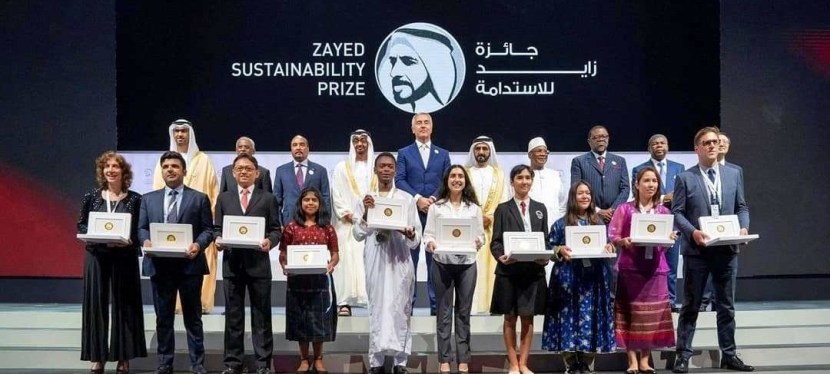
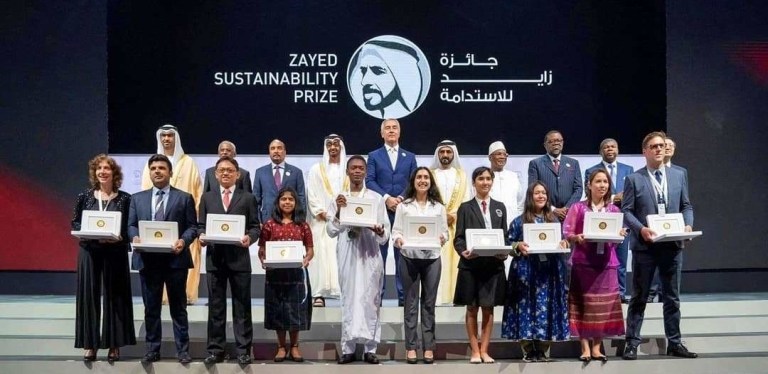
As a testament to the profound steps MAIA is taking, last week the school was awarded the Zayed Sustainability Prize for Global High Schools in the Americas category. The school was one of 10 chosen winners from 2,100 applications that represented 130 countries. “This prize is given to global high schools in six geographic regions that can demonstrate impact, innovation, and inspiration to enable inclusive and equitable access to quality education.”

zayed prize
Prize Recipients, MAIA representative Front Row 4th from Left

Three representatives from MAIA attended the Sustainability Conference and award ceremony in Abu Dhabi, United Arab Emerites (UAE). It boggles the mind to see these women, who were raised in a culture that told them that they weren’t valuable, embarking on their voyage to UAE.

Take a minute to think about the daily challenges you face. And then think about how brave these women have to be every day, to break the mold, to find their voice, to dare to reach for more in life. Think about Ester, a 9th grader from rural Sololá, Guatemala. Attending school beyond 6th grade was an enormous leap just a couple of years ago. Last week she traveled to the other side of the world. She crossed a vast stage to receive a prize for her school, a tangible testament to how meaningful and impactful all of the effort and sacrifice have been. She met people from all over the world – from UAE, Chile, and Croatia, to name a few – and represented on a global scale her school, her heritage, and her country. These MAIA representatives, these courageous Mayan women, are teaching the world about Guatemala while showing us all what is possible. This is bold. This is audacious. This is hope.


Tell me, what is it you plan to do with your one wild and precious life?

The poet Mary Oliver died today. My favorite poem of hers is The Summer Day, so I copied it here. I especially love the last three lines. It’s a great reminder to pay attention to the details, to find pleasure in the little things, and to remember that we get just one precious life. It is uniquely ours. And we are each unique. So, as Oscar Wilde said, “Be yourself. Everyone else is taken.” Live authentically, with passion, and with love.

The Summer Day

Who made the world?
Who made the swan, and the black bear?
Who made the grasshopper?
This grasshopper, I mean-
the one who has flung herself out of the grass,
the one who is eating sugar out of my hand,
who is moving her jaws back and forth instead of up and down-
who is gazing around with her enormous and complicated eyes.
Now she lifts her pale forearms and thoroughly washes her face.
Now she snaps her wings open, and floats away.
I don't know exactly what a prayer is.
I do know how to pay attention, how to fall down
into the grass, how to kneel down in the grass,
how to be idle and blessed, how to stroll through the fields,
which is what I have been doing all day.
Tell me, what else should I have done?
Doesn't everything die at last, and too soon?
Tell me, what is it you plan to do
with your one wild and precious life?

from New and Selected Poems, 1992
Beacon Press, Boston, MA

Copyright 1992 by Mary Oliver.
All rights reserved.

Rude Awakening

I know a thing or two about pain.  Emotional and physical.

Any woman who has had a baby knows about breathing through pain.  And I am here to say that I am absolutely as imperfect as they come when it comes to breathing through anything.  I get so angry and frustrated and want to just wallow in my misery sometimes.  Very graceful.  Very zen.  I am more of a just-give-me-a-to-do-list-and-I’ll-do-it kind of person.

As with most new parents, we didn’t sleep much those first few months.  Our baby was fussy and needed to be held all the time and, being the worried new mom that I was, I spent what little “free time” I had researching what I was doing wrong and the many ways I may never sleep again.

I am from a family that says things like, “I am not sick, I just don’t feel well”.  We push through and don’t complain.  So when my hands started to hurt about six weeks postpartum I chalked it up to constantly holding a heavy baby and exhaustion.  The pain would come and go, and time was a very slippery and elusive concept in those days, so carpal tunnel syndrome seemed like a legitimate possibility.  Sure some days my legs kind of ached, too, but that’s what atrophy feels like, isn’t it?  I distinctly remember hobbling down the stairs to the backyard saying to my mom, “I feel like I am getting worse and not better.  Is this normal?”.  Then one day my knee visibly swelled up.  Having barely left the house in months, let alone done anything active enough to cause an injury, I finally couldn’t find an answer for that one.

I was diagnosed with Rheumatoid Arthritis (RA) two weeks later.  Cue record scratch.  Arthritis is for old people, isn’t it?

I’d love to say that I went home from the doctor with my chin held high and soldiered on with zero self-pity.  Ha!  No, no, no. There were some serious bellyaching moments and I definitely asked “why me” more than once.  I was shocked, almost offended, that this could happen to me.  What the heck did I do to deserve this?  Very zen, like I said.  For me, RA meant one big old Rude Awakening.

Pro tip – don’t google your newly diagnosed disease when you get home from the doctor.  It doesn’t end well.  Ignorance truly is bliss.

With the words “severe prognosis” ringing in my ears, I was sent home to begin to ween my baby off breastmilk so I could start on some pretty powerful medications to try to change the course of the disease.  I remember calling my OB and asking for advice on how to ween a baby, explaining what had happened and why in this age of “breastmilk is best” pressure I was stopping.  The nurse I spoke with, thank goodness, was so compassionate.  I will never forget her kindness and her words, “You did such a good job”.  I needed to hear that. It’s very lonely to be sick, have a brand new baby with all the societal judgment that comes with parenting, and your choices aren’t yours anymore.

That was part of the emotional pain of RA for me. The diagnosis, whether you have a little baby or not, brings a flood of fears and unknowns. Google told me that 1/3 of people with RA are so disabled after five years that they can no longer work; I was denied short-term disability; the medication side effects and disclaimers were terrifying to read. The disease itself is an unpredictable roller coaster ride. Some days are better than others, some medications work well, others make you nauseous. It’s all trial and error. No lists.

And the physical pain? Well, it’s like nothing else, quite. A broken arm? Maybe. Childbirth?  I guess so. It’s intense and deep and unrelenting. 40mg of prednisone and 800mg of ibuprofen wouldn’t even touch it some days. I couldn’t lift my baby out of the crib because I was cradling my arm so gingerly. Some days I couldn’t walk. I never knew where the pain would go next, which joint would be affected. Hips, shoulders, jaw – those are the worst. You can work around a hand or a finger, but it’s impossible to eat or even smile when your jaw joint is inflamed. I begged my dentist to tell me it wasn’t RA and I just needed a root canal. Anything, like I said, for someone to just fix it.

I have tried to figure out what triggers my flare ups.  I cut out sugar and caffeine and alcohol and gluten – pretty much all joy – and it made no discernable difference except that I was more miserable and now high maintenance as well. I have submitted myself to science and participated in pain studies. Mostly I learned that I have a high tolerance for pain and that ice is my friend. I have no idea why some days are better than others. Remember how I said that I like order and a nice to do list? Yeah, RA doesn’t work like that.

It turns out that that kind of checklist mentality, where if you just check the right boxes you are in control, is a false premise. That remains a disappointing life lesson for me. But I am working on it.

Long, long story short, eventually the meds did their thing and my RA went into remission. For the time being, I don’t have any pain and haven’t had any permanent damage to my bones or joints. That in and of itself is a miracle. Truly. I’ll write a whole post on how different the outlook is for RA patients who were diagnosed after methotrexate started to be used to treat RA as compared to previously when all that could be done was attempt to manage the pain.

It took a lot of time, a lot of deep breathing, thousands of laps in the pool, sometimes screaming underwater, sometimes also crying into my goggles, for all the emotional toxicity to work its way through my system.  But eventually, that piece settled, too.

Now I swim in a masters swim program. I participated in a triathlon a year ago, something that was absolutely unimaginable only a year prior. I go to crossfit. I traveled to Guatemala! Hope abounds.

I am tempted to say that I conquered RA, that I win. But that would mean that I haven’t learned anything from all of this. I have been around the block enough times now to know that my RA and I are just in a temporary place of peace, and that it will inevitably come back. And when it does, honestly, it will be really hard for me. I don’t expect that my despair will be as deep, but I’ll surely still long for that elusive checklist and the return to normalcy. Now I know, though, that I CAN come back, that RA is just one part of my story, and that I am not less than because of this. As Dory says in Finding Nemo, “Just keep swimming, just keep swimming”. Seems like some pretty darn good life advice. One day at a time. One breath at a time. One lap at a time. One foot in front of the other.

Post Triathlon
Post Triathlon with my “I have RA AND I am an athlete” shirt on

You Don’t See That Everyday

What’s so noteworthy about the following picture, do you think?

Bathroom Photo

If you said, “That’s a bathroom stall”, you’d be correct.  But you’d be more correct and I’d be more impressed if you said, “That’s a wheelchair accessible bathroom stall!  With a ramp to the door!  In Guatemala!”

My cousin Chris has been in a wheelchair since a skiing accident in college.  He is an accomplished athlete and motivational speaker.  In his memoirs, he shares what it was like for him after his accident, learning how to adapt physically and mentally to his new and challenging reality.

Because of Chris’ experiences, specifically his time in Tanzania preparing to climb Mount Kilimanjaro, I may be more attuned to the challenges people with disabilities face, especially in the developing world.  Have you ever noticed how rare a curb cut or an accessible bathroom is outside of the United States?  Have you ever considered how difficult it might be to get around in a wheelchair period, let alone on a dirt path?  In the snow?  Without ramps?  Without an elevator?  With no wheelchair at all?

Needless to say, when I saw this bathroom in the small community of San Juan La Laguna in Guatemala I about fell over with surprise and joy.  So today I wanted to share the important and meaningful work that Alma de Colores, a “labor and social inclusion program for people with disabilities” is doing in Lake Atitlan, Guatemala.  And to encourage everyone to think for a minute about how hard it is to live in the developing world as an able-bodied individual.  Or how difficult it can be to live in the U.S. as a disabled individual, even with the accessibility standards we have.  And to simply be aware of that as you go about your day today.

My cousin spends a lot of his time speaking at schools with his Nametags educational program, shining a light on the disabled community so that they are seen, so we all start to see their potential and our own potential, instead of focusing on the limitations.  The Nametags program teaches about resiliency, and also about the labels we put on ourselves and others.

Waypoint Adventure puts much of what Chris’ Nametags program talks about into action.  Their mission is to “challenge youth and adults with disabilities to discover their purpose, talents and strengths through the transforming power of adventure”.  And their work is incredibly powerful!  The liberation and delight that comes from triumphing over an “I could never do that” mindset is truly thrilling.

Shel Shilverstein wrote the following poem in Where the Sidewalk Ends:

Listen to the MUSTN’TS, child,
Listen to the DON’TS
Listen to the SHOULDN’TS
The IMPOSSIBLE, the WON’TS,
Listen to the NEVER HAVES
Then listen close to me –
Anything can happen, child,
ANYTHING can be.

Alma de Colores, Nametags and Waypoint Adventure provide the support and structure to make the impossible possible.  They teach about the power of community and inclusion, that no one climbs a mountain alone, that together we can transform people’s view of their abilities.  Those are phenomenal messages that transcend international boundaries.  Those are the universal messages of our common humanity.


Have you ever heard of the Magic City?

The Magic City is a mystical place of incredible, humbling beauty, where the rivers run clear, the trees are tall and plentiful, and the mountain ranges and landscape are vast.  It is also a place of extraordinary opportunity: to have a high quality of life, to raise a family, to hunt and fish and hike.  Never heard of it?

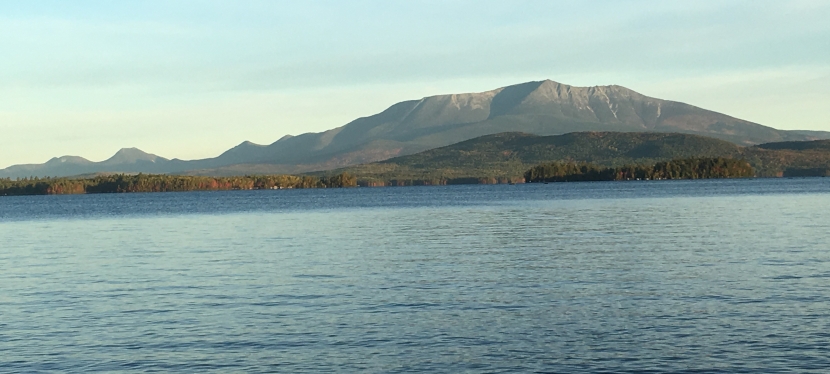
How about a small town in Northern Maine called Millinocket?  The name means “the land of many islands” in the language of the native Penobscot people.  It is surrounded by lakes and rivers and sits in the shadows of Katahdin, the “greatest mountain”.  It is about as stunning a setting as one could imagine or even invent.

In the early 1900’s, the town of Millinocket sprung practically fully formed from the depths of the dense, wild woods to become a thriving paper mill town.  Because of its virtually spontaneous creation and rapid growth it came to be known as the Magic City.

The views of Katahdin from Millinocket and the natural wonders and wilderness setting of the Katahdin region are enough to earn it the magic moniker.  For a time, the bounty afforded by the papermaking world of the Great Northern Paper (GNP) Company was also magical.  For years, Millinocket boasted the highest per capita income in the state.  There were papermakers balls, an opera house and movie theatre, open access to GNP land for hunting and fishing, and the guarantee of a lucrative job waiting for high school graduates.  At its peak, GNP was the largest landowner in Maine.

If you have heard of Millinocket at all, chances are you’ve mainly read the dire headlines about how tough they’ve had it there since the paper industry, the one industry in town for a century, foundered and eventually closed in 2008.  U.S. Census data reveals that Millinocket’s population increased rapidly through the 1970s and has declined each decade since.  The balls and opera house were long gone by the 1990s when I first showed up there.  Now so too are the jobs and the tax base.  And, swiftly, the hope, many of the young people, and much of the magic have drained from the region.

But this is a story about finding hope in unexpected places.  And the Millinocket of the past decade, with its bleak headlines, empty storefronts, vacant homes, and abundant for sale and for rent signs, surely is a place where hope has been more difficult to find.

However, in 2015, Gary Allen, a Mainer from the coast, had an idea.  And that idea was to hold a Marathon.  In Millinocket.  In December.

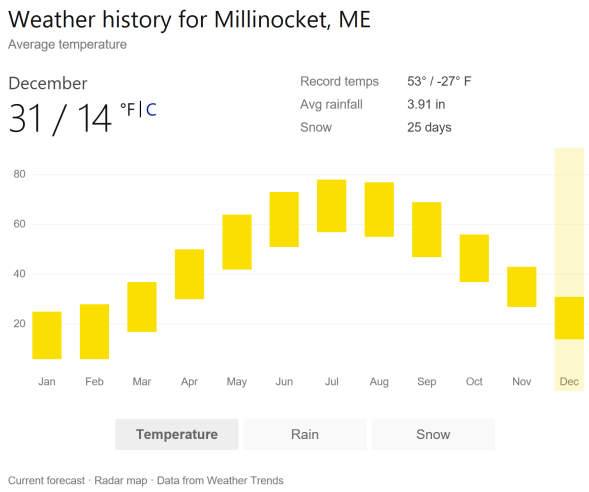
That’s right.  26.2 miles in a relatively remote part of Northern Maine where the weather graph looks like this:

Millinocket Weather graph

Because of Allen’s connections in the running world, 50 people ran in 2015.  But it wasn’t only runners who showed up that day.  The people of Millinocket did, too.  And with that, a new connection, a new relationship, was formed, and Gary Allen’s idea became a spark that has transformed in the intervening years to become one of the small wins this region, this town, desperately needed.

The Millinocket Marathon and a Half is now a certified USATF course.  The race will take place on Saturday, December 8, 2018, for the fourth consecutive year. It is the only marathon that takes place in New England during the winter and it is fully subscribed with over 2,400 people registered to run.  No entry fee is charged for this Boston Marathon qualifying event.  Race organizers hope that instead racers and their fans will spend money in the town.  The concept is: “Don’t Run Millinocket for What You Get; Run Millinocket for What You Give”.

Meanwhile, being the Mainers that they are, the locals dove right in to welcome the runners.  They have organized an Artisan Fair with over 45 crafters.  There are spaghetti and pancake dinners planned, a variety show, and a pre-marathon breakfast.  Multiple local establishments are hosting parties after the marathon as well.  If you want to see Millinocket and northern Maine hospitality shine brightly, this is an amazing opportunity to do so.

This marathon is a vote of support and an influx of interest and money just when the town needs it most.  It’s a remarkable demonstration of what a little idea, some hope and determination, and a few connections can make happen.  Kind of like magic.  Just think what could happen if we all thought, every day, about what we could give versus what we could get.

Read more