Working to Enhance the Voice of Women

I mentioned in a previous post that I have been doing a lot of writing, it just happens to not be happening on this blog site! It occurred to me that I should share some of my recently published writing here. So, in case you missed it, here is a link to an article in the local paper, or you can read below and view extra pictures and a video!

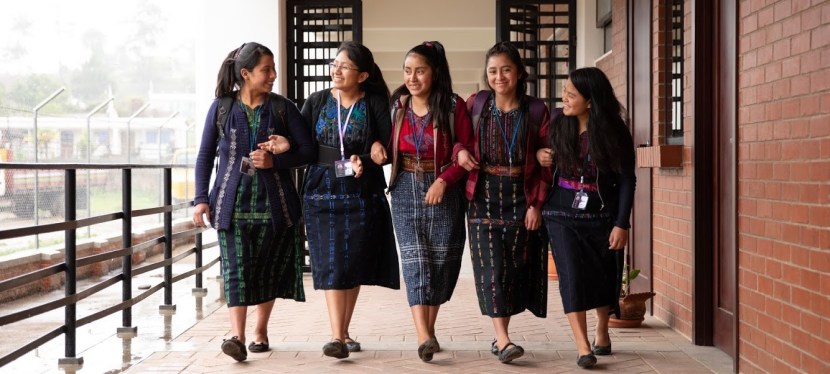
Meg Steere was recently appointed as the first New England-based Board member for the MAIA Impact School (www.maiaimpact.org), a school for indigenous girls located in Sololá, Guatemala. In its third year of operation, MAIA exists to “unlock and maximize the potential of young women to lead transformational change.” Guatemala is consistently rated by the World Economic Forum as the least equitable society in the Western Hemisphere. Meanwhile, countries that have greater levels of gender equality are safer and more prosperous. Educating girls is also among the top ways of combating climate change.

Guatemala Ranking SDG Gender Index

Meg traveled to Guatemala in October 2018 to attend the inauguration of the new school building. She was impressed by the caliber of the school leadership, and that, by design, the school is run primarily by indigenous women with an emphasis on empowering the local community. The school’s model markedly changes the trajectory of its student’s lives. In recognition of their success and their potential, in January 2019 MAIA was awarded the Zayed Sustainability Prize (see video at bottom of this post), demonstrating “impact, innovation, and inspiration to enable inclusive and equitable access to quality education.”

MAIA students are girls who have the talent, courage, vision, and desire to succeed but lack the opportunity. Through education, these women can lead their families and communities out of poverty. One key aspect of their education beyond academics is vocal empowerment. These girls have been raised in a culture that tells them to be quiet—that they are silly and stupid, unworthy and worthless. At school, they learn to trust their voices, to speak up, and to prevent societal judgment from defining their self-worth. This message transcends borders.

Susie Caldwell Rinehart—brain stem tumor survivor, ultramarathoner, mother, life coach, and Colorado-based MAIA Board member —released her memoir Fierce Joy: Choosing Brave over Perfect to Find My True Voice on May 15. Hers is a story of miraculous survival; motherhood; losing her voice, literally and figuratively, and then finding it again; and choosing to conquer her fear of imperfection in order to live her most authentic life. Susie and Meg have both found inspiration and strength in the courage of the Guatemalan girl pioneers. Through Susie’s medical journey, which brought her to MGH and Brigham and Women’s Hospital, Susie discovered that “the opposite of joy isn’t sadness, it’s perfectionism.” She began to write her memoir as she underwent months of recovery, radiation, and separation from her family in Colorado. She returned to Boston in early June for her book launch.

MAIA’s impact continues to expand, boldly challenging the narrative and compelling us all to be braver and to rethink what our expectations are—of ourselves and others—and why. Join this brave movement working to close the gender gap in education and catalyzing positive change globally. A portion of the proceeds from sales of Fierce Joy will be donated to MAIA Impact School. 100% of donated funds to MAIA go directly to the students, mentors, educators, and families.


The View from a Chicken Bus

This is an exciting day! My essay, The View from a Chicken Bus, was published today in Sky Island Journal, an online magazine!!!

The View from a Chicken Bus

Meg Ounsworth Steere

The chicken bus dives and weaves along the tight switchbacks, sandwiched between lushly green, undulating volcanic cliffs to one side and a vast, deep cavern open to the expansive lake below on the other. The retired yellow school bus migrated from the United States to rural Guatemala. Here it was given new life and transformed with wild paint, flashing lights, and blaring music into a chicken bus, a form of public transit.

Outside the dirty bus window, an overwhelming cacophony for the senses unfolds – the scenic natural beauty; the chaotic, crowded, narrow road; scents of cooking, burning wood, exhaust; sounds of honking, birds chirping, dogs yapping. Overloaded motorbikes swerve in and out of traffic carrying 2, 3, 4 people. Small 1990s pickup trucks, their beds full of standing riders, scream downhill inches away.

In the smallest openings on the roadside, tourists stop for pictures of waterfalls or the lake and volcanoes. Opportunistic market stands pop-up, their purveyors – women in their village’s colorful and ornately woven dress – mixing, patting, and baking tortillas, frijoles warming and ready to sell.

The bus is crowded, the air stale and warm. It winds its way up from the rural, lakeside villages to the hillsides around Sololá. Passengers, mainly rural Mayans, call to the driver for stops along the way. The men wear tattered jeans; t-shirts or lightweight button downs; a cowboy or baseball hat; work boots. The women are dressed in traditional Mayan clothing – a short-sleeved cotton blouse with brightly colored geometric designs; a thick belt; a calf-length skirt embellished with a colorful, embroidered band; simple pumps, flats, or sandals.

One passenger stands out from the rest as she calls to the driver to stop near the entrance to a large, modern school. The driver and other passengers look on, mystified about this place and this teenage girl, both standing out uniquely in the Sololá landscape: unusual, unfamiliar, a vision for what could be, but also a strange curiosity and maybe something to fear.

The girl walks the uneven, rocky dirt path along the road toward the school gates, clearly uncomfortable that the eyes of every passenger, neighbor, and bystander are boring into her back, their questions, doubts, and hopes piling up on her small shoulders. She sidesteps sewer water trickling down the road, brushes the dust off her shoes, and turns onto the paved drive to the school entrance.

In rural Guatemala, it is rare for anyone to complete more than sixth grade. Most families are generationally poor, stagnated and mired in a life of day-to-day survival by the impacts of racism, gender inequality, insufficient education or health care, and limited economic opportunities beyond what they already know – farming. The harvests have become less reliable with unpredictable and more volatile weather. Being Mayan comes with traditions and cultural norms, and also a history of marginalization and subjugation. During the 36-year civil war that ended in 1996, 93% of those killed were indigenous. About 50% of the general population, but 79% of the indigenous population, lives below the poverty line.

In rural Guatemala, the standard architecture features single- or two-story buildings, with concrete siding. The rusted and battered tin roofs are supported by gnarled, roughly hewn wood beams. The colorful exterior paint, if not the concrete itself, is chipped and worn. Buildings are stacked up the hillsides, one on top of the other, seemingly supporting each other as they claw into the mountainside, grasping to hold on. Roads vary from dirt paths cut into the hillsides to cobblestones or pocked asphalt.

Each year survival here becomes more difficult. Out of sheer desperation and hopelessness, some attempt to migrate north, leaving Guatemala and their history and families. For many, the prospect of leaving all that is familiar, walking all those miles towards an antagonistic and uncertain future, doesn’t seem like a much better option than staying and trying to carry on. Something fundamental must change for survival to be tenable here.

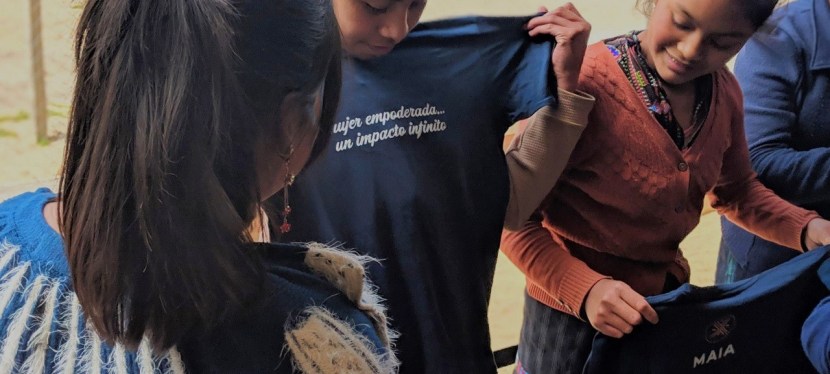
Enter this school and this unique girl. The sign on the school’s brick wall proclaims “MAIA, mujer empoderada…un impacto infinito” (empowered woman…infinite impact). Empowered, indigenous, poor, rural Guatemalan girls. I can’t help but stare and wonder. Historically girls here have been taught to be quiet; that making eye contact is disrespectful; that they don’t need an education. On average, women in Guatemala, especially Mayan women, only complete 3.5 years of school. Narrow options and limited health information result in Guatemala’s top ranking for the highest fertility rate and youngest population in all of Latin America.

How valuable is this young girl, full of talent, courage, and a desire to succeed? How powerful is the concept that by providing educational opportunity and modern learning tools, alongside mentorship and support for the students and their families, real, systemic change could trickle down and spread roots generationally? How courageous must these girls and their families be?

Every day these families make a conscious choice not to shrink back. Every day they bravely face the ingrained, negative messages that say that girls don’t matter; that they are silly and stupid, unworthy and worthless. These girls must sense their differentness, an isolating notion that can seep in and slowly ebb away at their drive and their souls if they let it. Their path is long and challenging. It takes the power of a sprinter and the endurance of a marathoner. They face the academic and emotional challenges of any middle or high schooler, but also the burden of being the first to break the status quo, push the boundaries of cultural norms, and change the narrative for themselves, their families, and their country.

The dense clouds overhead release suddenly, the splattering rain interrupting my reverie and fogging the view. The bus driver pulls the door handle, hinges squeaking, and the bus roars into gear. Through the rain-streaked window I see the girl cover her head and rush to catch up with her classmates. Together they pass through the school gates, a small but determined caravan of hope.

Click here to see the full issue: https://www.skyislandjournal.com/issues#/issue-9-summer2019/


On Becoming Powerful and Empowered

I have been writing a lot recently about the MAIA Impact School and my fight for girls’ education (rights, life – hope!) in Guatemala. Today I am bringing empowerment Stateside.

A couple of years ago, my Rheumatologist recommended adding weight-bearing exercise to my routine. Instead of doing what normal people do, you know, lift some weights here and there at the gym, maybe do the circuit equipment, I joined CrossFit Launchpad (CFLP). My Rheumatologist’s jaw dropped when I told her that. It was pretty funny, actually. I could see the wheels turning in her head, “Crossfit? Really? Do you always have to push the outside edge with this disease?” Why, yes, yes I do.

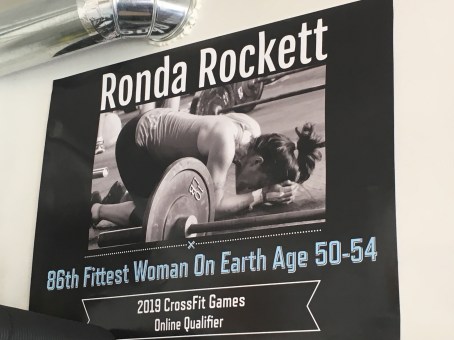
You see, I know myself, and it’s a fact that I will not pick up a weight unless I am instructed to do so. Accountability counts. Plus, the gym owner, Ronda Rockett, is a Primary Care Physician, so she knows all about body mechanics and physiology. When I told her that I have RA I felt safer knowing that she knew exactly what that meant. Plus, she seriously knows about health and fitness.

Crossfit Coach
Crossfit Coach and Athlete Ronda Rockett

Needless to say, I started showing up to these classes, at first cutting workouts in half and still hobbling around on pulled and tired muscles for days afterwards. I have been going long enough now that not much fazes me, the lingo all sounds familiar, and I have watched our crossfit community grow. The other day it struck me as I watched people moving around the gym, stretching and warming up, gearing up for the workout, asking questions of the coach – this small gym is a microcosm of society, a seemingly ever more rare reflection of what an inclusive, supportive, caring community looks like. The idea is to work hard personally, but not to leave anyone behind (even the family dog).

This tenet applies to everyone who comes to the gym – men, women, and children. People join CFLP for a whole range of reasons, including some who haven’t exercised in a long time; who weren’t “athletes”; who have weight they want to lose that just won’t budge or health issues they can’t shake and are sick of not feeling well. I notice them shyly standing in the corner, hoping to blend into the walls and go unnoticed, deferentially allowing others to go first, reviewing the WOD (Workout of the Day) saying things like, “I don’t think I can do this.” The weekly schedule reflects the scaled workouts and WOD modifications designed for them. I see how hard they work, and how it just wipes them out, sweaty, panting, red-faced, and exhausted at the end.

Over time, I witness a slow evolution brought about by hard work and perseverance. Not only are these budding athletes literally becoming more powerful by lifting ever heavier weights or accomplishing more sets in a workout, but they are also becoming more empowered. Being part of this community ignites a light within. Here, a strong core means much more than six-pack abs – it’s about your spirit and celebrating everything that makes you you. Given the right support and encouragement, it turns out you can do anything – in the gym and outside of it.

Scientific studies suggest that strong, healthy, active parents raise strong, healthy, active kids. According to Dr. Christine Carter, “the first step in the science of raising happy kids is to actually be happy yourself.” Check out this Time magazine article from 2014 about how to raise happy kids (10 steps backed by science). Here’s the summary list:

  1. Get Happy Yourself
  2. Teach Them To Build Relationships
  3. Expect Effort, Not Perfection
  4. Teach Optimism
  5. Teach Emotional Intelligence
  6. Form Happiness Habits
  7. Teach Self-Discipline
  8. More Playtime
  9. Rig Their Environment For Happiness
  10. Eat Dinner Together

At CFLP, Ronda and the other coaches encourage us beyond the amount of weight we can lift. We talk about setting (achievable) goals, forming new habits, nutrition and sitting down for a healthy meal as a family (not in front of the TV!), working hard, and gratitude. We are creating new pathways for ourselves, and also setting an example for our children. We are modeling what it means to be healthy and strong and to expect effort, but not perfection. We are also teaching them about building relationships and how a supportive and caring community behaves. I’ve said it before and I’ll say it again – no one goes it alone. Everyone needs support and encouragement somewhere along the line.

The other day, we finished the prescribed workout with a little time to spare. One member, the one guy in the room that class, suggested that we add on a little extra to finish out the time. This particular athlete had finished the workout well before the rest of us, and then stood there patiently swigging his water, cheering for each of us, and waiting for us to finish. When the coach asked him what he wanted to do for extra work, he responded, “whatever the team wants.” This is an attitude to emulate. Imagine our world if everyone strove to lift others up versus pushing them down; where unity was sought over division, support given versus criticism; where we meet face to face, put the screens away (for an hour!), and cheer hardest for the one who is coming in last; where our common humanity – our community – is celebrated and flourishes. Go team!

“It is not the critic who counts; not the man who points out how the strong man stumbles, or where the doer of deeds could have done them better. The credit belongs to the man who is actually in the arena, whose face is marred by dust and sweat and blood; who strives valiantly; who errs, who comes short again and again, because there is no effort without error and shortcoming; but who does actually strive to do the deeds; who spends himself in a worthy cause; who at the best knows in the end the triumph of high achievement, and who at the worst, if he fails, at least fails while daring greatly.” ― Theodore Roosevelt

Continue checking my Resource page for updates, including curated articles related to my blog posts, life coaching references, holistic travel kits, and book recommendations!

Ask and you shall receive!

Nick Kristof has made his way to Guatemala! I don’t actually think this is because of my post the other day, but I am still thrilled!

The focus of this piece, published in today’s NY Times (June 6, 2019), is on climate change driving migration…do you know what Project Drawdown says is the top solution to climate change? Combined, it’s girl’s education and family planning.  And so I circle right back to MAIA. This is extremely important stuff, folks. Educating girls in Guatemala has incredible trickle down impacts on so many issues, from simply the humanity of alleviating  the suffering of other human being’s day to day survival to creating opportunity and hope to reducing the impacts of climate change. 

Nicholas Kristof and the Power of Hope

It’s not just me. Nicholas Kristof, the renowned New York Times journalist and two-time winner of the Pulitzer Prize, also believes there is power in hope. He published an article in the NY Times opinion section on May 29, 2019, entitled Cash, Food and Health Care All Help the Poor, but Something’s Still Missing. It’s about poverty within the indigenous population in Paraguay, and how opportunity (also known as HOPE) can be a transformative force in substantively changing the trajectory of people’s lives.

Hope doesn’t mean just an idea and a good feeling. It means a pathway to something new and the supports to get there. The program in Paraguay references mental health support in addition to guidance on how to grow a small business. No one goes it alone. The notion that anyone is successful completely alone and in a vacuum is one of the biggest fallacies ever promoted.

As I read Mr. Kristoff’s article, I found myself thinking about the MAIA Impact School in Guatemala and the similarities between what he observed in Paraguay and what I have seen happening in Guatemala. The MAIA school, led by courageous and empowered Mayan women, sees hope in the form of providing a real, robust education to young girls with the potential to succeed but no opportunity to do so. These girls are rural, poor, indigenous, and female, four major challenges in a country where machismo is the norm and racism against the indigenous population is severe (of the 200,000 people killed during Guatemala’s 36-year civil war, 93% were indigenous). MAIA provides not only academic opportunity for these girls, but also the mentoring and support that they and their families need to navigate the extremely demanding road before them. This road begins with these girls beginning to build a path for their families out of systemic poverty. Imagine the trickle-down generational impacts when empowered, educated girls become empowered, educated mothers. The possibilities for change spread like the roots of a strong tree.

MY HOPE is that Mr. Kristoff finds his way to Sololá, Guatemala, as he winds his way back north…this story, the incredible work being done by this school in Guatemala to create hope and an actual opportunity for a viable future needs to be broadcast more widely. The little news we hear about Guatemala in the U.S. fixates on negative imagery from illegal border crossings and migrant caravans to drug cartels and political instability. What if the news focused more on what kind of hopelessness would compel someone to make that fraught journey to an uncertain and antagonistic future? What if they presented solutions that would help people build a future that would be a reason, a means, to stay?

Pulitzer committee, I’ll be awaiting your call ;-)!


Extraordinarily Ordinary

This weekend the skies were clear and blue, the breeze a gentle relief from the heat. You never know what you are going to get around here, the only guarantee is that you can’t count on it. For months the weather has been soggy, gray, cool, and grim. So when the sun is actually shining; when you go outside and don’t have to brace yourself against the chill or run back in for another layer; when your rainboots and umbrella are traded for sunscreen, and the wind isn’t even ruining the moment by blustering on, it feels rather miraculous.

One of the most extraordinary aspects of this weekend, though, was that apart from the weather it was totally ordinary. We didn’t have tickets to a big event. We didn’t go on a trip. No big plans or agenda. We gathered spontaneously with friends. We went to a BBQ. We rode bikes and played in the backyard. There was actual time to pause and reflect and, gasp, relax. It was totally decadent in its simplicity.

It’s one of life’s great ironies that the pursuit of more actually results in less. If you are treadmilling your way through life, manically pursuing more and governed by the next event on your schedule or to-do list, remember this: the deepest and most profound fulfillment doesn’t come from things to do or from things you buy. What matters most, what sustains us through the darkest days, where the real magic lies, is in noticing and cherishing life’s small moments, in teasing them out amid the fray of responsibilities, challenges, and disappointments. They happen organically and in some of the most mundane circumstances (and they are also, usually, free).

Find joy every day.

Delight in the small pleasures.

Be compassionate.

Embrace ordinary.

Live with gratitude.
Eagle with flag Memorial Day

While you are here, check out my Resources page! I have just updated it with a new material!

Setting Goals and Facing Failure

First of all, please excuse my absence on the blogosphere recently. I have been writing and writing and writing, but I can’t put anything I’ve been working on here because I have submitted it all to various journals and newspapers to try to get it published!!! As a result, much of my allotted writing time has been dedicated to that pursuit. Happily, I just received word this week that a creative nonfiction essay I wrote will be published June 15 in Sky Island Journal! Woohoo!

And, with that, let me write about some of the highlights of what has been in my mind – setting goals, and also failure, rejection, making mistakes, and trying anyway.

For some reason, I have a terrible time setting goals. I know the SMART goal recommendations – Specific, Measurable, Achievable, Relevant, and Time-sensitive. I love the list, but I still can’t come up with a goal.

I took a little online blog branding course several months ago after I started this blog. I was trying to figure out if there was some sort of methodology I should be following so you, dear readers, don’t wonder where on earth my head is every single time you read one of my blog posts. In other words, is there some sort of path or a strategy to building a blog that I have as yet not followed? (Answer: yes; but, see, it requires setting goals and focusing…so please proceed to the next paragraph…).

One of the first exercises was to come up with 3 goals. Oh cripe. My crossfit coach is always encouraging us to come up with goals, too. I have dodged that bullet for two straight years now. Both cases have got me thinking about how really and truly awful I am at setting goals and why that might be. I am 100% not awful at all at achieving things, I am just terrible at setting goals and answering questions like “what would success look like?” I don’t like to be hemmed in. In fact, probably if I set some goals I’d achieve them before I even wrote them down. Start a blog. See? That could have been a goal. But I did it already. Figure out how to pitch for publication. Done. I am a do-er. But I am also a planner, so I am slightly mystified about why this task both eludes me and causes me so much agita.

In the end, I’ve decided that my problem isn’t so much the task itself as the destination. I understand full well that if I knew where I was going and took actual concrete steps (i.e.: goals) to get there I might actually get there (or get there faster). I do get places, it just tends to be a more circuitous, scenic route. I’ll be the first to say that there’s a lot to be learned by not going from point A to point B. But if I am being completely honest, there’s also the reality (which I know is real thanks to decades of journaling because I would never remember this) that I re-learn truths I discovered already over and over again. My cousin wrote this great book called Things I Want to Remember Not to Forget (by Chris Waddell). I so thoroughly relate to that title. Is this life (asking for a friend)?

Anyhoo…I suspect my brain block about goals has at least a little to do with the unpleasantness of failure and rejection. If I set a goal and don’t achieve it, well that’s no good. Who wants that? If I set a goal and fixate on achieving it, that wouldn’t be great either, to be fair. Pitching to journals, even blogging, sets me up to be rejected and to push that old fear-mongering anxiety button that says I am not enough – not good enough, not smart enough, not worthy enough, a failure. Jeez. Tough crowd. But here’s the beauty of getting older – I get now that I am the one telling myself all these horrible untruths. Sure, I was helped along with material by the horror of being a rule-following, nerdy kid in middle school (fact: kids at that age are mean). But, ultimately, it’s down to me to face those negative storylines, check the narrative (“the feelings are real, but is the story they are telling true?”), and strive to make great mistakes. Then try again. This is what my husband and I teach our children. My goal is to be a good example. And, FINE, @crossfitlaunchpad, I’ll get my first strict pull-up, too.

Mountain proverb


An Ode to Moms Everywhere

“I See You”

I see you, mom, in pajamas at school drop off. You who could care less about your appearance because the fact that the kids actually made it to school on time is such an accomplishment it hardly matters. Today. This time.

I see you, mom, who can’t say no to volunteering, who says no one else steps up so you have to do it, who feels like life turned into one long tumble in the washing machine, dizzying and cold.

I see you, mom, with your junk drawer completely overflowing with accumulated, well, junk. Like bumper stickers that aren’t car worthy and old iPhone chargers and receipts and spare keys to neighbor’s homes, if only you could remember whose they were.

I see you, mom, who got lost along the way and doesn’t recognize much of who you are anymore, spending all your time in the service of others, so much so that you couldn’t say what stirs your soul if you were asked and you fall into bed so dead tired you don’t have time to think about it. Anyway, no one’s asking.

I see you, mom, with the nice pump on one foot and the mismatched flat on the other. Some days the best you can manage is to show up.

I see you, mom, with spit up dried into your new, dry-clean only blouse. There is officially no dignified way to exit the house when you have a baby.

I see you, mom, on a frenzied mission, scrolling through websites for quick healthy meals for dinner tonight. Guess what? They don’t exist. Especially if it’s 4:30pm and you still have the commute home and day care pick up and you haven’t gone to the grocery store in days. Because, seriously, who has the time? What dimension of hell is this that kids need to be fed three times a day anyway???

I see you, mom, racing away from gas pump with the nozzle still in your car.

I see you, mom, who is starving for intellectual inspiration and adult conversation, but can’t figure out how to balance even part-time work with all the other stuff that needs to get done for the family.

I see you, mom, head throbbing, feverish, body aching while ringing way too loudly in your ears are the repeated and urgent words, “Mooooommmmm, I don’t feel well.”

I see you, mom, at Starbucks, who absolutely knows that this latte is going to be the highlight of your day.

I see you, mom, who tries to do it all, chaperone and sell Girl Scout cookies and make healthy, homemade meals and sign the kids up for all their activities and then actually execute on getting them there. Did I mention the full-time job?

Or the:

Birthday party planning

Dishes

Laundry

House cleaning

Haircuts

Lunch boxes

Homework

Bedtime routine

Sleepless nights

Doctors appointments

Play dates

Sick days

SNOW days

School supplies

Sports equipment

New clothes

New shoes, ideally well before you are leaving for the piano recital and realize that the dress shoes don’t fit. Either kid.

I see you, mom, who is buried under never-ending piles of laundry and groceries to buy and bills to pay and birthday presents to buy and holiday meals to make.

Did someone say decorations? Yeah, I see you, mom, whose holiday lights are still on the tree. In May. Way to plan ahead for next year.

I see you, mom, who wonders why it is that the kids have to be reminded to wash their hands, pack their school bags, unpack their lunches, clean their rooms, practice their instruments…EVERY. SINGLE. DAY. How many years have we been doing this?

I see you, mom, who feels like the trip leader of life, like you are everyone’s guide on this journey and they can’t seem to function without asking you how to do it first. And then they ignore you and do it their own way anyway.

I see you, mom, who is taking care of your mom, and missing her wise counsel and yummy cooking and mom advice. You, who are flooded with memories of the incredibly capable woman she was, and can’t reconcile them with the woman she is now, who barely knows you let alone remembers your birthday or a recipe.

I see you, mom, who lost your mom far too young. And, you, whose mom is alive and helpful and wonderful and still bugs the heck out of you sometimes.

I see the whisper of tears in your eyes that you quickly brush away, when some days it just feels like too much. Strong shoulders, but human shoulders. Vulnerable and tired and overwhelmed by the pace and the volume and the sensation that you are not terribly in control.

I see you, I see you every day, and I know.

I understand. And I am here acknowledging all the little things that just don’t get done without you.

In Solidarity.

Happy Mother’s Day.

In gratitude for moms everywhere and for my village.

It’s a good time to put your own oxygen mask on. This is another writer’s take on why:

https://greatergood.berkeley.edu/article/item/put_your_own_oxygen_mask_on_first

make-sure-your-own-mask-is-secure-before-assisting-others-unintentionally-profound-quotes

True Confessions of a Mom Set Loose

October 31, 2018

On the plane from Miami to Guatemala City. This is my first extended solo excursion since having children, my first trip to Central America, my first trip to the developing world in a very long time. It’s a lot of first’s and with that comes excitement and joy and a re-awakening of my spirit or some part of me that’s been quiet for some time…as well as a visceral, biological longing and sadness that I can’t control and didn’t expect. It’s hard to say goodbye to my family and, much as I am sometimes desperate to bust out of the routine and the daily grind, it’s also incredibly difficult to break away.

By chance, the man who drove me to the airport this morning grew up in Guatemala. He was stunned that that was where I was headed. It feels like the universe conspired to cross our paths. I told him (between sniffles) that I hadn’t really done much for myself in 11 years and that I wanted to soak in the moment. He said, “You are like a comet, passing through so rarely but shining so brightly.” I like that idea!

So, here I am, halfway to Guatemala with my journal out and two books sitting beside me – Open Veins of Latin America (by Eduardo Galeano) and Less (by Andrew Sean Greer) – that I might actually be able to read with all this uninterrupted time. For the time being, though, my mind keeps jumping between thoughts of travel past and the younger me; about my kids, already anticipating our reunion; and imaginings about what this trip will be like! And this tells me that maybe I should take a couple minutes to just sit and be, quietly…but, first, a haiku:

Mundane and routine

Break the mold of must and should

Rare delight, bright light.

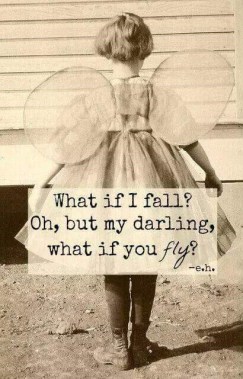
What if I fall quote


The Fixer

Life is such a committed and earnest teacher. Everyone has their stuff. And life dutifully provides opportunities, over and over again, to practice navigating whatever yours might be.

I like to fix things. Not like broken machines, but like broken people or uncomfortable situations or disorder. In fact, now that I think about it, I don’t like the feeling of anything that I feel responsible for being out of place. And I feel responsible for a whole bunch of stuff. That goes for people as well as a leaky faucet. I. Just. Can’t. Ignore. It.

I am experienced enough now (read: old) that I can see it happening, and I actually recognize it for what it is. I discover a “problem,” a switch flips in my mind, adrenaline floods in, and I hone in with laser focus on “solving the situation.” Everything else going on around me becomes annoying distraction. It’s really primitive. And if it weren’t so uncomfortable and I weren’t so focused on whatever the perceived threat might be, it’s also quite fascinating. I know what I am supposed to do here – lots of deep breaths and comforting reassurance to my anxious parts. But my brain keeps tacking back to the VERY BIG PROBLEM THAT NEEDS TO BE FIXED. In those moments, all I really, really want is to fix it so I can put this horrible feeling away and chillax.

The way this manifests when it comes to people who need help is much less obvious than when something breaks in my house. When I say “need help,” I don’t mean like they are hurt or that their house is on fire. Surely I’d go into adrenaline-driven fixer mode in those cases. No, in this case, I mean they need help with something emotional. There isn’t the flood of adrenaline or the laser-like focus, but it’s still a problem to be solved. Internally, it feels like some sort of calling, that it’s my job to fix the bad feelings, or at least temporarily to take away the pain. That’s a lot of pressure and, rationally speaking, it’s totally unrealistic. But who ever said this behavior was rational?

I noticed long ago that very often one’s best attribute or character trait doubles as one’s worst. For me, this is where being reliable and dependable kind of backfires. I am dependable and reliable so people find any number of ways to depend and rely on me. And, of course, then I feel the need to continue to prove my dependability and reliability and to not let anyone down. And it goes on like this in a sort of self-fulfilling cycle for ever and ever…until I crash and burn because I have lent out so much of myself to so many people that I have completely hollowed out my own core. Emotional problems tend to have a longer-running course than physical, house-on-fire problems. They require the pacing of a marathon versus a sprint. But when it comes to fixing things, I have the mindset of a sprinter and, inevitably, I hit a wall and start to get awfully tired…

I think a lot of moms suffer from the feeling of having only so much to give, being needed by many, torn in too many directions, and wanting to fix things that are out of their control. That’s certainly the case for me, and I fully support little getaways here and there to revive oneself and actually be able to think and breathe and just be.

But, for me, this internal fixer is a lifelong pattern. Only after I completely lost myself with the responsibilities of parenting (I don’t even need to explain that kids have needs), childing (also known as: being a reliable and dependable daughter), working (see also: proving I am a productive citizen and “pulling my weight” because, obviously, only a paycheck tells you that), being a good friend (“you can count on me!”), did it become clear to me that the two most-used phrases in my vocabulary are “I’m sorry” and “I should.” I’m either a disappointment/failure/inadequate (“I’m sorry”) and/or I’m driven to prove my worth/worthiness/value (“I should”). Nowhere in there am I thinking, “gosh, I’d love to do that.” It got to the point where I would ask myself, “What stirs your soul?” and I had literally no idea how to answer. Because, I’m sorry, I am so selfish, I should not be thinking about myself when so many people need me.

It turns out that it just isn’t possible to save everyone without totally tanking yourself. Another disappointing life lesson, but a true one. That’s the whole reason my blog has the title it does – it’s a reminder that you can’t run around putting everyone else’s oxygen masks on while simultaneously allowing yourself to be asphyxiated. It won’t end well.

None of this is to say be selfish. Not at all. I certainly struggle with that notion, because that’s how it feels: I am letting people down. I am selfish. I should just try harder. And, of course, there are plenty of things that just need to be done, whether they fill your cup or not. That’s life, and I spend the majority of my day doing just that. Most days, I do much of my to-do list, in all its mundane glory, joyfully. And I admittedly love knowing that people can count on me, and that they know that I am loyal and reliable no matter the circumstances. The trouble strikes when I need a break and don’t know how to say no. It would seem to be such a simple word. Two letters, and virtually the same spelling and pronunciation in multiple languages. And, yet, I am much more apt to say “maybe,” which really isn’t super helpful to anyone involved because it leaves the door open to a road I already know I don’t want to go down. SO, take it from me – when your plate is full and your cup is spilling over with responsibility to and for others, make sure there is a little time carved out in there for you. And if there’s a “no” screaming in your head, say it. It’s not indulgence, it’s self-preservation.

You can be more effective, not to mention more fulfilled, if you actually replenish yourself along the way. Find your inner compass, actually listen to it, and let it guide you. Prioritize. Be in charge of your to-do list, not subjugated by it. Evaluate the opportunity cost of the choices you make – what do you sacrifice by committing to x, y, z? Be intentional with how you spend your time. Think “if I say yes to ‘x’, what will I have to say ‘no’ to?” Say no sometimes. Be true to you. Make sure you are filling your cup. I can assure you, life will provide ample opportunity to practice.