Legacy and Impact

My mom passed away earlier this month. I realize now that her legacy isn’t just in what she did during her life, it’s in who I am in mine.

As with so much of our Alzheimer’s journey, it was a slow moving end. She was just subtly different one day to the next and I found myself in a strange(r) waiting period for several months. I spent a lot of time sitting with her – sometimes she was awake, but often she slept – and thinking. After all these years, my brain can’t understand that she is gone. I knew she was mortal – though she did have a knack for making me question that – but it’s still a complete mental doozy. Grief in the traditional form of reckoning with her absence from this Earth altogether sits in my peripheral vision. It’s there, but somehow I am not ready for it yet.

There are so many threads to pull on from these last several months that merit further reflection, but the most revelatory at this stage for me is the idea of my mom’s legacy. I have always known how much I loved my mom and how deeply she cared about me and my brothers. Through the lens of her life in review, which somehow only became more accessible when the end was approaching, I see more clearly what she passed on to me. There are obvious things, like my eye color and my curly hair. And then there are the more subtle, nurture things. As I worked to capture who my mom was in her obituary, all the ways she served her community became abundantly clear. I was telling someone just yesterday that one of the first things I did when I got to college was to join the student volunteer center. It struck me then how my mom quietly did her thing and influenced the person I became without me even really noticing it. In other ways she was more overt. I have thought a lot over the years about how freaked out she was when I took a semester off from college. She worried that I wouldn’t go back. All this time I’ve maintained the narrative, “Didn’t she know me at all? I was always going to go back.”

But, now, I see it more clearly. It didn’t have to do, exactly, with knowing me. It was about what she wanted for me. She did everything she could for our entire lives to make sure my brothers and I had a smoother path and better opportunities than she did. She graduated from college when she was 49 years old. I was 16. It could not have been easy with 3 kids, our endless sports schedules, and her school work – and yet she still managed to get us where we needed to be and to put dinner on the table. She wanted me to finish college while I was still young and unencumbered, to just have that college degree in my back pocket.

It makes me think about the parents of the Girl Pioneers at MAIA that I work with in Guatemala. By choosing to educate their daughters, they chart a different path for their families with the hope of improving the future for the next generation. This path is unfamiliar to them and requires real courage, commitment and selflessness. But they want better for their children so they take a chance on this opportunity.

Several years ago MAIA ran a fundraising campaign called Nim Mama, which means “Great Mother” in the Maya Kaqchikel language of this region of Guatemala. The campaign focused on honoring mothers and their collective strength, beauty, and transformative power. The images of the pioneering, brave girls of MAIA with their mothers at their side brought me to tears. They reflected back to me my own mom’s strength and guiding light and reminded me how important my education was to her.

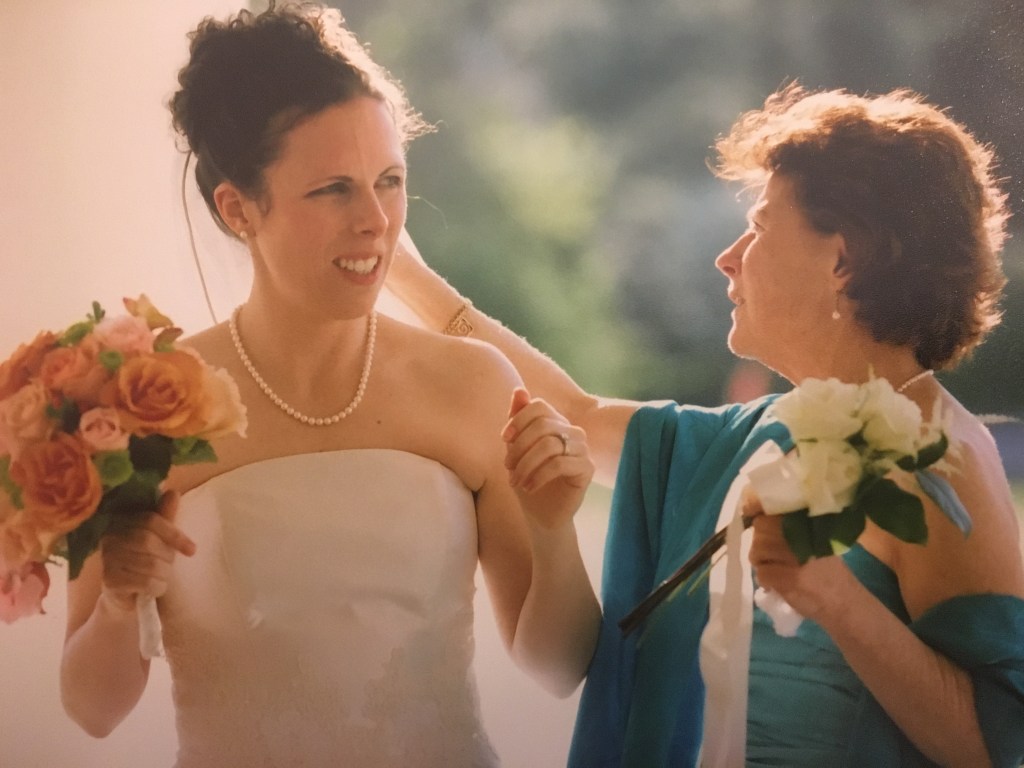
As I go through old photos of me and my mom I think about the legacy of what she gave to me. She stood alongside me, literally or figuratively, my whole life in the same way that the mothers of MAIA stand alongside their pioneering daughters. I realize now that my mom will live on through me – in who I am, in how I tell her story, and by paying it forward like she did so that the next generation has more opportunities and a smoother path still than I did.

I am the same age now that my mom was when she graduated from college. I have two great kids and a loving husband. That college degree that I earned at 22 has opened doors for me. As her primary caregiver for the last decade, our roles reversed for a while as I became more and more responsible for her well-being. I accompanied her to her last day on this Earth to the best of my ability. And I know she is proud of all of these things. It helps me to imagine that she can see it all now and can feel really good about how well she guided my way.

I turn 50 next week. As my way of celebrating my 50 years on this Earth as well as the nearly 50 years I got to spend with my mom, I’m raising funds for MAIA. Paying it forward for the next generation is the best gift I can imagine receiving. Please consider joining me. https://donorbox.org/meg-s-50th-birthday-fundraiser-for-maia-guatemala
Coming into the Light – 10 Life Lessons from a Year of Writing and Living Courageously

A year ago, a friend asked me to create a blog about our trip to Guatemala. I had never set up my own website before or blogged (gosh, I still detest how that word sounds) or publicly written much at all to that point. But she knew that I liked to write, having watched me carry my journal everywhere back in our days together in Madagascar in the 1990s and then again as we traveled around Guatemala. I assumed I could figure it out, and it seemed like a good challenge.

What I discovered is that there is more formatting and behind-the-scenes work needed to get a website set up than I expected. It’s more time-consuming than it is difficult, and I spent ages just trying to think of a website address. I eventually settled on “Put Your Own Oxygen Mask on First” thanks to a sticky note that sits on my desk as a reminder to myself. At a certain point, I just needed to get writing. So I plugged it in, and after confirming that no one had claimed it yet, I went with it. I know it’s probably too long, but it was time to unstick myself from the nitty-gritty details and get down to writing. As time passes, I adjust and tweak the site’s format and layout. As with so much in life, greater clarity comes with time. You can perfect – or improve it – later. The most important part is to just get started.

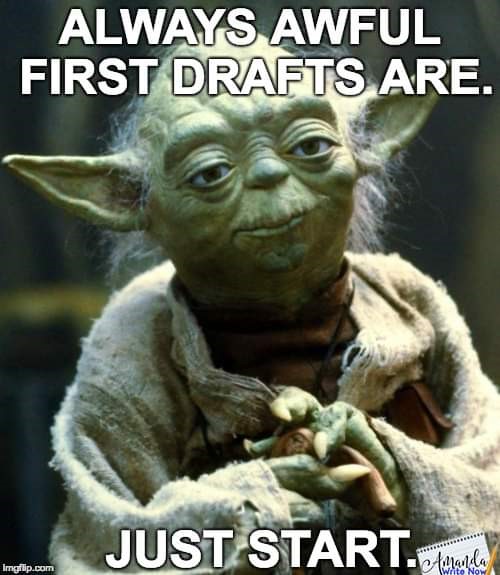
First draft yoda

And start I did. I published my first post on November 15, 2018. Looking back at the past year, I am astonished for many reasons, but especially with how this writing endeavor has blossomed and grown. In the past year I wrote 50 blog posts. FIFTY. That’s a lot of 5am wake up calls. The lesson here is that writing is most effectively accomplished with focused, uninterrupted time, and for many writers that’s early in the morning. The other lesson is that I can pretty much turn any pursuit, even if it starts as a passion project, into work. The good news is that I noticed it happening and backed off a bit. That’s the gift of being in your 40’s – perspective and life experience!

Throughout this year I have had days – okay, weeks – where I have become discouraged and self-conscious. My strong and judgmental inner-voice has ruled my thoughts saying, “Who really wants to read this stuff?” and “Isn’t this a little self-indulgent?” I hear a Sarah Palin-esque derogatory and snarkily delivered, “How’s that hopey changey stuff working out?” in my mind and wonder, “What’s the point? Does all this – any of this – really matter?” I am but a drop in an ocean of snark and negativity, and does anyone really care about what I have to say anyway?

Anais Nin quote

But I carried on, because I like writing and how it helps me sort through my thoughts and experiences. About halfway through the year I began to pitch essay ideas to journals and newspapers, partially out of curiosity and partially, to be honest, to see if the pros though my writing was any good. And I was delighted that a couple pieces were chosen to be published! My essay The View from a Chicken Bus, about an indigenous girl’s journey to school in Guatemala, was published by Sky Island Journal in their Issue 9 in June. It has since been nominated for Sundress Publications’ “Best of the Net” and the Pushcart Prize. My essay on being a sandwich generationer and a child of Alzheimer’s was published by the Washington Post in August and then picked up by the Boston Globe, the Chicago Tribune, the Baltimore Sun, and eventually by Maria Shriver who published it in her Sunday Paper on November 3, 2019.

What a thrill and unexpected gift it has been to watch my words travel around the world! Talk about validation! The feedback I have received from readers has been astonishing, compelling, heartening, and uplifting. I am amazed that my words can bring others to tears, or lift their spirits, or provide a new perspective to set the tone for their day or week. Other caregivers who have walked the long, lonely, difficult road of caring for a loved one with Alzheimer’s reached out to me from all over the country to express their sorrow at my loss, but also to share with me their journeys and their pain.

The fact that my experience resonated with so many other people, that my words touched people’s hearts and inspired them to open up to me, highlights how important connection is, how critical it is to break down the feelings of loneliness and isolation – be it from our circumstances or our modern culture – that can overwhelm us. A friend shared, as she observed my writing journey: “I had never really considered how sharing an experience, beyond an in-the-moment conversation perhaps, could help others.” But it does. I think, in some way, I have always felt that innately, but evidence is mounting about how much it matters (and is missing). According to the results of a recent scientific analysis, loneliness is becoming a worldwide epidemic, and not just for caregivers. Fostering connection with other people, providing a means to have hope, it turns out, are critical remedies to a burgeoning public health issue.

Hope is what drives all of us forward. When all else is lost, what propels us forward besides our hope and our connection to other humans and those we love? So, then, why not be guided by hope? Why not seek connection with others (and, when I say connection, I mean authentic, genuine connection, not Instagram likes or FB “friends”). The alternative is so bleak. Everyone struggles. Everyone seeks a purpose and for their lives to have meaning. Having hope is not an absence of difficulty, or an avoidance of reality. It’s the light at the end of a tunnel of darkness; it’s the anchor that keeps you moored in stormy seas; it’s an intangible but absolutely critical feeling that is sometimes found in the unlikeliest of circumstances and where you least expect it. It matters immensely. This coming year I will redouble my efforts to share stories that give hope, especially where and when we least expect it.

Walt Disney storyteller quote

This year has been an exercise in writing, personal growth, and reflection. There is plenty of room to continue to grow in all of those areas. As author Rob Buyea has said, “The largest room in the world is room for improvement.” Isn’t that the truth? I will forever battle the internal judgement that says that no one wants to hear what I have to say, or that I have to prove myself, or that I am only as good as my last published article. I continue to find room to breathe into the self-doubt, to practice empathy and self-compassion. I live and write with integrity and intention. Or I try to. And I am blessed by this purpose-filled life that has grown out of the sometimes tumultuous and quagmired quest for who I wanted to be when I grow up. As I look back, here are the lessons I have learned through this year of writing (plus a couple of years of living):

  1. Don’t let the details be your undoing; as with writing, the first draft usually stinks but it has to be written to get to the next draft; so it is with life – get started and keep going;
  2. My biggest critic is myself – and I suspect I am not alone in that (why else would the imposter syndrome be a thing?). Check the narrative. The feelings are real, but is the story they are telling you true? Monkey mind is how Buddhists describe it. I guess I’ve always been a storyteller of sorts ;-).
  3. Be open to new perspectives about who you are and what you can do. As I began to think of myself as a “writer,” it opened my eyes to new opportunities and to connecting with people in a new way. I have made new friends this year that I would never have known or had occasion to overlap with a year ago;
  4. Curious gets you a lot further than furious when it comes to connecting with and understanding other people;
  5. If you’re at all like me, learn to check yourself when what started as a fun pursuit becomes a deadline-driven project; remind yourself who is in charge – or should be – you or your to-do list?;
  6. Being vulnerable is uncomfortable; it is also real, human, and relatable;
  7. Conformity is boring. Be uniquely you. Always;
  8. Sharing our stories is how we relate to and connect with one another;
  9. Storytelling is an art, and it’s an important part of helping humans understand their purpose and their past;
  10. Thank you for reading!
  11. BONUS – I like lists (and post-it notes).

First draft Anne Lamott

“My deepest fear is not that I am inadequate. My deepest fear is that I am powerful beyond measure.

It is my light, not my darkness, that most frightens me.

I ask myself, who am I to be brilliant, gorgeous, talented and fabulous? Actually, who am I not to be?

I am a child of God.

My playing small doesn’t serve the world. There’s nothing enlightened about shrinking so other people won’t feel insecure around me.

I am born to manifest God’s glory within me. It’s not just in some of us: it’s in everyone. And, as I let my own light shine, I unconsciously give other people permission to do the same. As I am liberated from my own fear my presence automatically liberates other.”

-Marianne Williamson