Memories and Mommas

It’s been a (very, very, very) long time since I’ve sat down to write.

I used to take the wee hours of the morning for my writing time, rising before anyone else in the house was awake to get my thoughts down. Revisions can happen later, but inspiration and the time to get it down only seems to happen for me before the day takes off on it’s own. Now that I recognize how important defragging the ole motherboard (aka the brain) is, I prioritize sleep. And there is only so much time in a day. Plus maybe I have been having trouble making myself sit down to write alongside a dose of writer’s block and a springling of hopelessness for the world. Deep sigh.

BUT, I’ve updated the site’s Dementia and Caregiving Resources so I wanted to say check those out.

And, while I’m here, and because it’s Mother’s Day (in the U.S. anyway) and because I think about Alzheimer’s all the time when it comes to my mom, I’ll reflect a little on the love and loss that this day embodies for me (and, I presume, many of us in one way or another with mom’s gone too soon, mom’s lost to dementia, mom’s that were never the mom you hoped for…it’s complicated).
My mom was one of the greats. I am so lucky for that, surely even more than I realize. I continue to unearth the treasures of my past that she saved on my behalf. She was family first 100% and she showed up and cheered for her people reliably, consistently, always.

And also, it wasn’t perfect. She got on my nerves something fierce sometimes. We did not operate the same way – at all. There is no to do list that stands a chance against me. My mom would begrudgingly make a list and then lose it somewhere between home and the grocery store.

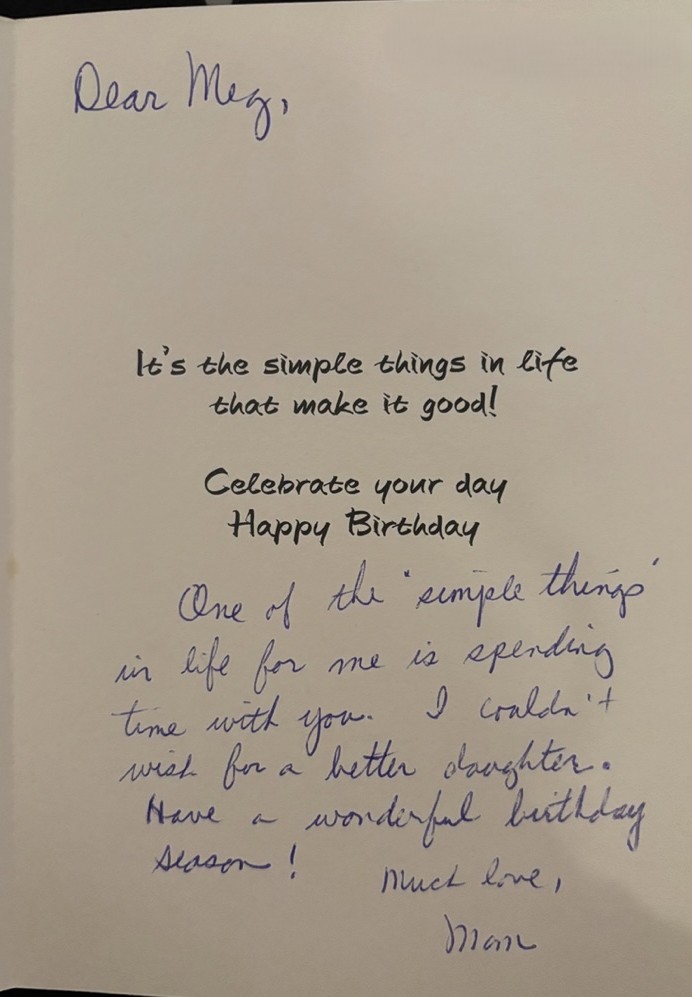
I think about all the ways I could have done better by her. I’d start by wiping the scowl off my face in her college graduation photos. I was in 11th grade and I couldn’t understand – not even close – what it took to finish college on the cusp of 50 with 3 kids and a household to run. I also think of her every time I unload the dishwasher. I wish I could tell her I am sorry for all the times I took a clean bowl out of the dishwasher and left the rest, as though I didn’t know who that chore would fall to. I could have done better. And also I was a kid and I own my selfishness and recognize that one of the blessings of a mom like mine is that she loved me even when I was at my worst. What I lost is the opportunity to tell her, “I got mine, mom. Ha ha! Karma is a bitch.” And then she’d smile and we’d laugh. Clearly from the birthday card pictured she only dwelled on the best in me – and we did have part of my adult life to enjoy each other’s company and make up for my teenage transgressions. We traveled around Europe together for two weeks when I was in my mid-20s and she told me she had to pinch herself that I wanted to spend so much time with “your dear old mom.” It was a gift, in both senses of the word. Sometimes I let myself dawdle at the precipice of imaginings about what the last 14 years could have been like for me and my kids, but that generally leads to a vice tightening sensation around my heart and lungs so I tamp it down. When did that kind of thinking ever lead anywhere good?

Oh, my mom is still here. But she’s so far gone. She deserves better than the indignities Alzheimer’s has thrown at her, slowly robbing her of her memories and her agency and everything that made her her.

I’ll be precise. Not exactly everything. She does still smile and sometimes she laughs, too. She still taps her toes to music and raises her arms in the air as though she is conducting an orchestra. She is still loving and wants to be loved. Those things are all authentically her. In fact, perhaps the most remarkable thing about my mom is that her Alzheimer’s journey has been the epitome of grace. Somehow, despite having aphasia and being on the severe side of the cognitive impairment scale when we moved her into memory care, she has managed to create connection and to build relationships. The caregivers and nurses at her facility truly love her. It’s remarkable that she has been able to affect people in this way, to somehow remain her outgoing, loving self and make a bond with others, despite everything.
And by everything, wew, let me tell you, it’s a lot. My mom is dying a slow death by a thousand cuts and indignities. As am I, emotionally. She’d be so pissed if she was of sound mind and she walked in to see herself now. I know this and there’s nothing I can do about it. I just keep showing up and showing her love no matter what, like she always did for me. I hold her hand, I clip her nails, I feed her pudding and chocolate chip cookies. And there’s real and unexpected joy in these little moments, seeing her take pleasure in those things (specifically the pudding and cookies). It’s very clear that she enjoys these treats – her eyes soften and glimmer, she chews with her mouth closed, slowly, savoring the moment. She is happy and able to experience joy. I try to find peace in this reality.

I have grieved aspects of my mom in multitude different ways over the last 14 years since concerns about her memory were first raised. It’s astonishing that you can grieve and plateau and then something new happens and you grieve again, but differently. And yet this grief has no closure. I’ve been told that there is more grief to come when she actually departs from this world. It’s a pretty stunning thing to grieve someone for 14 years and not even have started yet. Sure, I’ve adapted over time to wherever she is in each stage of this disease. I’ve learned to make conversation with myself and nod and smile to her nonsensical words since she has been nonverbal for so long. I try not to notice the crumbs scattered all over her shirt and lap, or that she’s not wearing her own clothes the majority of the time. Sometimes my inner narrator gets angry, as though her tenacious hold on life is some sort of punishment of me. But I know rationally that she would never want this for herself, let alone for me. Her body and a version of her spirit just keep going for some mysterious reason, and I keep trying to find new ways to sustain my reserves, to adapt, to love her, to live in the moment, to focus on the simple things, and to keep going, too. Just like my mom taught me, and teaches me still.

The Wonder of the Imperfect

Can you envision a world renewed by imagination and integrity? This is the vision of the W.S. Merwin Conservancy in Maui, whose mission it is to inspire innovation in the arts and sciences by advancing the ideas of poet W.S. Merwin – his life, work, house and palm forest – as fearless and graceful examples of the power of imagination and renewal.

I am highlighting this specific Merwin poem because anytime someone embraces imperfection, my ears perk up.

Be real, be imperfect, be compassionate, and live with integrity and imagination.

THE WONDER OF THE IMPERFECT

Nothing that I do is finished
so I keep returning to it
lured by the notion that I long
to see the whole of it at last
completed and estranged from me

but no the unfinished is what
I return to as it leads me on
I am made whole by what has just
escaped me as it always does
I am made of incompleteness
the words are not there in words

oh gossamer gossamer breath
moment daylight life untouchable
by no name with no beginning

what do we think we recognize

– W.S. Merwin, from The Moon Before Morning (2014, Copper Canyon Press). Used by permission of the publishers.

Maui Beach photo

Photo from http://welltraveledkids.com/2016/03/6-great-family-beaches-maui-perfect-kids/

Don’t You Forget About Me Part II – Memory (and Mortality) on My Mind

It is ironic that, if you’re lucky, you’ll end up getting old. And, yet, most people (Americans, anyway) are in complete denial about it. The vast majority fight any changes to their lifestyle until they find themselves in a full-on crisis. Human nature? A fighting spirit?

Letting go of a phase of life is hard, especially when accompanied by stubbornness (that is possibly – probably? – driven by grief and fear). Amusingly, from my observations, there is also a dose of ageism and othering, as in, “old people live in ‘those places’ and I don’t want to be surrounded by old people” (to be fair, given that I continue to think I am 25 and that ship sailed a couple decades ago, I can see more clearly now how this cognitive dissonance could happen). And then, of course, there’s our culturally-driven death denialism. This excellent TED Talk and NPR story – Death Is Inevitable. Why Don’t We Talk About It More? – lays out very honestly the reality that life and death go hand in hand. What are we afraid of?

I get that it’s hard to face a future where you might be less capable than you are now. Or dead. But, also, if you don’t approach that future proactively, you put someone who loves you (or is responsible for you) in a position of having to do it for you. And what’s really not fun? THAT. Because being in a situation where a decision is made for you doesn’t feel great for anyone involved.

The website and podcast Best Life Best Death provides great insights and resources for these types of discussions and decisions. It turns out that as scary as it might be to think about, it’s actually quite empowering to face into it. Atul Gawande’s book Being Mortal: Medicine and What Matters in the End, similarly, discusses end-of-life care and aging, specifically with the lens that medicine CAN – and often does – prolong life, but it doesn’t distinguish between quality versus quantity.

One aspect of aging that Gawande discusses that resonates with my lived experience is long-term care. This can be achieved through in-home care or a care home/assisted living-style place. In-home care can work up to a point – it depends on how many hours of care are needed, if there is more than one person in the home, if you can find good caregivers. With in-home care the vetting, hiring, firing, and oversight of caregivers falls on the family. In a care facility, that level of management gets taken care of. In my experience, the economies of scale flip dramatically toward a care facility when overnight care is required. As I mentioned in my first post on long-term care, it is a big, complicated, and multi-faceted subject.

Gawande notes that the traditional nursing home, which is probably what comes to mind if you are 30 or older and haven’t been in the trenches of caregiving in the last decade, focused so heavily on resident safety that the living environment was, well, institutional – personality-less, depressing, and uninspiring. More and more community-focused and less institutional options exist now, like the one in the Netherlands highlighted in the NPR episode I spoke on several months ago (link) or the one in France (link) or the one in Canada (link). They may not exist in the U.S. in the distinct forms reflected in those examples, but there are definitely independent and assisted living communities that nurture the same kind of vibe. Where my mom lives, for example, though it’s not a village design per se, residents move about freely, have choice with their daily meals and activities, and staff provide creative programming to keep residents engaged (ie no one is sitting in a wheelchair in a hospital-like corridor staring into space for hours on end).

These communities answer the concern of not wanting to be isolated, institutionalized or separated from the rest of society as we age. For people of sound mind right up to moderate dementia, they are a downright dreamy compromise between maintaining one’s autonomy and agency while living in a place that fosters community and can handle the inevitable issues that arise as one ages (falling, complicated medication management, mobility issues, impaired driving, etc.). And that’s great.

BUT, when you are talking about someone with Alzheimer’s or dementia, it’s a whole different ballgame. As those diseases progress, the bucolic concepts of integration into an age-diverse community and free-will are just not realistic.

I really stumbled in Gawande’s book and in listening to the NPR piece about adapting care models in the US over this issue. It’s this grand philosophical abyss: what happens when a person no longer has the ability to make decisions for themselves, but also isn’t actively dying any more than the rest of us? There isn’t quality to preserve or new memories to be made or even old memories to review. It’s just an existence. My mom has all the free-will in the world, but doesn’t move of her own volition. She doesn’t speak or make any decisions either. She is well-loved by her care team, her needs are met, and she seems happy. Which is an enormous relief for me. But, if she weren’t, and many aren’t, what really can be done about it? It’s much more fuzzy from this vantage point to expound upon what matters most in the end. The end, when it involves dementia, can be quite a lengthy state of pending for all involved. I’ve taken to calling it grief purgatory.

There is an absolutely perfect discussion of this challenge in a super funny/sad podcast called Let’s Not be Kidding. Episode 6 – The Bus Stop at the End of the World – sets up so much of what I have been trying to write about but keep getting tripped up over. Listen to minute 3:30 to 5:50 or so…it even mentions the, gulp, costs (which I will get into another time and, of course, impact many people’s proactive efforts – if you can’t afford a care home, what else is there to do but wait until the crisis comes?).

My mom has lived at the bus stop at the end of the world for five years. Even here, we used to go for coffee and for long walks in her neighborhood. She would join our family for Thanksgiving or Mother’s Day or just to visit. Now it’s a project to get her from her bedroom to the community room. It’s a continuing evolution to less. I consider the village style residences and the premise of changing long-term care in the U.S. for people with dementia, as discussed in the NPR episode I was interviewed for, and I’ve decided that we have to face the fact that there are two different situations happening here. One is early stage dementia or just a nice, older person trying not to be a burden on their relatives and choosing to move to some sort of retirement community. And then there are the locked floor stages of dementia and Alzheimer’s with assistance required for all activities of daily life. And these are vastly different. The needs of the patient as well as the families throughout each of these stages and levels of aging and caregiving are also vastly different.

Oddly, the most held I’ve ever been in this decade-long journey was when my mom was on hospice and seemed to be actively dying (spoiler alert: she didn’t). It was the early years when we suspected Alzheimer’s and just after her diagnosis when I really could have used the knowledge, understanding, and support that comes with hospice. I had literally no idea where to even start in those days. It’s been 10 years now and I speak with people every few months who get sent my way one way or another because they are facing similar questions and concerns and don’t know where to turn. Existing support systems – logistical, financial and emotional – are woefully inadequate. Families and caregivers across all income brackets need help to function – and to keep functioning for the many years that these diseases interrupt a life – until someone figures this whole dementia issue out.

I haven’t even gotten to the part where the needs of dementia patients are 24/7/365 and typically beyond the capability of a single individual. And that universally across the US the number of domestic workers/health aides/caregivers is really low and the quality and reliability of these care providers is wildly variable, both for in-home care and at a facility. This is a profession that is traditionally underpaid and these workers need support to achieve adequate wages, health insurance, paid leave, job training, and retirement planning for themselves. If domestic workers aren’t treated with dignity and can’t achieve a living wage, how do we expect to care for our aging population as the number of people living with dementia increases?

I don’t know where the oxygen mask is in this post, but I felt all this needed to be said (and maybe that’s it, I just needed to put it out there and get it off my chest – surely there are others who are or will experience this, and there’s some solidarity in that). Adjusting the architecture, design, and ethos of care communities is surely one piece of the puzzle. However, as ever, fundamentally what makes a home are the people in it and how they care for each other. The people who are losing their agency, their families, and their caregivers need to be integral to and at the forefront of making long-term care better.

And, with that, I need to publish this thing once and for all!

Deep breath. Somehow, we got this.

On a Quest for Quiet

Hello and happy summer!

It’s been ages since I’ve managed to sit myself down and write. Quieting myself and settling into stillness are not strengths of mine, but I am working on it.

My kids have been away for four days, it’s 6:30pm, and this is the first time I’ve really sat and felt settled since they launched. Me thinks it’s not them that causes the whirring frenzy, perhaps, but me. That is good data. And, also, each day presents a new day to practice.

It’s funny because I vaguely remember vowing to myself in those pandemic months that brought the world to a stand still that I’d bring forward into my future life the lessons I learned then about finding quiet (inside me as much as around me) and saying no sometimes to preserve open spaces on my calendar. How quickly old habits return and suddenly life is leading me again versus the other way around.

Today, in this moment, though, I have found my way to quiet. And I am celebrating the calm that is washing over me, even now as I write.

To close I am sharing a poem that resonated deeply with me when its author, Rosemerry Wahtola Trommer, read it aloud to our writing group last week. I have turned to these words daily since. I hope they resonate for you as well.

Take a deep breath in….and then blow it out. That always, always helps. If only I can remember to do it.

In a Time of Much Doing

How soon I seem to have forgotten
how to be still, how to not plan,
how to step out into the day
and let the world itself write
the story of how a morning becomes
an afternoon becomes a night
becomes a woman.
How soon I seem to have forgotten
the value of not doing,
the gift of unscheduling,
the blessing of dipping my toes into the stream
of no time, then wading in full body,
where I remember I am part of an infinite story
at the same time I relearn how fragile it is,
this life.
How soon I forgot I could change it all.
Even now, I could be still again.
I could choose silence.
Even now.

Rosemerry Wahtola Trommer

It’s a Dog’s Life: Lessons from My Dog VII (Find Place and CHILL)

Hi, again, Tucker here.

I’ll be honest, I have been one wound up schnoodle recently. I am still as fluffy and lovable as ever, but my main hooman (the mom one) has been using – ahem – inappropriate language in my company (in fact, directed at ME, I dare say) way more than normal these days.

In my defense, the weather is getting warm and there are SO. MANY. GOOD. SMELLS. Grass growing, bugs flying, flowers blossoming, other animals out and about. A veritable cacophony for the senses. Plus the bunnies taunt me all day long, sitting just outside my window chewing on MY grass. And then the hoomans keep putting meat on the firey thing on the back porch causing these incredible aromas to waft through the air (who am I kidding? Raw or cooked, that meat smells damn fine to me!).

What is a dog to do? I am not a guy to be vague about what I want. Some may say I have a stubborn streak. Perhaps that I am a bit needy. I believe in speaking my truth. And, the truth is, I want their dinner, not mine. Needless to say, whining (on my part) is involved and then cursing (on my main hooman’s part) follows. So undignified.

These episodes always end with me being sent to my Place cot. At first I act like I’ve never heard that word before and I have no idea where I am supposed to go, but then I have a “light dawns on Stonehenge moment” and I leap over there with an expression like, “Here? Is this what you meant?” I do enjoy a bit of improv theatre. Then I am told – quite emphatically, I might add – to SIT. And then to Stay. There are treats involved so I am all in on this game.

What’s really amazing is that within seconds of sitting on Place (aka a forced time out), I feel so much better. Almost like the whining and fussing is some sort of out-of-body experience and Place gives me a moment to pause and reset that puts me back in touch with my inner schnoodle. One minute I am pacing and whining and begging for hooman food and the next I am lying down on my cot and this big, deep sign spills out of me. Ahhh, what a relief. All that frenetic energy just floats away.

It occurs to me in my moments of Zen – is it me that needs Place, or is it my hooman?

Because, if we are being honest, she seems a little wound up, too. It’s, like, way too easy to push her buttons.

My main hooman says I am driving her to drink, but if she would just pay attention she would see that I am showing her the path to inner peace: find a peaceful place, sit still, and breathe. Anxiety melts away and you emerge from this pause with more clarity and more mastery of being instead of constantly doing doing doing.

If nothing else, I am here to teach.

My advice: send yourself to Place and take a deep breath. It takes practice to learn how to do it for yourself, so have someone send you until you figure it out. I highly recommend extorting them for treats as part of your healing process.

Photo by Samson Katt on Pexels.com

Oh, the Wrinkles

Lately, when I take a good look in the mirror, the phrase that comes to mind more often than not is, “Dude, what happened?” Since I think I am still 25, that is, in fact, the exact expression. Sometimes it’s just “dude,” sometimes it’s a simpler, more inquisitive “huh” sound. But the confusion and questioning as I inventory my gray hairs and wrinkles is the same.

Where – and when -, exactly, did all these pinch points around my eyes and mouth develop? I barely noticed. Somewhere along the line time started running away from me…and just kept going! I remember when I was a kid and time stood still for days on end – long, aimless, completely boring days, especially during the sweltering summers of my childhood. I’d complain to my mom that I was bored and she’d tell me she could find me work to do around the house and, voila, I would instantly be cured of boredom and find myself somewhere else to be and something else to do. In hindsight, that was a pretty predictable outcome (my mom knew what she was doing!). These days I can’t remember the last time I had the occasion to be bored.

Needless to say, a fair bit of time has passed since I was a little girl and even since I was 25 (ho hum). I mean, literally, that was more than two decades ago. I don’t know if I’ll ever be able to wrap my head around that.

What I do know, with absolute certainty, is that I have earned every one of these wrinkles. Sure, some probably came from poor sunscreen choices when I was a kid. But a lot came from standing on the precipice of a new adventure or from facing into the difficult stuff that inevitably comes up in a life and not turning away because it was too hard or painful or might cause me to break (or wrinkle). I have broken down and gotten myself back up enough times now that I guess I should know I have some serious years under my belt.

Though I may have the odd Botox dream (ha ha), in fact each wrinkle is a hard-earned badge of a memorable life. It’s the sign of time spent leaning in to all of the adventure, opportunity, and challenge that come with living fully. Not to mention the laughter. As Lori McKenna so pithily says in People Get Old, “Every line on your face tells a story somebody knows.” What a wonderful sentiment.

From heartache to adventure, hard work to achievement, sunny skies to skinned knees, those wrinkles are the story of your life written across the canvas of you. Live and lean into those lines.

Gratitude Jar

Last year the holidays were tough. Omicron began picking up the pace somewhere between Thanksgiving and Christmas, and the idea of being together with friends and family, which had so recently seemed possible, was suddenly as far off as ever. Again. I was so sad to have to cancel all of our plans and to be returned to this place of fear and isolation. And, worse, once I got to that place, I couldn’t remember anything good at all that had happened in all of 2021. Surely it wasn’t all bad? Right?

I have written about the negativity bias (Utterly Imperfect and Always Seek the Sweet) before, and it’s truly fascinating how hard it is to find positive memories or thoughts when times are tough. Our family started a gratitude jar last Christmas as an antidote to the negativity that has really swallowed us whole for the last several years. The gratitude jar (I called it our Glad Tidings jar) partially forced us to make a conscious effort to be aware of our blessings, no matter how minute, and also created a steady supply of all the good things the year brought us, no matter the conditions or circumstances of the end of 2022. The glad tidings jar sat on our kitchen counter with a notepad and pen next to it all year. Anytime any family member was so moved they could add a little note.

In the end, this year was mostly, kinda, normal. We were able to celebrate Thanksgiving and Christmas with family in a way that was very reminiscent of pre-pandemic years (no masks, no distance, much laughter and noise and good food). The year also brought its fair share of hardship and health issues and loss. Life showed up in all its fragile beauty in 2022, as it always does.

I am happy to see that we have a full jar of notes about the blessings in our life. I am excited to look back and remember both the amazing things as well as the mundane that brought us joy and gratitude this year, from reprising international travel to finishing an entire school year uninterrupted to our first big snow storm to, simply, it’s June :-).

Here are a few random selections from the jar:

January – “Reading the Adventures of Tintin!”

February – “Sponge Bob the Musical”

June – “I am feeling thankful for having such a loving and supportive family.”

August/September – “COVID came…and left”

This is one new year’s tradition I can get behind and bring forward into 2023.

Happy New Year! Wishing glad tidings to all.

Photo by Alexas Fotos on Pexels.com

OMM – Perseverance

Oh my gosh, it’s been a long, long time since I have sat down to write. Even sitting here now, putting pen to paper, all I feel is resistance. I changed the order of the widgets shown on the website’s pages before I finally opened a blank document to start writing.

What happened? Nothing really. Or nothing specifically. A huge wave of inertia crashed over me and I could not write anymore. It’s been a dose of living outside the 4 walls of my home again and being legit busy (and oddly out-of-shape with the calendar juggle – or am I busier than I remember being before?). Added to that I started to feel like I have nothing to say that’s worth sharing. I took all these writing classes, started to overthink it, got frustrated (and distracted), and promptly stopped writing. And that’s kind of the story of my average Joe-ness. I get just so far with something, get bored or frustrated, and move onto something else (currently I have decided I will learn Spanish).

Ah! But here is the unexpected part that I’d like to think shows some growth – I am onto those old habits and I have decided to not, in fact, give up on writing (or Spanish!). This old dog can learn new tricks – and perseverance is the name of this long haul game called life.

I can’t say how often I will write or when I will next grab the time needed to wade through all the resistance and put pen to paper, but I wanted to say hi and I’m still out here and that I hope getting caught up in the messy confusion of life – and finding one’s way back! – resonates.

OMM – Thoughts on Adversity

Adversity is like a strong wind. I don’t mean just that it holds us back from places we might otherwise go. It also tears away from us all but the things that cannot be torn, so that afterward we see ourselves as we really are and not merely as we might like to be.

Arthur Golden, Memoirs of a Geisha, pg. 348

Everyone faces adversity. Lean into it.

OMM – It’s Okay

I am borrowing from Matt Haig’s The Comfort Book for today’s Oxygen Mask Moment, as the end-of-school-year madness (and weeding my garden) absorb all of my “discretionary” time. Plus, it’s so, so good.

To the below I would add, it’s not only okay, it’s better. So much more genuine and real.

It’s okay to be broken.

It’s okay to wear the scars of experience.

It’s okay to be a mess.

It’s okay to be the teacup with the chip in it. That’s the one with a story.

It’s okay to be sentimental and whimsical and cry bittersweet tears at songs and movies you aren’t supposed to love.

It’s okay to like what you like.

It’s okay to like things for literally no other reason than because you like them and not because they are cool or clever or popular.

It’s okay to let people find you. You don’t have to spread yourself so thin you become invisible. You don’t have to always be the person reaching out. You can sometimes allow yourself to be reached. As the great writer Anne Lamott puts it: “Lighthouses don’t go running all over an island for boats to save; they just stand there shining.”

It’s okay not to make the most of every chunk of time.

It’s okay to be who you are.

It’s okay.

Matt Haig, The Comfort Book

Let your light shine!

Be well, deep breath, you got this.

We will be alright.