
I used to earn $50 per week.
Accommodation was provided as part of my job, and we pooled our resources to purchase food in a family meal plan. I lived in T2R9 in the unorganized territories* of Maine at the time, a one hour drive to the closest town. We made one trip to town per week, family-style in a lumbering repurposed Suburban. The town trip consisted of food shopping (family plan), collecting and sending mail, doing laundry at the laundromat, and using the payphone – yes, for real, the payphone. If you’ve never seen one, I included a picture here. There weren’t a ton of extras to spend money on in Millinocket, ME, which suited me just fine since I didn’t have any money to spend anyway. Somehow I managed to break even each week.


Well, every week except for the week that I got my period. Tampons and pads weren’t part of the family plan. And, guess what? They are expensive and, also, essential. The other women on the crew lamented the same issue – every month we slid further into debt. And there was really nothing we could do about it.
You would think that this experience might have made me wonder as I traveled in developing countries how women there handled this issue. I guess I assumed there was some practice handed down woman to girl about feminine hygiene and how female bodies work. I often assumed other cultures were more evolved and open than my own close-lipped, grin and bear it Irish-Catholic heritage. I made those assumptions and didn’t think much more about it.
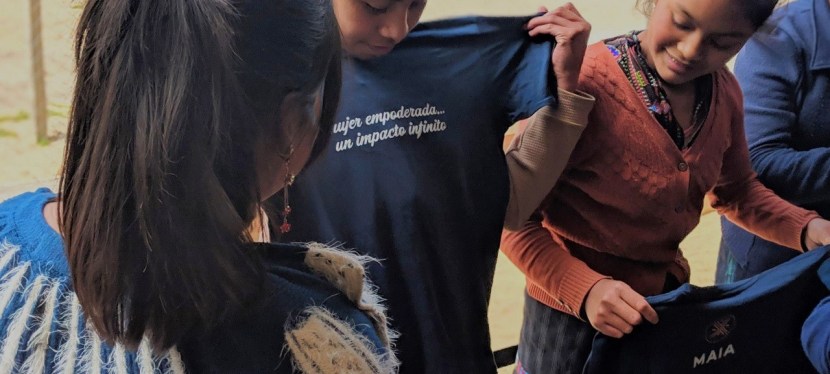
It turns out, there isn’t a good practice in most developing countries for handling basic health education on this issue. In many countries, girls miss school, are sent to huts together to wait out their “time,” or sit on a piece of cardboard alone in a room until it’s over. Every single month. I only figured this out recently when one of the women I was traveling with in Guatemala brought kits from Days for Girls to distribute to the students at the MAIA Impact School.
Do you understand how vulnerable a group of girls in a hut alone could be? Or how much school is missed when this happens every month? Or, simply, how unhygienic it is not to have a means to deal with this, or a cultural support system to explain why it is happening and what it means? Does teenage pregnancy in these circumstances, inequitable educational attainment between girls and boys, or high maternal death rates really come as a surprise in a world where this completely natural and necessary process isn’t discussed, in many cases is feared, where tampons, pads or pharmacies don’t exist, and where earning $50 per week is more the norm than the aberration?
To begin to address this problem and solve the many ancillary issues it creates, Days for Girls (DfG) developed reusable sanitary supply kits that are hand-made in the United States by individuals and groups committed to creating change for these girls. Sewing groups gather regularly or sewists work independently to make pads that can be discreetly hung on a washing line to dry and that last for approximately three years. The design has evolved over time – 28 different iterations to date – into an effective, durable, reliable and environmentally friendly product. Over the years, Days for Girls has earned the trust of village elders and other decision-makers, winning some semblance of freedom for girls worldwide.


Wisely, these kits aren’t just distributed to anyone who asks. Days for Girls requires the person distributing them to be trained and to teach the recipients about how to use the pads and care for them properly, but also about what is happening with their bodies and why. Kits go where people involved with Days for Girls travel. The number of kits available depends on how many each chapter is able to produce.


My local Days for Girls chapter sent this recent status update: “212 kits will go to Uganda in a week, to help girls stay in school. 10 kits will head to Guatemala in July as a pilot project. 10 more travel to Zambia soon. The last 20 will be donated to Days for Girls’ refugee project. They will be taking 11,000 kits to each of three refugee camps. Imagine fleeing your homeland and arriving somewhere unfamiliar, then living in a camp with thousands of other people, none of whom have access to sanitary supplies. The conditions under which many others live is challenging, to say the least. We hope to relieve some of the misery. The kits have been extremely well-received in the camps in which they have been distributed in small numbers in the past. We will also be sending some kits to Ghana in December.”
I am astonished both by the thoughtfulness and impact of this program as well as by my own ignorance. The provision of these basic supplies has an immense effect on a girl’s well-being, dignity, and potential. Globally, countries that have greater levels of gender equality are safer and more prosperous (World Economic Forum). Educating girls is also among the top forms of combating climate change (The Unsung Solution to Climate Change). In Guatemala specifically, “if women had equal economic participation, in 10 years the Guatemalan GDP would grow by 46%, or $40 billion, or $2,460 per person. In a country with an average per capita income of $4,060, that’s a big deal” (MAIA Impact School). Reducing the number of school days that girls miss matters enormously. This is a really big deal.
To follow are a couple of examples of videos from the Days for Girls website that more fully display the results of providing these basic necessities alongside health education. #daysforgirls #maiaimpact #girlsforgirls.bracelets
*Side note – I know it says unorganized, and I get now what it means (no local, incorporated municipal government – essentially vast swaths of territory with very few human beings), but in my early days in T2R9 I kept thinking the word was “disorganized.” I remember thinking what an odd way that was to describe a place, but, fine, own it, you disorganized territories. Whoever heard of moose and black bear getting organized anyway. That may just be me and it may only truly be funny when you’ve been living in the woods with the same 8 people for months on end, but it still cracks me up.
Update – check out legislation that just passed in New Hampshire! Lack of access to feminine hygiene products should never keep girls out of school – in the US or anywhere else!
Article: https://www.huffpost.com/entry/new-hampshire-passes-bill-requiring-free-menstrual-products-in-all-public-schools_n_5d31bd0de4b0419fd32bd119


 Put Your Own Oxygen Mask on First