Legacy and Impact

My mom passed away earlier this month. I realize now that her legacy isn’t just in what she did during her life, it’s in who I am in mine.

As with so much of our Alzheimer’s journey, it was a slow moving end. She was just subtly different one day to the next and I found myself in a strange(r) waiting period for several months. I spent a lot of time sitting with her – sometimes she was awake, but often she slept – and thinking. After all these years, my brain can’t understand that she is gone. I knew she was mortal – though she did have a knack for making me question that – but it’s still a complete mental doozy. Grief in the traditional form of reckoning with her absence from this Earth altogether sits in my peripheral vision. It’s there, but somehow I am not ready for it yet.

There are so many threads to pull on from these last several months that merit further reflection, but the most revelatory at this stage for me is the idea of my mom’s legacy. I have always known how much I loved my mom and how deeply she cared about me and my brothers. Through the lens of her life in review, which somehow only became more accessible when the end was approaching, I see more clearly what she passed on to me. There are obvious things, like my eye color and my curly hair. And then there are the more subtle, nurture things. As I worked to capture who my mom was in her obituary, all the ways she served her community became abundantly clear. I was telling someone just yesterday that one of the first things I did when I got to college was to join the student volunteer center. It struck me then how my mom quietly did her thing and influenced the person I became without me even really noticing it. In other ways she was more overt. I have thought a lot over the years about how freaked out she was when I took a semester off from college. She worried that I wouldn’t go back. All this time I’ve maintained the narrative, “Didn’t she know me at all? I was always going to go back.”

But, now, I see it more clearly. It didn’t have to do, exactly, with knowing me. It was about what she wanted for me. She did everything she could for our entire lives to make sure my brothers and I had a smoother path and better opportunities than she did. She graduated from college when she was 49 years old. I was 16. It could not have been easy with 3 kids, our endless sports schedules, and her school work – and yet she still managed to get us where we needed to be and to put dinner on the table. She wanted me to finish college while I was still young and unencumbered, to just have that college degree in my back pocket.

It makes me think about the parents of the Girl Pioneers at MAIA that I work with in Guatemala. By choosing to educate their daughters, they chart a different path for their families with the hope of improving the future for the next generation. This path is unfamiliar to them and requires real courage, commitment and selflessness. But they want better for their children so they take a chance on this opportunity.

Several years ago MAIA ran a fundraising campaign called Nim Mama, which means “Great Mother” in the Maya Kaqchikel language of this region of Guatemala. The campaign focused on honoring mothers and their collective strength, beauty, and transformative power. The images of the pioneering, brave girls of MAIA with their mothers at their side brought me to tears. They reflected back to me my own mom’s strength and guiding light and reminded me how important my education was to her.

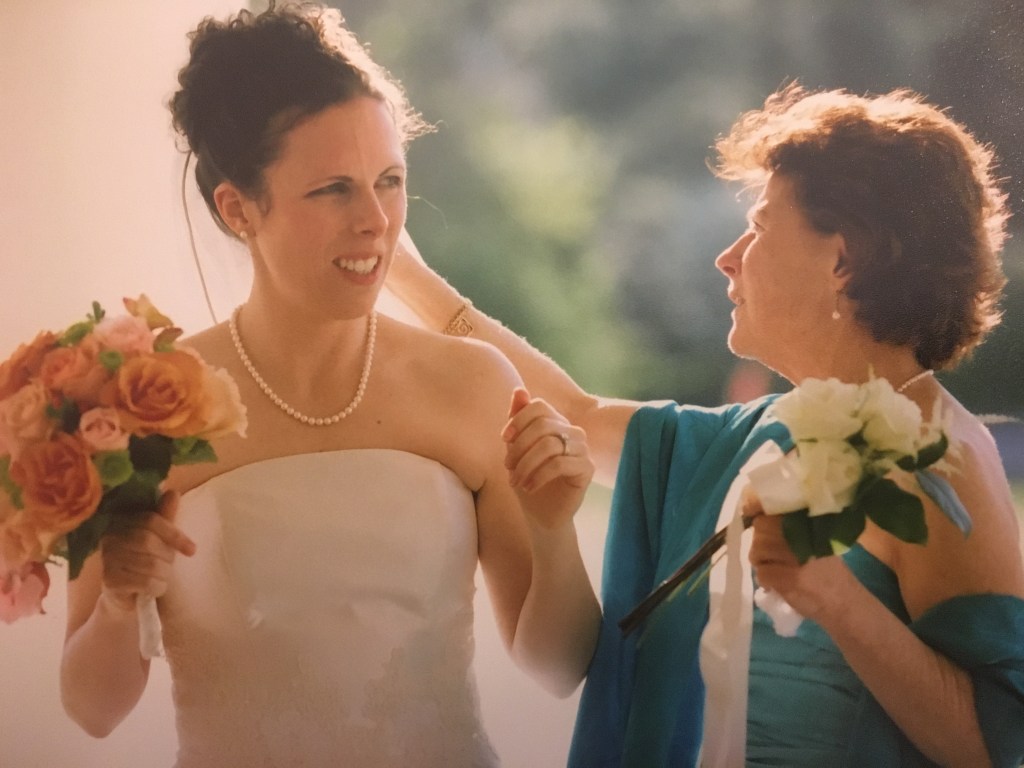
As I go through old photos of me and my mom I think about the legacy of what she gave to me. She stood alongside me, literally or figuratively, my whole life in the same way that the mothers of MAIA stand alongside their pioneering daughters. I realize now that my mom will live on through me – in who I am, in how I tell her story, and by paying it forward like she did so that the next generation has more opportunities and a smoother path still than I did.

I am the same age now that my mom was when she graduated from college. I have two great kids and a loving husband. That college degree that I earned at 22 has opened doors for me. As her primary caregiver for the last decade, our roles reversed for a while as I became more and more responsible for her well-being. I accompanied her to her last day on this Earth to the best of my ability. And I know she is proud of all of these things. It helps me to imagine that she can see it all now and can feel really good about how well she guided my way.

I turn 50 next week. As my way of celebrating my 50 years on this Earth as well as the nearly 50 years I got to spend with my mom, I’m raising funds for MAIA. Paying it forward for the next generation is the best gift I can imagine receiving. Please consider joining me. https://donorbox.org/meg-s-50th-birthday-fundraiser-for-maia-guatemala
Let It Snow – Even in August

All through the fall, my son poured time and effort into learning a piano piece for his winter recital. He was ready to share his music, but a schedule conflict meant he couldn’t perform. He’d worked so hard on his piece, it was a shame he wouldn’t be able to share it.

“I bet you could play at Grammy’s place if you wanted to perform with an audience,” I suggested.

To my surprise, he was willing to try it. It took a couple of months to facilitate making it happen – volunteer paperwork, CORI forms, scheduling, etc. – but then he was added to the entertainment roster to play on the memory care floor for about a half an hour every-other-Sunday.

As I’ve shared before, my mom, who has Alzheimer’s, has lived on the memory unit of her care home since she started needing 24/7 care seven years ago. Our/her trajectory appears to be an anomaly. She has incredible staying power and a bright spirit that’s impossible to extinguish. But this journey can be emotionally exhausting at times. It can be a struggle to connect with her in any sort of meaningful way. We have lost the back and forth quality of a traditional relationship where each person contributes a part of themselves. Though the metaphysical cords that connect my mom’s heart with mine will never break, as the years with Alzheimer’s have gone by the way we engage with each other on this Earth has an increasingly gossamer-like quality – wispy, ethereal, and easily split and broken.

I often think there’s nothing new to be seen or done with my mom. We’re just here, in a moment, one part biding our time, one part just surviving, and one part seeking the sweet in everything that we still have because we still have something (and what else can we do?). I keep showing up because I promised her I would and she deserves all the love I can give her – plus you never know when the last time will be. Surely when she passes away it will still feel like the time I devoted to her wasn’t enough and I’ll want to go back and be part of every minute I missed. Even knowing that day will come I still cycle through the full spectrum of feelings – many negative – about our situation. Visiting her can be very lonely, that’s just all there is to it.

With that as context, my son and I arrived one Sunday morning in March for his piano performance. He was still wiping the sleep out of his eyes and I was nervous because I am a people-pleaser and I was hoping this wasn’t a bad idea. I know it’s hard to visit my mom and the memory care floor in particular. I know there are unfamiliar – and sometimes unpleasant – smells and that there are people who do and say unexpected things or make strange sounds. There are lots of wheelchairs and walkers and hoyer lifts. I also know that this is not the Grammy who baked cookies with him and watched him play soccer and read bedtime stories to him about a tickle monster and then tickled and tickled him until he couldn’t breathe. I had decided a long time ago not to force my kids to visit their Grammy. They were really happy to be with her in the earlier days of Alzheimer’s and then they weren’t anymore and I understand that. It’s not easy for me, either.

The staff had gathered a small group of residents around the piano with my mom’s wheelchair right next to it. We said hello to Grammy, who was awake to my surprise and happiness, and then stood there awkwardly trying to gauge what to do next. After a couple minutes my son sat down at the piano, I muted the TV, and told him to go ahead. He dove in with the first piece that came to mind from memory – Let It Snow. The staff who were passing by in the hallway and I looked at each other in silent agreement, “Please no more snow.” But the residents? They loved it! Most don’t leave the floor and are not oriented to day or time so, for them, Let It Snow is simply an upbeat song that triggers fond memories buried deep in the mind. No winter fatigue for them. They clapped. They sang. They shimmied in their chairs. They smiled.

He played a few more pieces – from Viva La Vida by Coldplay to Axel F from Beverly Hills Cop. And then he froze. He turned to me and whispered, “I can’t remember how this one I’ve been working on most recently starts.”

“Just start where you can remember, even right in the middle, like when you practice at home. They just like to hear the music. “

And so he started where he could remember. And they were thrilled.

“Wonderful!” “Bravo!” they exclaimed.

My mom? She tapped her toes and her leg up and down to the beat. She raised her hands in the air like a teen at a rock concert. She smiled. She was alert and engaged. She tried to sing or talk. My son’s music manifested a clear response in her. It felt like we three were directly connected, almost in conversation, in a way I hadn’t experienced with my mom in a really long time. I know she has always loved music, but this was a completely unexpected, direct relational back and forth with her. And she was so happy.

As for my son, he discovered that he really likes playing for his Grammy and her neighbors. He goes on a weekly basis now. They are thrilled all over again every single time he comes. Let It Snow begins the recital every week, even in the middle of August. And next week, we will do it all over again in exactly the same way and the reception will be just as warm, engaged, and happy.

And me? Being with my mom as we walk this journey remains the most beautiful, burdensome blessing. I am so grateful for having a chance to discover a new way to connect with her and to feel joy together that I hadn’t yet experienced. Not only did this moment touch me deeply in my soul and fill me with emotions that are difficult to put into words, but the whole recital was an awesome example of people showing up for each other as their best selves – open and joyful, without judgment, making and enjoying music together to the best of their abilities. Every single person in that room contributes to joy and meaningful – even if momentary – connection. This recital time has presented a newness to how I engage with and relate to my mom, a balm for my caregiver fatigue and loneliness, and the kindling of a small, hopeful flame in my heart that has fused part of the fraying threads to my mom back together.

Is Being Stuck the Same as Finding Stillness?

The theme of my first poetry/writing class was Stillness. Finding stillness seems like a good idea in this whirlwind world. I often think it would do me some good to find a little stillness in my busy mind and can’t-sit-still body. I get the idea. But I went to a dark place with it, and all I could think about was being stuck. I had to ask, after reflecting on it for a couple hours, if being stuck was the same as finding stillness?

These last months I have been living ever more into the bittersweet of life, the tide carrying me along in a daze. My kids are growing – literally inches before my very eyes some days. And my mom keeps on beating the odds and crushing life. Except, in her case, I ask myself more and more often – why? She isn’t living the life she would have wanted. She wouldn’t recognize much about herself currently, though her loving heart, joyous spirit, and beautiful laugh remain in tact. I tell people all the time that since Alzheimer’s started affecting her she remembers what’s in her heart way more than what’s in her head. I’ve felt that to be true, and didn’t realize that Tennessee Williams is quoted as having said,

“Memory takes a lot of poetic license, for memory is seated predominantly in the heart.” – Tennessee Williams

It’s neat to think about memory living in the heart for someone who is severely cognitively impaired and doesn’t have a memory in the traditional way we think about it. It’s a gift that my mom has such a loving disposition because she doesn’t say much, certainly not much that makes sense. A lot of the time she has this far off look and I have to work to get her to focus on my face. So it’s not the most interactive relationship, and yet, she still exudes love, which is gratifying and heartwarming.

I wonder sometimes if her stillness in time is stuckness. The world keeps on whirring on by her and she remains essentially the sane and completely oblivious to it. I know I certainly feel stuck right smack dab in the middle of the sandwich even as the world keeps whooshing right on by. I heard someone on a podcast recently say that a sandwich is too generous a term, referring instead to this stage of life as more of a panini. Call it what lunch item you will, I’ve been in this for a very long time and this past summer I officially hit the summer of my discontent. Shakespeare may write about winters of discontent. I can tell you, no iambic pentameter involved, that this rainy ass summer stuck between kids launching and mom lingering, was discontenting. Probably not for the first time. Nor the last.

I’ve been caring for my mom for 10 years. TEN. During that time my kids went from babies to toddlers to teens. They are growing, launching, evolving. My role in her care, what it requires of me, and how I navigate it, have all changed and evolved during this time as well. And, sure, my mom has changed, too, but not in any good ways. She’s still alive, and she still gives love, but she also has no agency and isn’t part of her kids’ or grandkids’ lives. She is physically here and simultaneously absent. She’s the most present absent person I’ve ever met. She has missed it ALL even though she is literally, physically, right down the road. These last months I’ve just been stuck on the tragedy of that and the purgatory of this responsibility as well as my grief.

It’s the dawn of the summer of 2025, and I am just getting around to editing and posting this piece that I drafted in 2023. That tells you without any words required what life is like stuck in the sandwich! I recently read Mothers and Other Fictional Characters in which the author, Nicole Graev Lipson, shares the Portuguese word “saudade,” which translates roughly to “the presence of an absence, the ache that replaces what’s gone.” That’s such a perfect way of describing grief (I called it The Void in a previous post). It’s feeling the presence of the people we have loved who have departed this Earth fully. In my mom’s case, I actually live with the absence of who she was every day. Saudade.

Saudade – the presence of an absence, the ache that replaces what’s gone – page 20, Mothers and Other Fictional Characters by Nicole Graev Lipson

Anderson Cooper’s All There Is podcast talks a lot about grief, too much for me, to be honest, because I get it and I typically look to podcasts for an escape. But the title of the most recent one, Love is What Survives, struck me because that just makes sense. The pain we feel in loss is love with nowhere to go. I am grateful for having been so loved. And that helps move me forward and feels the slightest bit like the stuckness, for now, is melting.

“The most painful state of being is remembering the future, especially the one we will never have.” –  Søren Kierkegaard

Ah, and if you made it this far, to answer my own question, no, I still cannot sit still so apparently being still and being stuck are not the same. In fact, sitting still would allow me to write more blog posts. Being stuck prevents me from doing so. Somehow being stuck gets in the way of the emotional and physical stillness of the mind required to create. Or that’s what I think anyway. Since I seem to be finding room to write again, it seems whatever blocked me mentally for the past two years has shifted. For now! Always, just for now. One day at a time.

Crossroads and Goalposts…or Two Roads Converged (at the Racecourse Ground)

You know the Robert Frost poem The Road Not Taken, where two roads diverge in a wood and Robert Frost takes “the one less traveled by and that has made all the difference”? It’s one of my favorites. I’ve always been that person taking the road less traveled – and I am certain that those choices have indeed made the biggest differences in my life.

But, lately, I’ve been thinking less about diverging paths and more about what happens when roads converge, when parallel lines inexplicably but inevitably meet at the vanishing point, when connection happens in a place and time that seems to be almost predestined. That’s magic.

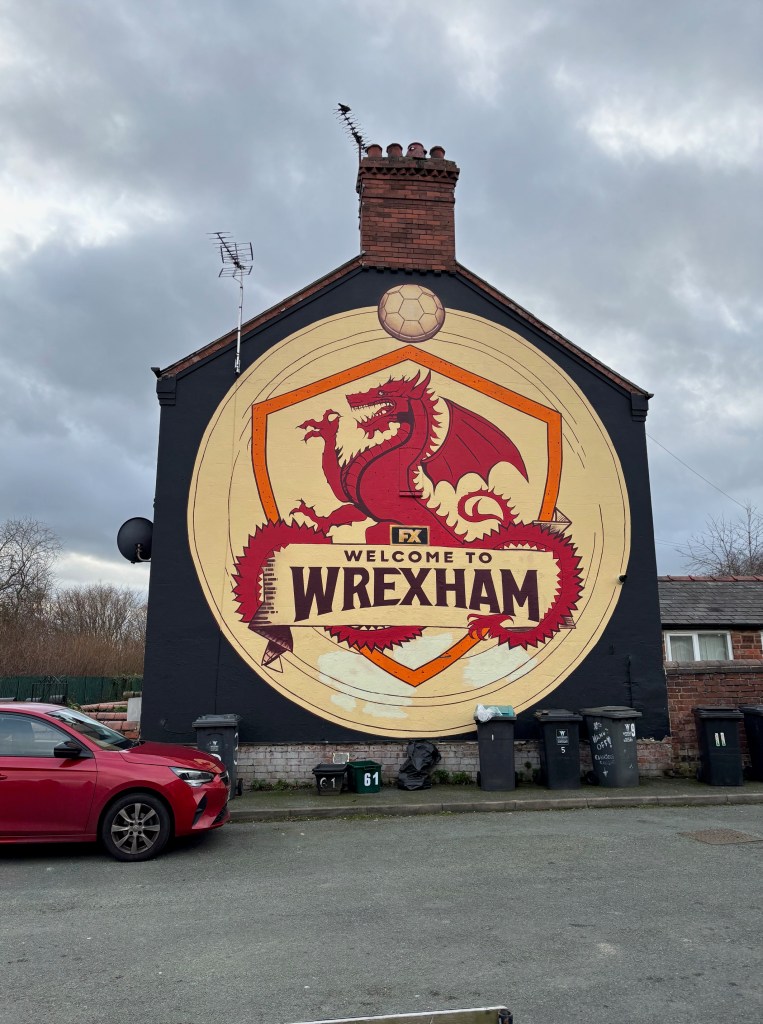
I don’t usually write about a TV show. Heck, I barely watch TV. It’s rare to find a show that everyone in the family enjoys, but sometimes a show captures your attention and your heart and doesn’t let go. For our family, that’s been the case with Welcome to Wrexham. If you haven’t watched, here’s the quick version: it’s a docuseries about the Wrexham Association Football Club (AFC) – aka soccer – in North Wales – the oldest club in Wales and third oldest in the world – that was relegated (i.e. demoted) due to poor performance season after season. They got stuck in a low level semi-professional league for almost a decade and a half. The club was bought several years ago by actors Ryan Reynolds and Rob McElhenney, who are attempting a fairytale comeback and documenting it as they go. Kind of a real life Ted Lasso.

It’s not just about football or I would have checked out long ago, I am guessing. What makes the show special is how intrinsically linked the football club is to the community and the community to the club. Wrexham is a hard scrabble community that’s a bit down on its luck, quite like their football club. But they are a people who show up and cheer for (in their own special vitriolic way, as the case may be) their hometown team even when they continue to lose and disappoint. These are fans who live and breathe their team. They are a community that has gone through tough times economically and remain proud of and committed to their town, region, and sense of place. Wrexham is a place where people help each other out and make their own luck because nothing comes easy so they brew a cuppa tea and carry on with it.

If that sounds familiar, that’s because it is.

I grew up in Philadelphia, a city that is equal parts heart, hustle, and heartbreak. It can be tough, resilient, a little rough around the edges, gritty, and always full of character (and characters). Both Philadelphia and Wrexham are towns with deep history and beauty (as well as a touch of piss and vinegar). Both have been underestimated, overlooked and written off too many times. They also both feature crazy (okay, enthusiastic) sports fans, for whom every loss is personal. A guy I went to high school with once said that losing in sport was “the Philly man’s destiny.” Ouch – and also not entirely wrong. The history of sports heartbreak pervades the local consciousness. Still, sometimes, despite ourselves, we actually DO win, and then all hell breaks loose (in Philadelphia, the all hell breaking loose part happens win or loose).

So, yea, Welcome to Wrexham is fun and also it hit a lot of familiar notes.

If this were any other underdog sports story, though, I would have moved on by now. But Wrexham is different and this one stuck. Why? Well, props to the formidable force that is their marketing team, let’s be honest. And, also, of course, the Rob McElhenney/Philadelphia hometown connection is a blast. I get a kick out of the Philadelphia Eagles cameos and the description of the green Wrexham jerseys as “Philadelphia Eagles green.” Plus, would you believe that my neighbor in Boston grew up in Wrexham? You can’t make this stuff up. That’s a lot of roads converging. What do a Philly girl and a girl from North Wales have in common? A lot, it turns out!

The story of Wrexham AFC is not one just about sticking together and overcoming adversity no matter the circumstances, though it is those things, too. It’s about finding hope where and when you least expect it and rewriting the narrative. Welcome to Wrexham is the lens through which this journey is shared. It provides a window into life in North Wales and a proximity to a local football club that Americans don’t typically have access to. It invites viewers to feel part of a storied team that is the beating heart of a historic, resilient community. Wrexham’s magic is in building bridges and forging lasting connections, both of which are bigger and more enduring than the show. And connection, like I said before, is my driving life force.

Up the town!

Diolch (thank you!), as always, for reading.

Memories and Mommas

It’s been a (very, very, very) long time since I’ve sat down to write.

I used to take the wee hours of the morning for my writing time, rising before anyone else in the house was awake to get my thoughts down. Revisions can happen later, but inspiration and the time to get it down only seems to happen for me before the day takes off on it’s own. Now that I recognize how important defragging the ole motherboard (aka the brain) is, I prioritize sleep. And there is only so much time in a day. Plus maybe I have been having trouble making myself sit down to write alongside a dose of writer’s block and a springling of hopelessness for the world. Deep sigh.

BUT, I’ve updated the site’s Dementia and Caregiving Resources so I wanted to say check those out.

And, while I’m here, and because it’s Mother’s Day (in the U.S. anyway) and because I think about Alzheimer’s all the time when it comes to my mom, I’ll reflect a little on the love and loss that this day embodies for me (and, I presume, many of us in one way or another with mom’s gone too soon, mom’s lost to dementia, mom’s that were never the mom you hoped for…it’s complicated).

My mom was one of the greats. I am so lucky for that, surely even more than I realize. I continue to unearth the treasures of my past that she saved on my behalf. She was family first 100% and she showed up and cheered for her people reliably, consistently, always.

And also, it wasn’t perfect. She got on my nerves something fierce sometimes. We did not operate the same way – at all. There is no to do list that stands a chance against me. My mom would begrudgingly make a list and then lose it somewhere between home and the grocery store.

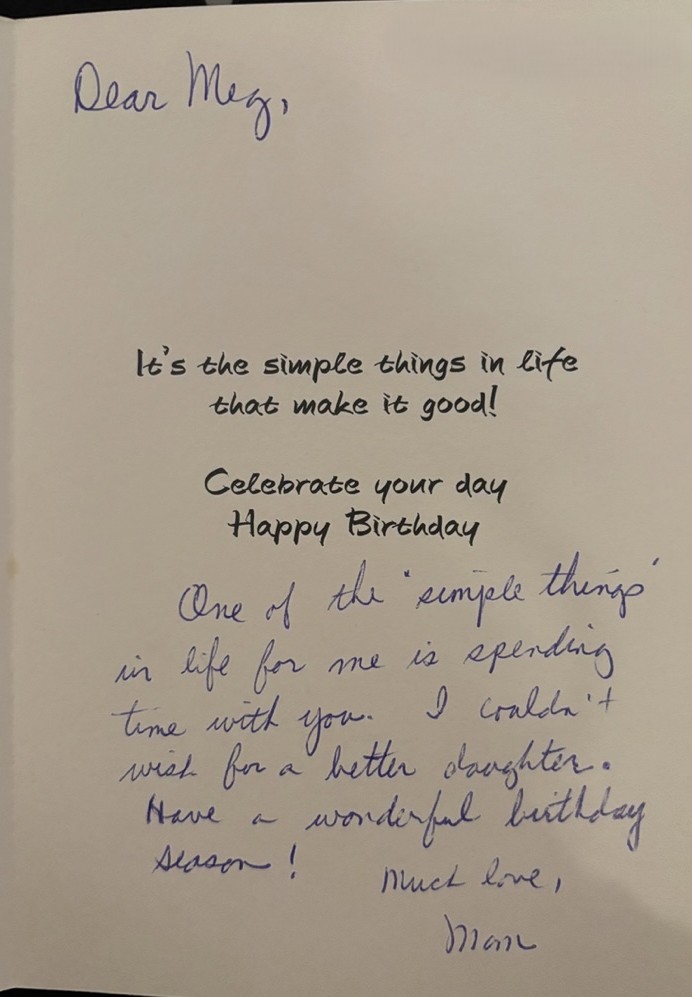
I think about all the ways I could have done better by her. I’d start by wiping the scowl off my face in her college graduation photos. I was in 11th grade and I couldn’t understand – not even close – what it took to finish college on the cusp of 50 with 3 kids and a household to run. I also think of her every time I unload the dishwasher. I wish I could tell her I am sorry for all the times I took a clean bowl out of the dishwasher and left the rest, as though I didn’t know who that chore would fall to. I could have done better. And also I was a kid and I own my selfishness and recognize that one of the blessings of a mom like mine is that she loved me even when I was at my worst. What I lost is the opportunity to tell her, “I got mine, mom. Ha ha! Karma is a bitch.” And then she’d smile and we’d laugh. Clearly from the birthday card pictured she only dwelled on the best in me – and we did have part of my adult life to enjoy each other’s company and make up for my teenage transgressions. We traveled around Europe together for two weeks when I was in my mid-20s and she told me she had to pinch herself that I wanted to spend so much time with “your dear old mom.” It was a gift, in both senses of the word. Sometimes I let myself dawdle at the precipice of imaginings about what the last 14 years could have been like for me and my kids, but that generally leads to a vice tightening sensation around my heart and lungs so I tamp it down. When did that kind of thinking ever lead anywhere good?

Oh, my mom is still here. But she’s so far gone. She deserves better than the indignities Alzheimer’s has thrown at her, slowly robbing her of her memories and her agency and everything that made her her.

I’ll be precise. Not exactly everything. She does still smile and sometimes she laughs, too. She still taps her toes to music and raises her arms in the air as though she is conducting an orchestra. She is still loving and wants to be loved. Those things are all authentically her. In fact, perhaps the most remarkable thing about my mom is that her Alzheimer’s journey has been the epitome of grace. Somehow, despite having aphasia and being on the severe side of the cognitive impairment scale when we moved her into memory care, she has managed to create connection and to build relationships. The caregivers and nurses at her facility truly love her. It’s remarkable that she has been able to affect people in this way, to somehow remain her outgoing, loving self and make a bond with others, despite everything.

And by everything, wew, let me tell you, it’s a lot. My mom is dying a slow death by a thousand cuts and indignities. As am I, emotionally. She’d be so pissed if she was of sound mind and she walked in to see herself now. I know this and there’s nothing I can do about it. I just keep showing up and showing her love no matter what, like she always did for me. I hold her hand, I clip her nails, I feed her pudding and chocolate chip cookies. And there’s real and unexpected joy in these little moments, seeing her take pleasure in those things (specifically the pudding and cookies). It’s very clear that she enjoys these treats – her eyes soften and glimmer, she chews with her mouth closed, slowly, savoring the moment. She is happy and able to experience joy. I try to find peace in this reality.

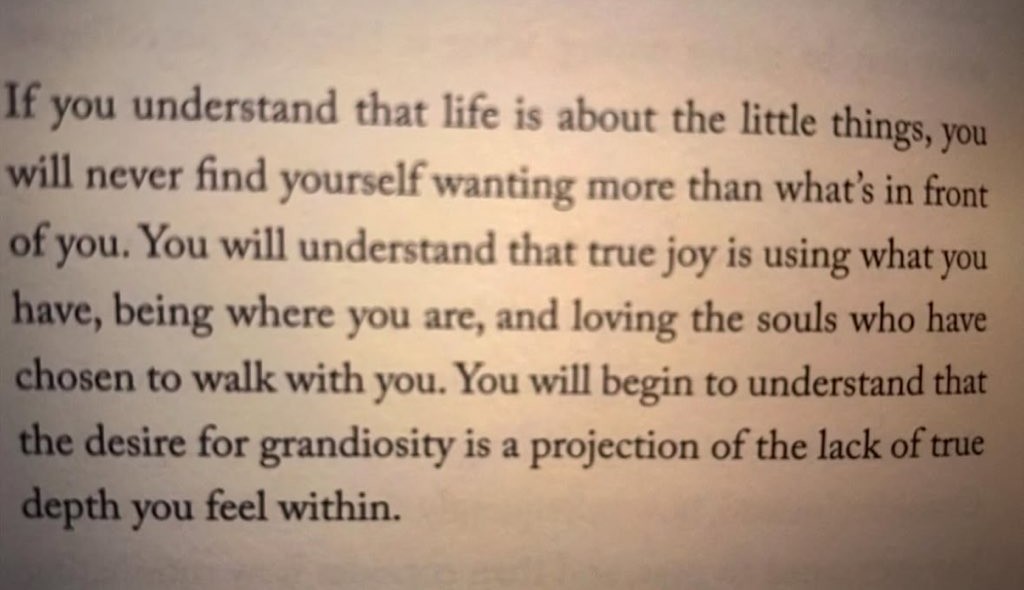
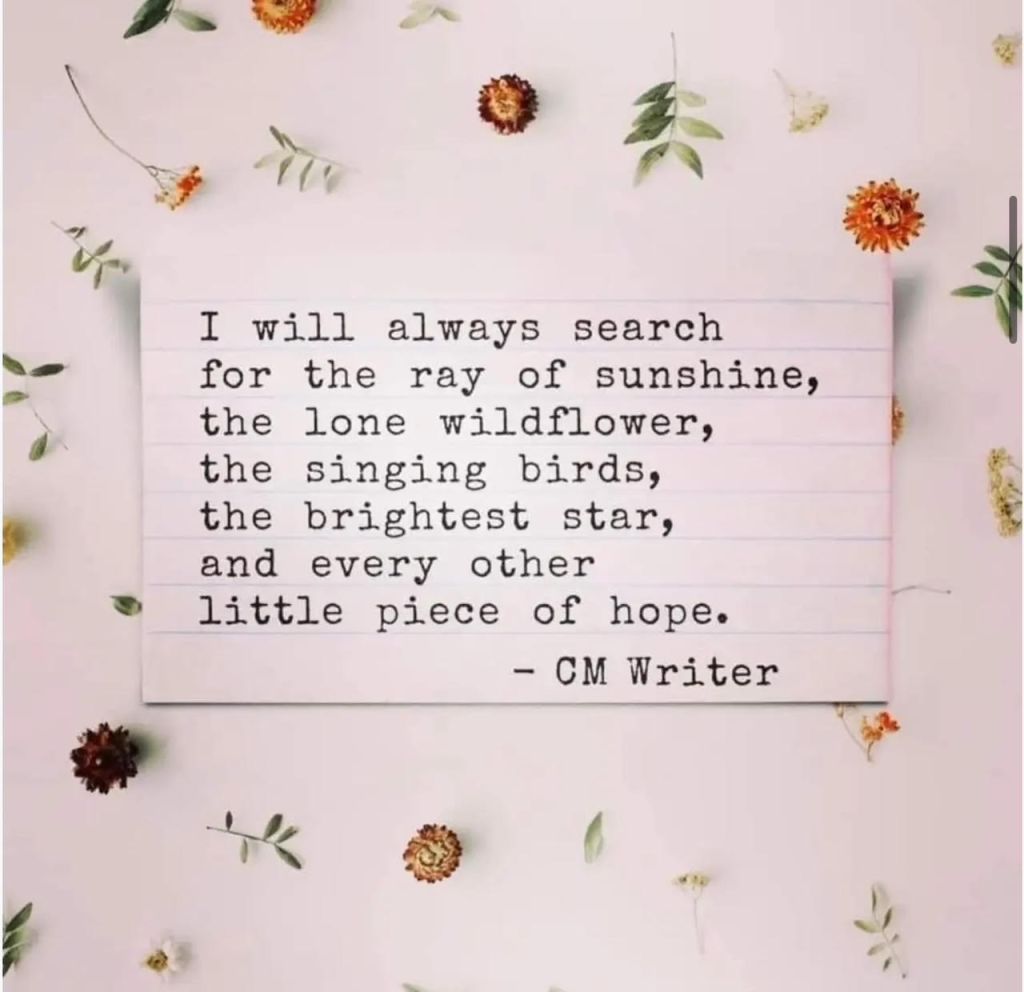
I have grieved aspects of my mom in multitude different ways over the last 14 years since concerns about her memory were first raised. It’s astonishing that you can grieve and plateau and then something new happens and you grieve again, but differently. And yet this grief has no closure. I’ve been told that there is more grief to come when she actually departs from this world. It’s a pretty stunning thing to grieve someone for 14 years and not even have started yet. Sure, I’ve adapted over time to wherever she is in each stage of this disease. I’ve learned to make conversation with myself and nod and smile to her nonsensical words since she has been nonverbal for so long. I try not to notice the crumbs scattered all over her shirt and lap, or that she’s not wearing her own clothes the majority of the time. Sometimes my inner narrator gets angry, as though her tenacious hold on life is some sort of punishment of me. But I know rationally that she would never want this for herself, let alone for me. Her body and a version of her spirit just keep going for some mysterious reason, and I keep trying to find new ways to sustain my reserves, to adapt, to love her, to live in the moment, to focus on the simple things, and to keep going, too. Just like my mom taught me, and teaches me still.

Don’t You Forget About Me Part II – Memory (and Mortality) on My Mind

It is ironic that, if you’re lucky, you’ll end up getting old. And, yet, most people (Americans, anyway) are in complete denial about it. The vast majority fight any changes to their lifestyle until they find themselves in a full-on crisis. Human nature? A fighting spirit?

Letting go of a phase of life is hard, especially when accompanied by stubbornness (that is possibly – probably? – driven by grief and fear). Amusingly, from my observations, there is also a dose of ageism and othering, as in, “old people live in ‘those places’ and I don’t want to be surrounded by old people” (to be fair, given that I continue to think I am 25 and that ship sailed a couple decades ago, I can see more clearly now how this cognitive dissonance could happen). And then, of course, there’s our culturally-driven death denialism. This excellent TED Talk and NPR story – Death Is Inevitable. Why Don’t We Talk About It More? – lays out very honestly the reality that life and death go hand in hand. What are we afraid of?

I get that it’s hard to face a future where you might be less capable than you are now. Or dead. But, also, if you don’t approach that future proactively, you put someone who loves you (or is responsible for you) in a position of having to do it for you. And what’s really not fun? THAT. Because being in a situation where a decision is made for you doesn’t feel great for anyone involved.

The website and podcast Best Life Best Death provides great insights and resources for these types of discussions and decisions. It turns out that as scary as it might be to think about, it’s actually quite empowering to face into it. Atul Gawande’s book Being Mortal: Medicine and What Matters in the End, similarly, discusses end-of-life care and aging, specifically with the lens that medicine CAN – and often does – prolong life, but it doesn’t distinguish between quality versus quantity.

One aspect of aging that Gawande discusses that resonates with my lived experience is long-term care. This can be achieved through in-home care or a care home/assisted living-style place. In-home care can work up to a point – it depends on how many hours of care are needed, if there is more than one person in the home, if you can find good caregivers. With in-home care the vetting, hiring, firing, and oversight of caregivers falls on the family. In a care facility, that level of management gets taken care of. In my experience, the economies of scale flip dramatically toward a care facility when overnight care is required. As I mentioned in my first post on long-term care, it is a big, complicated, and multi-faceted subject.

Gawande notes that the traditional nursing home, which is probably what comes to mind if you are 30 or older and haven’t been in the trenches of caregiving in the last decade, focused so heavily on resident safety that the living environment was, well, institutional – personality-less, depressing, and uninspiring. More and more community-focused and less institutional options exist now, like the one in the Netherlands highlighted in the NPR episode I spoke on several months ago (link) or the one in France (link) or the one in Canada (link). They may not exist in the U.S. in the distinct forms reflected in those examples, but there are definitely independent and assisted living communities that nurture the same kind of vibe. Where my mom lives, for example, though it’s not a village design per se, residents move about freely, have choice with their daily meals and activities, and staff provide creative programming to keep residents engaged (ie no one is sitting in a wheelchair in a hospital-like corridor staring into space for hours on end).

These communities answer the concern of not wanting to be isolated, institutionalized or separated from the rest of society as we age. For people of sound mind right up to moderate dementia, they are a downright dreamy compromise between maintaining one’s autonomy and agency while living in a place that fosters community and can handle the inevitable issues that arise as one ages (falling, complicated medication management, mobility issues, impaired driving, etc.). And that’s great.

BUT, when you are talking about someone with Alzheimer’s or dementia, it’s a whole different ballgame. As those diseases progress, the bucolic concepts of integration into an age-diverse community and free-will are just not realistic.

I really stumbled in Gawande’s book and in listening to the NPR piece about adapting care models in the US over this issue. It’s this grand philosophical abyss: what happens when a person no longer has the ability to make decisions for themselves, but also isn’t actively dying any more than the rest of us? There isn’t quality to preserve or new memories to be made or even old memories to review. It’s just an existence. My mom has all the free-will in the world, but doesn’t move of her own volition. She doesn’t speak or make any decisions either. She is well-loved by her care team, her needs are met, and she seems happy. Which is an enormous relief for me. But, if she weren’t, and many aren’t, what really can be done about it? It’s much more fuzzy from this vantage point to expound upon what matters most in the end. The end, when it involves dementia, can be quite a lengthy state of pending for all involved. I’ve taken to calling it grief purgatory.

There is an absolutely perfect discussion of this challenge in a super funny/sad podcast called Let’s Not be Kidding. Episode 6 – The Bus Stop at the End of the World – sets up so much of what I have been trying to write about but keep getting tripped up over. Listen to minute 3:30 to 5:50 or so…it even mentions the, gulp, costs (which I will get into another time and, of course, impact many people’s proactive efforts – if you can’t afford a care home, what else is there to do but wait until the crisis comes?).

My mom has lived at the bus stop at the end of the world for five years. Even here, we used to go for coffee and for long walks in her neighborhood. She would join our family for Thanksgiving or Mother’s Day or just to visit. Now it’s a project to get her from her bedroom to the community room. It’s a continuing evolution to less. I consider the village style residences and the premise of changing long-term care in the U.S. for people with dementia, as discussed in the NPR episode I was interviewed for, and I’ve decided that we have to face the fact that there are two different situations happening here. One is early stage dementia or just a nice, older person trying not to be a burden on their relatives and choosing to move to some sort of retirement community. And then there are the locked floor stages of dementia and Alzheimer’s with assistance required for all activities of daily life. And these are vastly different. The needs of the patient as well as the families throughout each of these stages and levels of aging and caregiving are also vastly different.

Oddly, the most held I’ve ever been in this decade-long journey was when my mom was on hospice and seemed to be actively dying (spoiler alert: she didn’t). It was the early years when we suspected Alzheimer’s and just after her diagnosis when I really could have used the knowledge, understanding, and support that comes with hospice. I had literally no idea where to even start in those days. It’s been 10 years now and I speak with people every few months who get sent my way one way or another because they are facing similar questions and concerns and don’t know where to turn. Existing support systems – logistical, financial and emotional – are woefully inadequate. Families and caregivers across all income brackets need help to function – and to keep functioning for the many years that these diseases interrupt a life – until someone figures this whole dementia issue out.

I haven’t even gotten to the part where the needs of dementia patients are 24/7/365 and typically beyond the capability of a single individual. And that universally across the US the number of domestic workers/health aides/caregivers is really low and the quality and reliability of these care providers is wildly variable, both for in-home care and at a facility. This is a profession that is traditionally underpaid and these workers need support to achieve adequate wages, health insurance, paid leave, job training, and retirement planning for themselves. If domestic workers aren’t treated with dignity and can’t achieve a living wage, how do we expect to care for our aging population as the number of people living with dementia increases?

I don’t know where the oxygen mask is in this post, but I felt all this needed to be said (and maybe that’s it, I just needed to put it out there and get it off my chest – surely there are others who are or will experience this, and there’s some solidarity in that). Adjusting the architecture, design, and ethos of care communities is surely one piece of the puzzle. However, as ever, fundamentally what makes a home are the people in it and how they care for each other. The people who are losing their agency, their families, and their caregivers need to be integral to and at the forefront of making long-term care better.

And, with that, I need to publish this thing once and for all!

Deep breath. Somehow, we got this.

On a Quest for Quiet

Hello and happy summer!

It’s been ages since I’ve managed to sit myself down and write. Quieting myself and settling into stillness are not strengths of mine, but I am working on it.

My kids have been away for four days, it’s 6:30pm, and this is the first time I’ve really sat and felt settled since they launched. Me thinks it’s not them that causes the whirring frenzy, perhaps, but me. That is good data. And, also, each day presents a new day to practice.

It’s funny because I vaguely remember vowing to myself in those pandemic months that brought the world to a stand still that I’d bring forward into my future life the lessons I learned then about finding quiet (inside me as much as around me) and saying no sometimes to preserve open spaces on my calendar. How quickly old habits return and suddenly life is leading me again versus the other way around.

Today, in this moment, though, I have found my way to quiet. And I am celebrating the calm that is washing over me, even now as I write.

To close I am sharing a poem that resonated deeply with me when its author, Rosemerry Wahtola Trommer, read it aloud to our writing group last week. I have turned to these words daily since. I hope they resonate for you as well.

Take a deep breath in….and then blow it out. That always, always helps. If only I can remember to do it.

In a Time of Much Doing

How soon I seem to have forgotten
how to be still, how to not plan,
how to step out into the day
and let the world itself write
the story of how a morning becomes
an afternoon becomes a night
becomes a woman.
How soon I seem to have forgotten
the value of not doing,
the gift of unscheduling,
the blessing of dipping my toes into the stream
of no time, then wading in full body,
where I remember I am part of an infinite story
at the same time I relearn how fragile it is,
this life.
How soon I forgot I could change it all.
Even now, I could be still again.
I could choose silence.
Even now.

Rosemerry Wahtola Trommer

The Directive of “Should”

Sometimes known as “shoulding all over yourself.”

I say “should” all day long. As in: “I should eat better.” “I should cook more healthy, homemade meals” – or the corollary – “I should get less takeout.” “I should write a book.” “I should be studying Spanish.” “I should be more disciplined (if I were I’d have written the book AND be fluent in Spanish.” “I should get some exercise.” “I should work full-time.” BUT ALSO “I should spend more time with my kids.” “I should be more present.” “I should write a new blog post.” “I should finish the stack of books by my bedside table.” “I should clean out the basement.” “I should be – fill in the blank – better, smarter, faster, more…” Except when “I should be quieter, more thoughtful, slow down.”

In sum, “I should definitely not sit still or pause to take a deep breath. ” Relax? Hahahahaha. PRODUCTIVITY is next to godliness. Or is it?

While none of the above cause obvious harm (except the part where I forget to breath in my pirouetting around) and all are fine aspirations (feeding my family healthy meals, for example, leans more toward the worthy obligation side of adult shoulding), the use of the word “should” results in a sentence that means something very different from the same sentence using the verb “want.” Not to mention that some of my shoulds are downright contradictory.

Look. Being busy and productive isn’t a bad thing. I like to be busy. It’s the tone of the busyness directive, and who is setting the agenda, that can be problematic. 

Should is an incredibly strong little word. Google tells me that it is a modal auxiliary verb, which I don’t remember ever having learned in my 8 years of Catholic school grammar (though, obviously, I SHOULD remember it and probably did learn it, if nothing else through example since Catholic teaching is based on should). Though should can be the past tense of “shall,” it is used primarily “to indicate obligation, duty, or correctness, typically when criticizing someone’s actions.” Trust me, should can be a powerful and judgy dictator. It implies that what you are doing really isn’t sufficient, and that there is more or better or different to be done. Like, get it together, you disappointment. Which is basically the shortest synthesis of Catholic school education there ever was.

When should is in charge, you cannot win.

Should brings even more heat when you move into the past. When you are shoulding yourself at least there is still hope that you could do or be better in one of the many ways you cajole and judge yourself.  The advanced phase of shoulding results in complete admonishment for the lost cause that is you with “I should have done X!” – ahhh, it’s all so obvious now, but it’s in the past and I really should have known better in the present. This tense of the verb is sometimes called the “modal of lost opportunities.” That sounds about right.

Like I said, some shoulds are necessary. And productivity is great. But it’s really important to bring awareness to what you are running around in service to and who is in charge of that action and directive that is key. Be the master of your own destiny! Also, saying no with no regrets is totally a thing. Or so I have heard.

Listening to oneself – really listening – is a rebellious act as well as an act of love. That’s my kind of rebellion (hashtag #shouldrebellion).