Finding Sanctuary

For years after having kids and while taking care of my mom, I had to modify what I thought my life was supposed to be to accommodate what it actually was. I spent far too long trying to shove the round peg that is me into the square hole that was my expectations of myself. Life intervened. Lessons were learned (painfully).

Eventually I let go of some things and I adapted. I left the working world and focused more on my family and my health. It was disorienting and I was consumed by guilt and grief because I wasn’t living the identity I had constructed for myself of being a “working mom.” A paycheck validated my worth and provided confirmation that I was contributing substantively to the world, as sad as that is to acknowledge. Without it, and without a title, I felt diminished and like my tether to and meaning in the broader world had shrunk. My life was fully in the service of others, consumed with sports schedules and camp sign ups, meal planning and doctors appointments. I craved purpose and passion. I got dirty diapers and dishes.

All moms are working moms.

a dear friend pulling me out of the abyss

I couldn’t accept for a while that this was a point in time, a temporary passage and where I needed to be for then, but not forever. I felt like I couldn’t hack it (and of course I assumed as I looked around that everyone else could and was doing “it” better than I was). What was “it,” you might ask? I am not even sure. Life? Work? Or, better, that most elusive work/life balance? My go-to mentality when I am up against a wall is that I must not be trying hard enough. But I couldn’t get out of my own way, and as most people eventually realize walls are pretty solid things. I remember reading When Things Fall Apart by Pema Chodron and wanting to chuck it against the wall after the 13th page because what she prescribed was to sit with my discontent, essentially, and what I wanted was a to-do list to fix it.

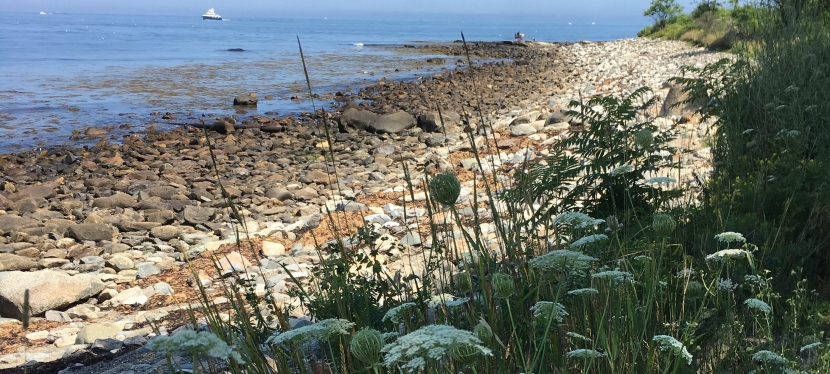
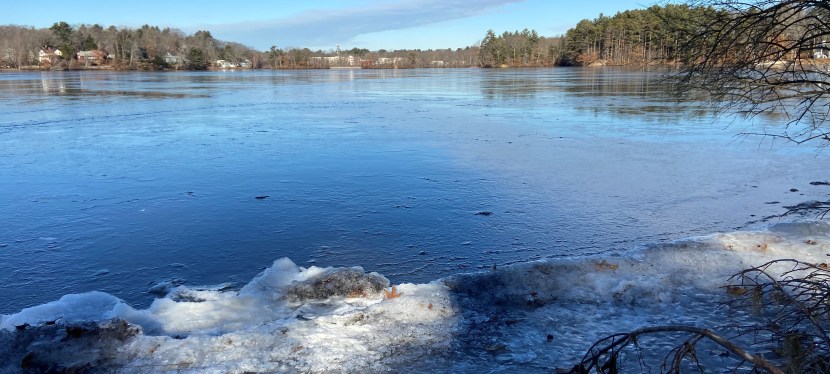
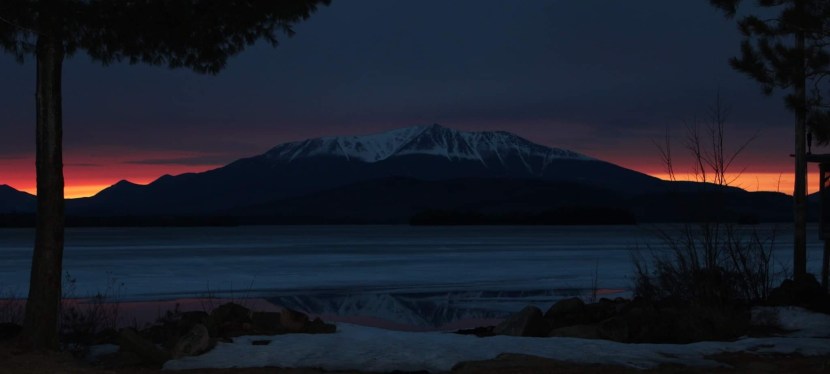
When the pace of life and the noise in your head gets to be too much, where do you find sanctuary? For me, there’s nothing like the smell of warm pine needles on a forest floor, the lapping of lake water against an evergreen shoreline, a boulder-strewn mountain rising in the distance, the stillness of sitting quietly by a pond. No cellphones, no crowds, no distractions. With headspace I can reorient and find my center again.

But for the longest time when my kids were young, I couldn’t travel. The place I dreamed of, Mount Katahdin in Northern Maine, was simply too far away and my life was too busy and too consumed by caring for others for me to disappear into the wilderness. Eventually I would institute an annual pilgrimage to Katahdin, but what about all the time in between? I learned to seek elements of Maine closer to home, and to find stability and happiness within. This is what Pema Chodron teaches, but it took me a while to accept it. It’s still a work in progress. I still get wound up like a top and overwhelmed by life. I still am my own harshest critic. But I find my center by carving out time for exercise; laughing with good friends (always reliable for grounding); being curious and just saying yes! to something new sometimes; taking a walk in my suburban wilderness (often now with my dog); and delighting in the little things like a crisp blue sky, flowers, or a box of cookies arriving in the mail. These are highly recommended life hacks for moms and for everyone else who might feel like life is directing them versus the other way around.

Yesterday I was reminded, spectacularly, about the power of finding sanctuary, be that a mountain vista or a more traditional place of worship. At the end of a tour of historic properties in a small, central Massachusetts mill town, our tour guide invited us to see the interior of one of the local churches. As you might guess, I am more of a nature-than-built-environment-as-sanctuary kind of person, but I am also curious. We walked through a dark entry foyer, nothing of note. But as the door to the sanctuary opened, it was a like a curtain that had veiled and protected my heart through this long, challenging year of isolation, lowering expectations, and gracefully accepting our lot was swept aside. This sanctuary of towering ceilings, stained glass windows, and ornate carvings forced a long, deep inhale. This church, modest in presentation from the outside and unexpectedly, stunningly beautiful on the inside, restored part of me that I didn’t even know was missing. It jolted awake a part of my brain that I hadn’t quite even realized was dormant. It reminded me of all the beauty there is in the world, and that you often don’t have to go very far to find it. There are unexpected treasures everywhere, if we are willing to stretch ourselves, be open-minded, and pull open the door to see it.

It’s a Dog’s Life: Lessons from My Dog Part IV (Friendship, Community, and Humanity)

Virtue, tolerance, compassion, and kindness are, unequivocally, alive and well. It may not seem that way at times, but “the better angels of our nature” are on display much more often than not, especially in small moments and daily (even limited by COVID) interactions. There is plenty of headline-grabbing nonsense and legitimate worry about an abundant proclivity to act on our most basic instincts. There’s certainly much to unpack about human psychology and group think, demagoguery, isolation, and desperation. But there are also acts of unparalleled humanity, courage, love, and, fundamentally, connection, to celebrate.

“Emotional literacy is the foundation of resilience, empathy…connection. We are hard-wired for connection and, in the absence of it, there seems to always be suffering.”

Brene Brown

To keep with the dog theme, I’ll start with an example from the night Tucker was injured. As I scrambled to get him to the ER, I sent a quick text to two of his puppy friends (okay, their owners) to let them know what had happened since we had tentative plans to meet for a walk. The response wasn’t just “Oh my gosh, how awful” or even “how can I help,” but instead “I will add extra to the meal I am making for my family and deliver it to yours so you don’t have to worry about dinner” and “I will come sit with you at the vet so you aren’t alone.”

I ended up waiting at the ER for about four hours – there are LOTS of dogs these days and a correlating increase in incidents from dog parks gone wild (plus, I mean, COVID is the answer for any slowdown or SNAFU, isn’t it?). During that time, my family was treated to a homemade meal (not of my making – the best kind!) and I had a friend to help me process what the vet was saying and to remind me to eat something myself. When thanked for their help, both said “of course, that’s just what people do.” And I think that’s exactly right, actually. Generally, that is what people do. And it’s awesome.

Then there was December, a blur of a month at the best of times, which these most assuredly are not. This December was a season of too much loss and too many tears. Through it all I kept coming back to the simultaneous outpouring of compassion and love. Both/and.

During one week in December three friends lost loved ones (only one from COVID, a reminder that people are still suffering life-altering losses and then there is also COVID). COVID-19 – whether the cause of death or not – has turned all norms of grieving upside down with distance and masks and the migraine-inducing nightmare of holding back hugs when that is all anyone wants – and needs.

That awkward restraint notwithstanding, my breath caught at the lump in my throat seeing how people showed up, again and again and in so many ways, for those grieving. In one case, my friend organized a short ceremony outside at a cemetery. It was a frigid mid-winter weekday afternoon in the middle of a pandemic. But when I turned onto the cemetery drive I saw a long line of cars that I recognized, all loaded with friends and neighbors, individuals and full families, who came to pay their respects and show their support. When the bereaved family arrived, people slowly emerged from their vehicles and walked quietly up the frozen, grassy hill to gather around the casket. We represented multiple faiths, many cultures and different backgrounds – and we stood on that blustery hillside, spread at a distance, but together as a community, to honor the passing of our neighbor and friend, to support his family, and to show love despite and because of everything. The officiant noted that as human beings we have our differences and we don’t always agree, but we can all agree that death is inevitable, and we all walk this earth not knowing when the end will be just that it will come. There is unity in this fundamental humanity.

If you choose to peek around the formidable walls constructed by sadness, distance, difficulty, difference, and loss, you will discover some of the purest forms of community, commonality, compassion, and connection. These are where unity and humanity reside. It is from here that we rise up and hold each other up and together. Be curious and kind. Seek the good that emerges from difficulty. Our humanity is in tact. Love wins.

When day comes, we step out of the shade of flame and unafraid.

The new dawn balloons as we free it.

For there is always light, if only we’re brave enough to see it.

If only we’re brave enough to be it.

amanda gorman – the hill we climb

To understand more about what makes us tick emotionally, here is a great podcast: Clear and Vivid with Alan Alda and Brene Brown (on emotional literacy , empathy, courage, and where they come from).

“Empathy is with someone, sympathy is for someone from over here.”

-Alan Alda and Brene Brown podcast conversation
In honor of my friend Ali

My Brain is Broken. Is Yours too?

Guest Post by Laura Gassner Otting

My brain is broken.

And yours might be, too.

For the last couple of weeks, my teammates and I have gotten together in my open garage, with our rowing machines spaced six feet apart, to do our regular morning workouts, just as we’ve been doing since the pandemic began. But over the past few weeks, something strange began to happen. Each day, from one moment to the next, I have been unable to remember the workouts, or unable to keep in my head how many minutes of rest between sets, or do the math about how long the whole workout will take.

The workouts are not complicated, and they aren’t different from what we’ve been doing for years.

But my brain is broken.

A friend, lamenting about missing travel, recently asked a question, “What was the last trip you took?”

I couldn’t remember that February client trip. But you know what I did remember? The March vacation that the pandemic cancelled. My brain conveniently forgot what I had, and focused only on what I’d lost.

My memory is failing me.

The last time I experienced this was when the bombs went off at the Boston Marathon in 2013. Once we were finally able to get home from the course, because we didn’t know what the next few days would hold, I went to the bank to withdraw some cash, just to have it on hand. I put my card into the ATM, and then hovered over the pin keypad. My mind was blank. I tried to think of the numbers, I tried to think of the finger movements, I tried to take the card out and start again, but the grey matter on which the memory sat had gone black.

I tried for weeks to go back, and after a month gave up. I walked into the bank and asked the teller for the number, which she handed to me. It was entirely foreign. I asked if she had reset it. She said, “No, this was the number automatically set when you opened the account ten years ago.”

I’d had the same number for ten years. And it didn’t even look familiar when she handed it to me.

Why do I tell you these stories?

Because the workout numbers were not set by me. The PIN number was not set by me. The client trip was not set by me. None of these things had as permanent of purchase in my mind as the things I set myself.

My Brain is Broken

Just like the marathon bombing inserted trauma into my brain, instantaneously fragmenting formerly organized bits into chaotic shrapnel, this pandemic has provided a slow motion replay, burrowing mole holes that leak at a sludge-like pace information which once easily found purchase.

Wait, many cloves of garlic did that recipe demand? What time am I supposed to pick up the kids? Am I adding these expenses correctly?

Also, I seem to have forgotten my PIN number again. And also the code to my own garage.

My brain is hurting.

This pandemic has been going on for seven months, and we are only halfway through it. The numbers are surging. The headlines are foreboding. The election is unending. And winter is coming.

Maybe you recognize yourself in this post. If you do, I see you, I feel you, I am you. Know that you are not alone. I don’t have any solutions other than what we already know: wear a mask, keep your distance, wash your hands. We will get through it, and we will get through it together. The fact is: there is no other way.

And, me? I’m going to try to focus more on what I have than what I’ve lost. That burden has proven too heavy for me and I can no longer bear its weight.

I am choosing to put it down.

And, I invite you to do the same.

Re-posted with permission from Laura Gassner Otting, author of the Washington Post bestseller, Limitless: How to Ignore Everybody, Carve Your Own Path, and Live Your Best Life.

So Much Still to Teach

She would laugh that we were so worried. I can hear her voice in my mind saying, if she understood, “What? About moi? Ridiculous.” She would probably be upset that we even sent her to the hospital in the first place. She is more of a stick-it-out-on-your-own, “I’m not sick, I just don’t feel well,” kind of person.

March 28 to June 5, 2020. That was the duration of my mom’s journey with COVID-19. She went to the hospital with gastrointestinal symptoms. We expected her to get fluids, be monitored for a little while in the emergency room, and then be sent home. Instead they tested her for the then recently arrived COVID-19, which I shrugged off as ER hypervigilance (leave no test un-run!). If only I could be there, I thought, I could explain to them what she can’t, that she always has a little cough and the sniffles. It’s nothing to worry about.

Her positive test result stunned us and resulted in her prompt admission to the hospital, where she tumbled into the black hole of a blossoming public health crisis and a rapidly filling hospital. She used to tell me not to set my expectations too high because then you just invite disappointment. When I heard “COVID positive,” my expectations were grounded pretty firmly in reality. 

She endured 2 separate hospitalizations (I wrote about the first one in a HuffPost essay – ironically, it was published the day she was sent back with secondary complications). She ended up spending 3 weeks total in the hospital. She didn’t eat or walk for weeks; had pneumonia (mild, mercifully) and then a pulmonary embolism and thrush. She was poked and prodded every which way and was generally miserable and confused. We eventually made the decision to discharge her from the hospital on hospice with the goal of getting her to a situation where she was comfortable and surrounded by people who loved her (even if I couldn’t be one of them because, COVID, which is pretty much the answer to any question of this dystopian existence anymore). We hoped that with one-on-one attention in a familiar setting someone could get her to eat. And we were prepared, if not, for her to leave this world in peace and comfort.

It was a long, long road full of Boost protein shakes and brownies for breakfast (for her, and, some days, to be honest, for me, too, because, well, I had to find comfort where I could). It was days of phone calls with doctors and nurses and hospice workers and chaplains and family and funeral homes. It was a nurse praying with her as she lay quietly in her bed, telling her we loved her even though we couldn’t be there. It was short Facetimes with my mom and the aides working with her, the Sound of Music or My Fair Lady playing on her CD player in the background. It was texted images of her sitting in a wheelchair getting her nails done or painting during a group activity. It was videos of her shuffle-dancing around the dining room, supported by an aide, honoring the woman she was and infusing joy where they could into her life. It was reports about her learning how to walk again, first with people supporting her on both sides, then, slowly, a few steps on her own. It took about 6 weeks for the odds of her making it through this illness to shift in her favor. She doesn’t remember any of it, which may have been her saving grace. Because she has Alzheimer’s, she lives in this exact moment, and then this one, and then the next, with no reference to the past or the future.

Through, and despite, it all, she exuded her characteristic grit and indefatigable spirit. She gave my brothers and I fatigued smiles through the Facetime screen, her inner spark sometimes igniting in her eyes through the otherwise wan expression on her face. More recently we have received videos of her humming a tune and dancing down the hall to the beat of her literal own drummer. Her laughter echoes like the first birds of spring after a long winter, issuing robustly and sweetly through the air, quickening the rhythm of my heart and flooding my soul with warmth. I only just realized as I listened more intentionally to her laugh, absorbing more fully this sound that so recently I thought I would never hear again, that her laugh echoes the sound of my own.

I guess it wasn’t her time. I guess she still has more to do here on this Earth, more to teach. I don’t know what else to say about how close we walked to the line, and then how she suddenly walked it back. She would say, “What did you expect? Of course I lived. Maybe don’t take life so seriously. Maybe don’t count me out just because the prognosis looks bad (really bad). Now tell me about you. How are you?”

I find myself speechless at times in her presence, my mind bending as I try to reconcile what happened to her and to our family during those months and the vast loss of life during this COVID outbreak, with her physically sitting there still with me, smiling, laughing, and full of LIFE. We sit outside on the patio at her care home admiring the trees and sky, listening to the river, singing or just sitting quietly. She still appreciates beauty in the world: a clear blue sky, a gentle warm breeze. She will close her eyes and tilt her chin upward, breath deeply, and smile broadly, completely at peace, 100% her authentic, younger self, the mom I remember. Post-COVID, she is back to walking unassisted, dance parties, eating, singing, giving back rubs, smiling, and laughing – lots of laughing. She doesn’t have much to say, and doesn’t understand much of what I tell her, but she knows I am someone special to her. She lights up like it’s a surprise party every time an aide walks her outside and she sees me standing there. On some biological level we are still connected, even if she can’t remember my name. She would like to give me a hug, reaches for me, but we sit and tap our toes together instead, a small physical connection that doesn’t potentially jeopardize either of us. COVID kisses. It’s the best we can do for now.

I recognize that I am one of the lucky ones. My mom returned to me from the brink, and she returned bubbling with happiness and love to share. She still has so much to teach, not only to me, but to all of us: about enjoying the simple things in life, like a warm breeze and a blue sky; about what it means to be fueled by love, to be guided by an inner joie de vivre; about dancing and laughing through life, no  matter what; about resilience and grit and never, ever counting someone out or giving up, no matter the odds; about how deeply the love between a mother and her child runs, and how it’s still recognizable when all else is lost.

When it comes time to say goodbye, whenever that may be, I hope I will be able to be there and to hold her hand. In the meantime, I am counting my blessings and following her lead: taking a deep breath; embracing unbridled joy; seeking daily, small moments of happiness; loving my family and friends hard; smiling and laughing often; feeling grateful for every day I still have mom on this Earth; and living as close as I can to this very moment, and then the next one and then the next, moment to moment to moment. Even now. Especially now.

My mom survived COVID-19 and has lived gracefully with Alzheimer’s for over 7 years. She still exudes love and compassion for others. She still smiles and laughs. She is still the life of the party. She continues to be an example to us all about a life well-lived, no matter what. She would say, “This too shall pass.” And it will. 

Mask up. We got this.

#Youwillbealright

#Wearethesolution

#Wearamask

I Can’t Breathe.

To breathe.

It’s the most fundamental aspect of what it means to be alive. In fact, if you google “to breathe” the definition runs from “to draw air into and expel it from the lungs” to “to live” to “to feel free of restraint.” That’s pretty poignant in the context of recent events.

I can’t breathe.

As someone who runs a website called Put Your Own Oxygen Mask on First, who encourages myself and others to take as many big, deep breaths as they possibly can every hour of the day (because I tend to forget – not completely, obviously – but enough that it doesn’t do me any favors), I can’t help but reflect on how powerfully the inability to draw breath has affected our world these last several months.

Oxygen mask. Ventilator. ICU. George Floyd. Death. Tragedy. False Accusation. Grief. Fear. Protest. Anger.

I can’t breathe.

I continue to try to put my attention towards where I can find hope. Without hope, it feels that we are irrevocably broken and that all is lost. When hopelessness takes over, there is no sense in going on.

I can’t breathe.

But on we must go, deep into the the discomfort and uncertainty. And thus we must, daily, find reasons for hope. If you focus on the thousands of peaceful protestors that have turned out nation-wide and not the looters and property destruction, you start to see the threads of hope and where we are headed. There is a united and diverse coalition actively exercising their democratic rights to confront police brutality and the social inequities that plague this country.

I don’t pretend to have answers. I don’t pretend to get it right every time, and I know that I have work to do to be a more conscious and conscientious ally. I look to my friends of color to understand their daily experience more deeply and to have that guide my actions. I always have, but I am doubling down on that now. I know I can galvanize my privilege and will continue to advocate for the voiceless and vulnerable. I am committed to asking the questions, learning more, and participating in forging a better, safer, more equitable future.

Stand together.

Lift up your voice.

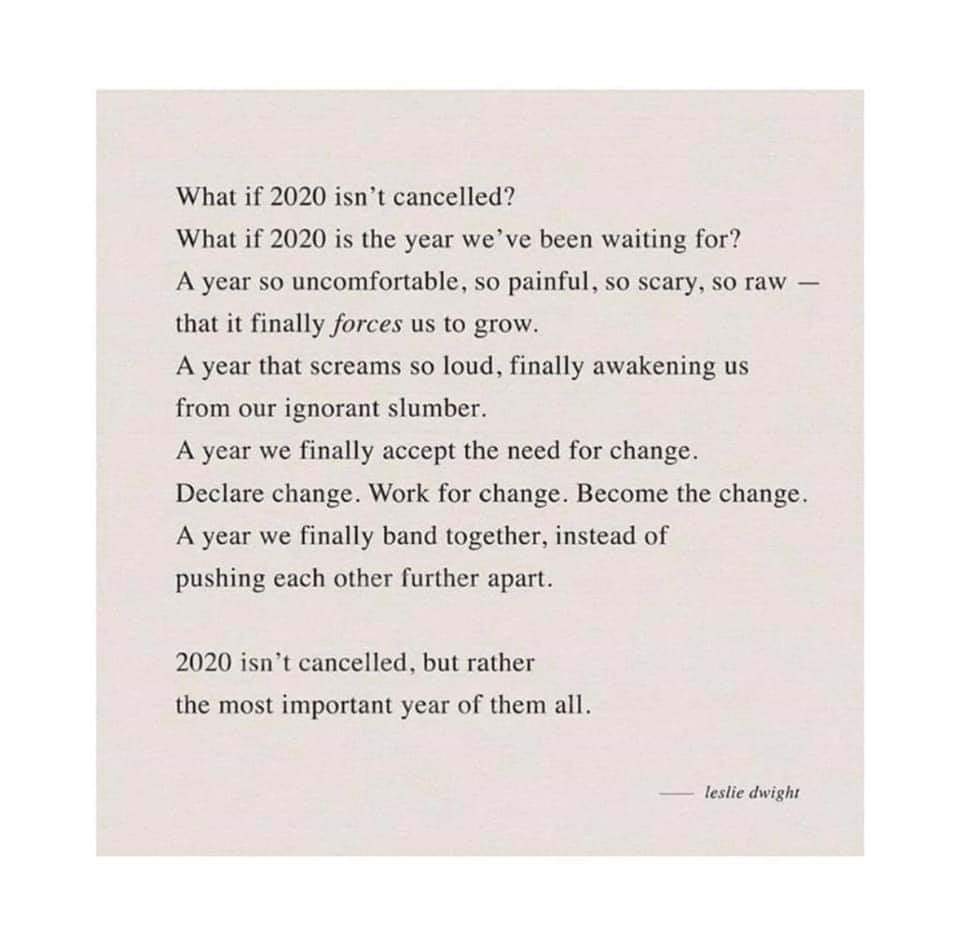
Breathe.What if 2020 isn't cancelledAnd don’t forget – please – that we are still in the middle of a pandemic. Social distancing, masks, and hand washing still matter tremendously. So do police – good police. Both/and. Life is complicated and shades of gray, ironically, not black and white. Let’s not lose track of what the story is about. It’s about greater equality for people of all colors – and that includes access to health care, education, safe living environments, opportunity. It’s about systemic racism that disadvantages some while privileging others. It’s about reforming bad policing. It’s about caring for our neighbors as ourselves, against injustice, violence and virus.
Check out my Resources page for reading and other information on #BlackLivesMatter and being anti-racist.

To do list


“Every Sunset has the Promise of a New Day” – Ralph Waldo Emerson

Where to start? My mom is in hospice care, which is a daunting word but may not mean it’s the end. What were the words the doctors used to describe her during her first hospital stay? Oh, yes, “resilient” and “feisty.” No, I definitely wouldn’t count her out.

That said, she started with COVID symptoms a month ago today. An entire month spent sick and in and out of the hospital. I’ve got a few thoughts about this, but they aren’t what you’d think. The emotional side of our situation seems to have shut down for the time being. What’s on my mind right now?:

1. If she passes from this, would she be considered a COVID statistic? I’m guessing not. And I am guessing she is not alone in this protracted COVID-related battle. So basically the mortality rate is already wrong.

2. Hospice care. Angels on Earth. I wish I had these resources and compassion at my fingertips when my mom was diagnosed with Alzheimer’s. Honestly, I battled the hard stuff alone years ago, not knowing where to start or how to handle it and navigating this totally unfamiliar and uncomfortable (and unwelcome) landscape. No case manager or social worker to listen or guide. Hospice would have obviously been dramatic for back then, but I could have used a crutch. Something. Now I realize what it feels like to have professionals who see this stuff all the time reach out to me and ask if I have questions and how I am doing. I can say with 100% certainty that I could have used that seven years ago. Just putting that out there for what it’s worth. Which actually leads me to a third point that I wasn’t planning to make.

3. Assisted living. What the bloody hell Massachusetts? Get your shit together and help these people out. They have been put in a position of having to function like hospitals because of the state’s lack of preparation. I get it, it’s a crisis, but damnit we saw it coming. It’s one fire drill after another at care homes across the state and the country. Manning the helm are some of the finest people you’d ever want to meet. And I mean the real kind of “very fine people.” They did not sign up to be on the frontlines of anything remotely like this, and surely they are not paid nearly enough for what they do, but they show up day after day with compassion and courage in spades. Meanwhile, front line assistance, offers of free life insurance, etc., focus only on hospitals and medical staff. Massachusetts doesn’t even count assisted living with its nursing home numbers, meaning that state data are undercounting this public health crisis’ impact on seniors. Does this also mean that assisted living residences are excluded from the state’s COVID assistance measures? I cannot fathom how these places continue to function, financially or emotionally, right now. The people who work in these homes deserve recognition, thank you’s, and more. WAY MORE.

Civil War icon Joshua Chamberlain said, “In great deeds, something abides. On great fields, something stays. Forms change and pass; bodies disappear; but spirits linger, to consecrate ground for the vision-place of souls… generations that know us not and that we know not of, heart-drawn to see where and by whom great things were suffered and done for them, shall come to this deathless field, to ponder and dream; and lo! the shadow of a mighty presence shall wrap them in its bosom, and the power of the vision pass into their souls.”

We are being tested. Eventually history will look back on this period, reflect and probably judge, hindsight always bringing clarity of vision that the present doesn’t offer. I think about Chamberlain’s quote, about the courage and valor of battle, the honor of walking a field like Gettysburg or the beaches of Normandy today and thinking about those who have passed before us, who fought so courageously and with a united front for something bigger than themselves.

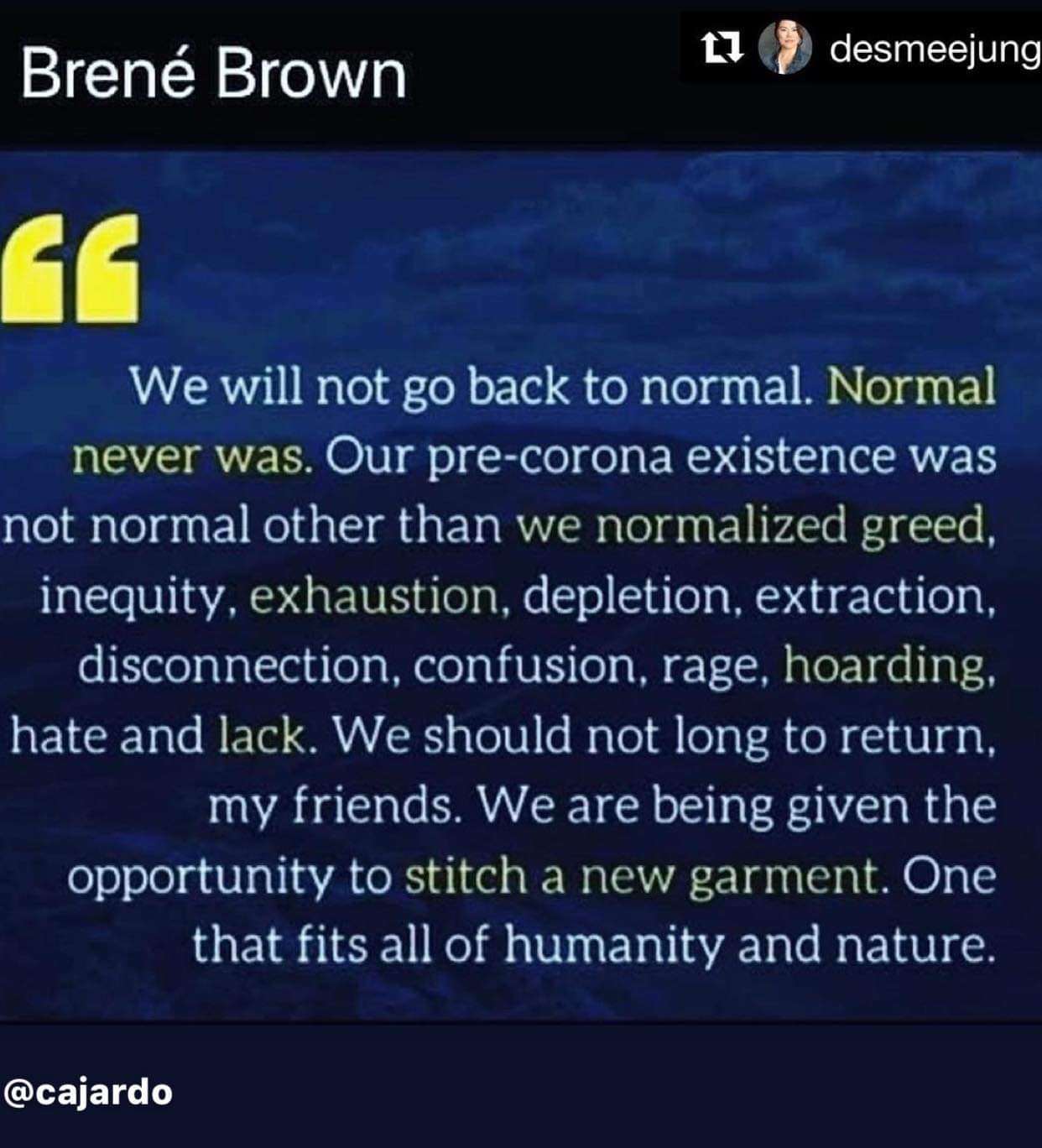
The enemy is invisible in our current battle, and the battle rages in our hospitals, our care homes, and our public spaces. But the concept endures. The honor in battle (and life) comes from sacrificing for something bigger than yourself, and from protecting the vulnerable. I was taught to respect my elders. They are not expendable collateral damage. We have already failed many of them by not acting fast enough. We can’t give up now. Looking back on this moment in time, we want history to extoll our courage and our compassion, our sacrifice and unity. We do not want to be haunted by spirits admonishing our soul-less self-interest and determined individualism at all costs. Is going “back to normal” really what we want? Normal failed our most vulnerable. We need to do better.

Wew. I woke up in a tizzy today. Tomorrow is a new day. Take a deep breath. We got this.
Stay well, stay home.
You will be alright.
Brene Brown back to normal quote

COVID Gets Real and Hits Home

Taking a break from gallivanting around the world to bring it to you straight here. This is HARD. Today is day 41 by my count. My mom was hospitalized three weeks ago and diagnosed COVID positive. It got REAL around here fast. I wrote an essay about it that HuffPost published this morning. Check it out in my Clips. Also, the featured photo today is a painting my brother did. Just sayin’. So damn talented.

At any given moment I am shades of overwhelmed, fine, depressed, grateful and everything in between. I miss the grocery store. I mean, that’s low. What used to be a chore has become a dreamed-of escape. That’s where we are.

I spend my days cooking, cleaning, doing laundry, procuring food items, entertaining my children (I have stopped calling it homeschooling because that would imply they are learning something when, frankly, I have no idea if they are. I am just happy when we get through another day mostly intact), and trying to keep up with my quarantine journal (which is remarkably challenging to find time for, an odd situation to find myself in since I never leave my home). My mom being unwell has added a layer of intensity to this isolation existence as I have worried for her well-being and tried to navigate emotionally once again how quickly life can be upended. There were days during the past three weeks when I needed to call the hospital to check on my mom but also really, really needed to grab that grocery delivery time one week out (the first available) to ensure my family had the provisions we need. So bizarre. The brave neighbors and friends who are still going to the grocery store jumped in and saved us as my juggling act came crashing down, even sometimes adding a bouquet of flowers to the items they dropped for us on the front porch.

Rest assured, when I am not virtually traveling the world with you, I am keeping it really real here. Our virtual travels and hope-filled stories bring me tremendous joy and give me meaning and perspective (and, boy, have I needed that lately). It’s helpful to focus my busy brain on positive things, to spend time learning about places I’ve never been and remembering places I have.

It all feels so futile sometimes. Life. This version of life in particular. My mom alone in a hospital, sick and unable to communicate. All of us at home. Futile and frustrating and fraught.

And then I remember: One day at a time. Tomorrow is a new day. Breathe.

We need to continue to have hope and to find the fun where we can. My mom, and my beloved aunt Nancy, and their mom would say – this too shall pass. And so it shall.

Today is Marathon Monday in the Boston area. It’s literally a state holiday and a true rite of passage to spring. Obviously the marathon isn’t happening. My family is participating in the #BackyardBostonMarathon instead. I am running around my house 26.2 times; my kids are doing the same around the backyard. My husband is doing an insane number of push ups and sit-ups (to get to 262) plus a 2.62 mile run.

It’s not the marathon, not by a long shot. But if we all do it together (I mean, apart together, of course – stay home! do NOT go on the marathon course), that’ll channel the spirit of the event and that’s meaningful. My mom’s care home and hospital are along the marathon route. Give her a virtual wave and hug as you “run” by. We can use all the spirit of the marathon more than ever because, folks, we are in one right now. I am personally seized up on Heartbreak Hill. So cheer me through and I’ll cheer for you, too. I’d love to see your photos!

Stay well, stay home.

You will be alright.

Hope is like a drop of honey quote

Song for the times

This one speaks for itself. The words are perfect for right now, even though the song was released in 1994! I remember it from then, but if you haven’t heard it before it’s timeless and super appropriate for now. The emphasis added by bolding is mine. Those lines get me every time. In 1994 and today. And, also, I am apparently old :-).

None of us will miss this storm. It’s raging all around us now. I’d love to know the end of this chapter, to avoid some of the tougher parts, to know how it’s going to turn out (and of course dreaming that it’s going to turn out okay). But we can’t know that. We are in this and we are in deep. Dive into the well of courage and inner-strength in your heart (dig a deeper well if you need to – moments like these, when we face adversity and are tested, force us to evolve and flex our resiliency muscles), love your neighbors and lift them up (all of them – remember we are ALL human and we are all in this together), and think about how we can do and be better on the other side. Hold on tight. This is one rickety old roller coaster and we are in for some shaking. But that’s where we need to go. And then we will move forward and move on. Changed. Wounded. But oddly stronger.

Woodsong by the Indigo Girls

The thin horizon of a plan is almost clear
My friends and I have had a tough time
Bruising our brains hard up against change
All the old dogs and the magician

Now I see we’re in the boat in two by twos
Only the heart that we have for a tool we could use
And the very close quarters are hard to get used to
Love weighs the hull down with its weight

But the wood is tired and the wood is old
And we’ll make it fine if the weather holds
But if the weather holds we’ll have missed the point
That’s where I need to go

No way construction of this tricky plan
Was built by other than a greater hand
With a love that passes all out understanding
Watching closely over the journey

Yeah but what it takes to cross the great divide
Seems more than all the courage I can muster up inside
Although we get to have some answers when we reach the other side
The prize is always worth the rocky ride

But the wood is tired and the wood is old
And we’ll make it fine if the weather holds
But if the weather holds we’ll have missed the point
That’s where I need to go

Sometimes I ask to sneak a closer look
Skip to the final chapter of the book
And then maybe steer us clear from some of the pain it took
To get us where we are this far yeah

But the question drowns in it’s futility
And even I have got to laugh at me
No one gets to miss the storm of what will be
Just holding on for the ride

The wood is tired and the wood is old
We’ll make it fine if the weather holds
But if the weather holds we’ll have missed the point
That’s where I need to go

Listen here.

Songwriters: EMILY ANN SALIERS

© Sony/ATV Music Publishing LLC
For non-commercial use only.
Data From: LyricFind

Stay well, stay home.

You will be alright.

Hardy Chalk art2

What Would Light be without Darkness?

Apparently the existential thinking of my French studies sunk in somewhere after all despite the fact that I would desperately wish for the French novels and films of my academic years to come to a conclusion or point of some sort. Mercy!

Several decades later, as I travel in my little world, I notice how the holiday lights proliferate by the day and how the reflecting snow augments their brightness. It’s no mystery that the season of light happens on the longest and darkest of days as we (in the northern hemisphere, anyway!) descend towards winter. As I witness and delight in the decorations springing up around me, and as I set up my own decorations, I can’t help but also think about the darkness.

Darkness usually has such a negative connotation. Certainly at this time of year, darkness comes ever earlier and, as the sun sets, the cold burrows deeper into your bones. Personally, I have trouble leaving the warmth of my home to venture out into the dark. As far as I am concerned, when it’s dark the day is over. That doesn’t work out so well when it is dark at 4:30 in the afternoon. But as I set up my decorations, I find myself anticipating the dark, knowing that the lights are muted, invisible, meaningless without it.

Maybe I’ve spent too much time freezing my toes off in a snowbank recently, but my brain has been firmly veering toward the existential. What would light be if we didn’t have darkness? Not much. It turns out, the darkness I generally dread is the platform for the delight of the glimmering lights all around me. This makes me think further about gratitude and love: Would we even understand our good fortune without suffering? Isn’t grief one of the deepest and most profound expressions of love?

I think about the trials I have faced in my life, about times and places I never want to revisit or repeat, about the people I have loved and lost (or am still losing slowly, every day). I recognize how the challenges transformed me into the person I am today, that the slow loss of my mom to Alzheimer’s forced me to pay attention and to spend extra time with her while we could still talk, that the sudden loss of my aunt drew me closer to my uncle and cousins, that “grief is just love with no place to go.”

Grief is really just love quote

Adversity and challenge can be blessings in disguise. With them comes introspection, awareness, knowledge, compassion, connection, and gratitude. Without them is a life unquestioned, many paths not taken. Adversity led me to work in the woods of northern Maine and to travel to the other side of the world to study in Madagascar. It was the discomfort and emptiness of my questioning, who-am-I-and-where-do-I-fit teenage years that gave me courage, that forced me to stretch myself, that showed me who I really was and helped me define my passions, and that taught me to see with gratitude the blessings that exist every day in my life. Once again, the darkness was the platform for the light.

At this consumeristic time of year, I am even more mindful of my many blessings, especially the basics. Here is my short list of cherished things. We should never take these (and many more) for granted. Trust me.

  1. Shelter – I see the snow on the ground, hear the wind howling outside. I have woken with wet toes when the bottom of my sleeping bag slid out from under the tarp that protected me from the rain; I have slept outside when temperatures have dipped below 20 degrees, every article of clothing I could carry on my body, my sleeping bag hood drawn down to my eyes around my head. But my nose was still so cold I had trouble sleeping. I am so grateful to have a roof over my head and heat to keep to me warm;
  2. Umbrellas – You only have to get soaked in a rainstorm once to understand what a wonderful invention these are. Live in the woods working days on end in the rain and you will never forget the comfort of being warm and dry;
  3. Washing machine – As a mom, laundry is, admittedly, the bane of my existence at times. But, oh my gosh, the machine does it all by itself! And we are fortunate enough to have one in our home. One bout of stomach flu running through the family is all it takes to realize how awful life could truly be. Imagine walking your laundry to the laundromat down the street when you are recovering from the flu. That’s right. We are blessed beyond measure.
  4. Clean water – I fill my water bottle directly from the tap. If you have never experienced anything else, it’s easy to see how having clean water, on demand, anytime you need it wouldn’t register as a luxury. But many countries don’t have treated water and many women spend the better part of their days fetching water from miles away. I knew that the parasites and bacteria in untreated water wreaked havoc on more delicate American and European GI systems (sometimes called Montezuma’s revenge), but only recently did it strike me that those who live in developing countries also get sick from the water. Water they drink every single day. Five months in Madagascar taught me clearly how impossible it is to work, go to school, be healthy and strong – live – with constant tummy troubles.
  5. A quality education – Education is a much less tangible “thing,” but it’s so critical that I have to include it. An education is both a foundation and a launchpad. A quality education is something that should be a right and a guarantee. But it isn’t, not in many developing countries (where many girls are fetching water instead of going to school), but also not equitably in the U.S. An education provides a path toward financial security, a way to access broader opportunities, and, fundamentally, hope. She’s The First recently launched a powerful video about how imperative and transformative an education is. One of the extraordinary women profiled is a graduate of the MAIA Impact School in Guatemala.


I could go on. But those are my top five.

Hopelessness is the darkest of places to be. In this season of light and giving, I encourage you to think about how you can shine your light into the darkness. Shine your light on all of your blessings, no matter how small they may be. Reach out to those who are in need of hope. If each of us were to be a ray of light for even just one other person this year, think about how much hope we could fill the world with. Let’s make 2020 EXTRA-ordinary, each in our own ways.

In thinking about something bigger than us as individuals, and in the giving spirit, here are some of my favorite organizations that are doing the difficult, audacious, and awesome work of providing high-quality education, clean water, and recognizing our common humanity across the world. I am holding them and all of my readers in the light this holiday season.

MAIA Impact School – Unlocking and maximizing the potential of young women to lead transformational change.

Water for People – We believe in a world where everyone has safe drinking water, forever.

One Revolution – It’s not what happens to you, it’s what you do with what happens to you.

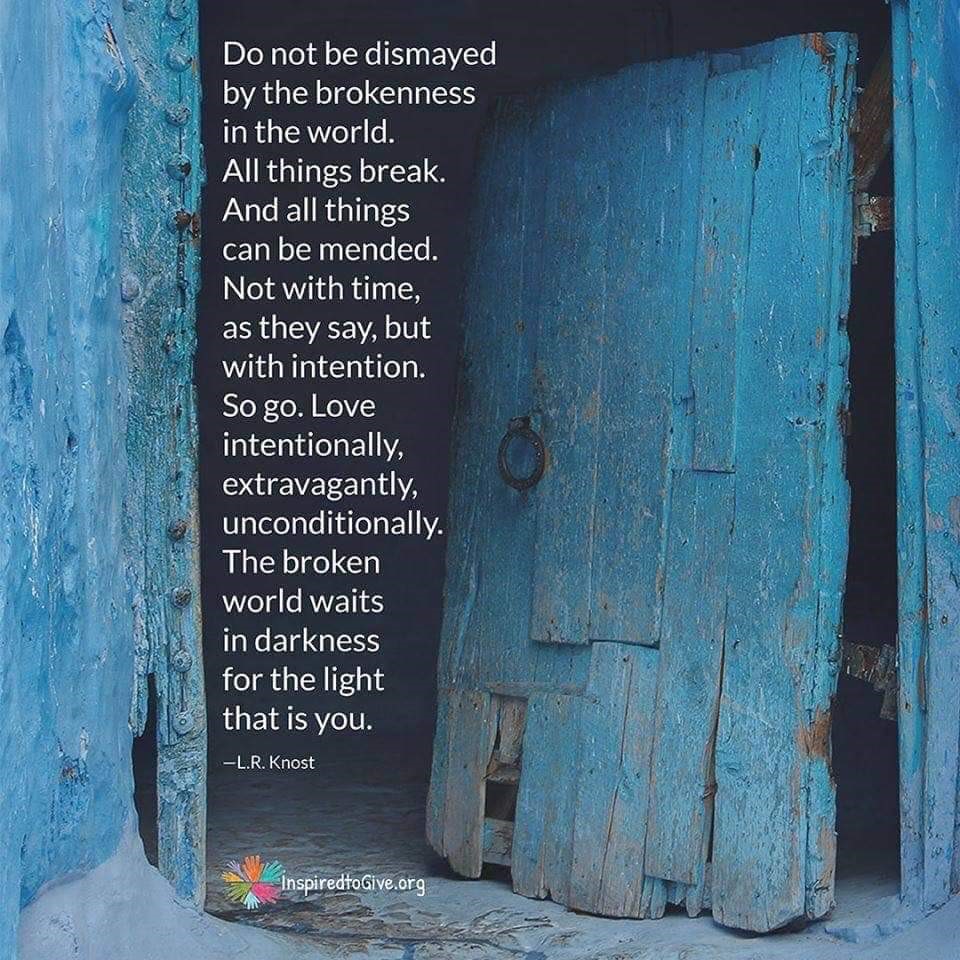
Brokeness of world quote


What are We Without Our Memories?

My mom forgot my birthday for the first time six years ago. As an almost-forty-something, I didn’t need a big birthday party or lots of attention or anything like that. But it is a stunning milestone for a mother to forget the day that she brought her baby into the world. And for said baby, it was incredibly painful the first time it happened. There are some things that seem like they would be impossible to forget.

Especially for my mom, a woman who embraced motherhood fully and in every way. Raising my brothers and I was the best job she could dream of. That’s not just me putting on rose-colored glasses and saying so – she told me that. When I say our mom was our biggest fan, I am not exaggerating. She showed up in so many ways. She was on the sidelines for all of our games, only missing them if there was a conflict with another sibling’s schedule. She attended every ballet recital (a bouquet of flowers in hand), swim meet (day-long affairs in over-hot, heavily-chlorinated air to see your kid swim for 30 seconds), soccer game (sometimes taking up entire weekends for months on end, game after game), hours and hours of shuttling us to music lessons, baseball practice, soccer, tennis – you name it, we played it. Even in the early stages of Alzheimer’s she was there on the sidelines for Kindergarten soccer and witnessed her grandson’s first goal ever. It was 28 degrees, the field was covered in frost, her memory was failing, she was frightened about the future, her world was shrinking – and there she was. She showed up time and again – for us, for everyone in her family, and for her friends.

Don’t get me wrong, we were far from perfect and I am pretty sure she had her moments when she wanted to run out of the house screaming to escape from us and the insanity we were causing her. In fact, she actually did so on at least one occasion, prompting our next-door neighbor, who had been out gardening, to come over and put his arm around her to comfort her. It kind of became neighborhood lore. So I know she thought we were royal pains in the ass sometimes – and we were – and surely she was overwhelmed keeping track of us and our schedules and our issues and, of course, the never-ending laundry. I imagine she had her moments of cursing us quietly under her breath, or venting to her friends or sisters on the phone. I am certain there were lots of things that got missed. My mom was chronically last minute in her approach to life. Her desk was a jumble of papers, binders, and – to my mind – complete and utter chaos. It looked like she didn’t sweat the small stuff, but I think the truth is that she was the world’s biggest procrastinator. You could count on her, but she’d make you sweat it out, tumbling through the door with the cake or hors d’oeuvres or whatever she had promised to bring just seconds before the start of a big event.

For my birthday, she would hang streamers in the dining room and bake a cake from scratch. She took cake-decorating classes to improve her skills, and – as cliche as it is to say it – she baked love into every morsel of every item she made. She planned epic treasure hunts in the woods for my friends and I – two-hour hikes with elaborate clues and “treasure” hidden along the way that ended at a river where we would feed the ducks with stale bread she had been collecting and freezing for months. It only occurs to me to wonder in hindsight how she got the clues placed and the treasure hidden all while baking and decorating the cake, organizing the party, and keeping up with my brothers and I. While those more elaborate birthday celebrations faded away as I got older, if I was home my mom would always bake her famous chocolate chip vanilla cake with cream cheese frosting (recipe below). If I was away, she sent a card and called. She was never extravagant, more of a simple but elegant woman. But she always acknowledged what a special day my arrival was for both of my parents and how much I meant to them. Like I said, this is the stuff that you would think you could never forget.

But forget she did, first six years ago and increasingly each year since as time for her becomes more and more of a loose construct and words and their meaning elude her. This year I baked her famous cake for my daughter’s birthday and brought her a slice to see if the taste brought back any recognition of all of these wonderful, deeply held memories. She liked the cake, smiled while she ate it, but otherwise was blank. For my birthday, I brought tea and cookies to her care home to celebrate. Because, really, my birthday is about us, maybe even more about her than it is about me if you think about it! She was happy as usual to see me, springing from her chair with delight, her hands swinging dramatically in the air to wave me over, a huge smile across her face. She loved the idea of a party, but I don’t think she really understood the birthday part. She used to break into song, part of her brain holding onto familiar tunes like Happy Birthday better than other things. But she didn’t sing this time. She just enjoyed her cookie and her tea, and I enjoyed her company. Despite all that I have lost of her, I still have that.

I am left wondering time and again as we face into Alzheimer’s ever more deeply, what is life without a memory? I read Atul Gawande’s book Being Mortal: Medicine and What Matters in the End and, while inspired, grateful for this new perspective, and appreciative of the recommendations for aging and dying well, I found myself wondering how one can have a meaningful, purpose-filled life and live life to the fullest until the very end if you can’t remember anything. Who are we without our past? It’s one thing to live in the moment, moment to moment. That’s enlightenment. But isn’t life, ultimately, a collection of memories? Isn’t that what we all aim for, to create wonderful memories? So many of my conversations start with, “Remember when?” What happens when you don’t? Without memories, what does it mean to be alive?

I don’t have any good answers. I just wonder. And I wonder what goes on inside my mom’s head, what she is seeing when she points to things that aren’t there, what she is trying to describe when she can’t find the words, what it feels like to entrust yourself and your well-being completely to another person.

Where is the hope in this? I don’t know. But there is definitely connection. There is some deep, biological recognition of one’s own, no matter what else has departed. And I guess there’s hope – or magic of some sort – in that. And there’s always cake.

Bethie O’s Famous Chocolate Chip Vanilla Cake

1 cup yogurt (plain or vanilla)

1 cup oil

2 cups sugar

3 cups flour

2 heaping teaspoons baking powder

3-4 eggs

1 bag mini chocolate chips

2 teaspoons vanilla

Mix. Bake at 350.

Tube cake – at least 1 hour

Flat cake – 30 – 35 minutes

Cupcakes – 20 – 25 minutes

Cream Cheese Frosting

1 teaspoon vanilla

3 ounces cream cheese

Confectioners sugar

Dab of milk

Mix to taste and consistency. And enjoy!

Just because you carry it well