I am a connector, traveler, writer, and (over)thinker. As well as a mom, daughter, wife, sister, and friend. I have had to learn - and continue to practice - that taking care of myself actually helps me take better care of others. I am here to tell stories of hope and to inspire connection between people, places, and ideas.
The poet Mary Oliver died today. My favorite poem of hers is The Summer Day, so I copied it here. I especially love the last three lines. It’s a great reminder to pay attention to the details, to find pleasure in the little things, and to remember that we get just one precious life. It is uniquely ours. And we are each unique. So, as Oscar Wilde said, “Be yourself. Everyone else is taken.” Live authentically, with passion, and with love.
The Summer Day
Who made the world?
Who made the swan, and the black bear?
Who made the grasshopper?
This grasshopper, I mean-
the one who has flung herself out of the grass,
the one who is eating sugar out of my hand,
who is moving her jaws back and forth instead of up and down-
who is gazing around with her enormous and complicated eyes.
Now she lifts her pale forearms and thoroughly washes her face.
Now she snaps her wings open, and floats away.
I don't know exactly what a prayer is.
I do know how to pay attention, how to fall down
into the grass, how to kneel down in the grass,
how to be idle and blessed, how to stroll through the fields,
which is what I have been doing all day.
Tell me, what else should I have done?
Doesn't everything die at last, and too soon?
Tell me, what is it you plan to do
with your one wild and precious life?
from New and Selected Poems, 1992 Beacon Press, Boston, MA
Copyright 1992 by Mary Oliver. All rights reserved.
Is there such thing as good grief? Because it feels like an oxymoron. Grief is heavy and hard and, of course, sad. It implies the loss of something important. How could that ever be good?
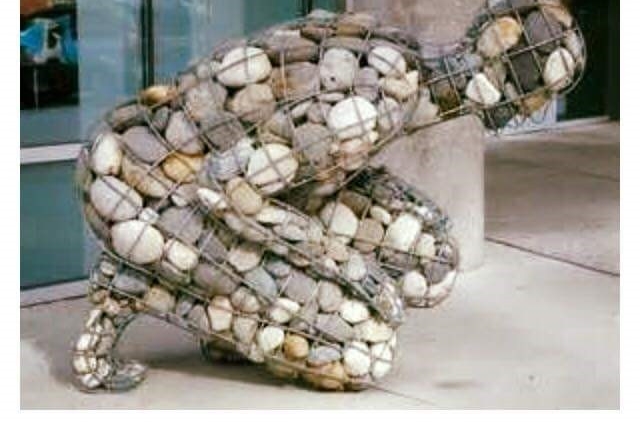
I was saying to a friend the other day that I’ve grieved so much lately that I must be on the path to enlightenment. Right??? I mean, what else is the point of all this suffering and introspection? I get it, I really get it. Life is fragile and short and beautiful and hard. And grieving is something you have to live through; there are no shortcuts. The Weight of Grief, a sculpture by Celeste Roberge, accurately and poignantly reflects how it feels.
The Weight of Grief by Celeste Roberge
Grief is a funny thing. I can be ambling along quite pleasantly in my “normal” life and it just sneaks up, welling up unexpectedly in my chest from seemingly nowhere to overcome me. I’d love to call out, “MERCY”, to the universe and actually get a reprieve. But, instead, here I am facing again the reality that this life journey isn’t something that’s totally in my control and diving deeper into gratitude for what I have and authentically living for what really matters.
Charlie Brown by Charles Schulz
Charlie Brown by Charles Schulz
Here’s where the good in grief lies. Grief amplifies the otherwise mundane, magnifying the importance of the smallest gesture. I had never understood the importance of ritual, for example. Generally speaking, I am not a huge fan of ceremony or tradition. But when we joined hands in a circle around my aunt to pray together, though our brains were addled with grief and a sensation of numbness was overcoming us, we all knew verbatim the words. It required no shuffling of papers or notes, no cueing, no preamble. There was incredible solidarity in that harsh and deeply painful moment.
Food is another item that ascends to the pinnacle of significance during times of grief. People deliver food to grieving families as a way of saying, “I love you and I don’t know what else to do so here’s one less thing to worry about.” Food becomes an important means of connection, both literal and figurative sustenance.
When my aunt died unexpectedly two weeks ago, she had been anticipating our arrival to visit for a couple of days. Her refrigerator was full of some of the family favorites: her homemade mac and cheese, broccoli (our staple veggie), pasta and meatballs, and ricotta cookies. We decided that we should gather as a family and enjoy the meals she had prepared. My husband was given the task of packing up the food and bringing it to my cousin’s house. He felt strongly that he was delivering something sacred, so he packed the car with ceremony and care. Nancy had baked her love for us into each morsel of that food. The food was emblematic of her devotion to us and her anticipation of the time we would be spending together. It always tastes good, but never before had consuming mac and cheese been so poignant.
I can’t talk about food and not mention the chocolate chip cookie, which is hands down one of our family’s most treasured delicacies. My mom and my aunt were like some sort of chocolate chip cookie ambassadors, working industriously to spread their love of this perfect cookie far and wide. Chocolate chippers were regularly in the cookie jar on our kitchen counter, homemade and delicious. Every time I came home from college my mom was pulling a fresh batch from the oven, the smell of melting brown and white sugar, butter, and gooey chocolate chips permeating the kitchen. Our exchange students from France, Germany, Serbia, and countless visitors from elsewhere, were quickly indoctrinated to this most American delight. When traveling abroad, my mom even brought brown sugar and chocolate chips with her so she could reproduce the official chocolate chipper there. When I lived in Madagascar, I improvised using chopped up chocolate bars to make some for my homestay family. I am not kidding at all when I say that we believe with an almost religious zeal in the chocolate chip cookie as the quintessential unifier and the answer to almost any question. At Nancy’s celebration of life, we served chocolate chip cookies.
The last item I wanted to highlight are the plentiful rocks and shells on a New England beach. They can seem like nothing much at times, commonplace and a regular part of the beach landscape. Many people just walk by them, preoccupied with their thoughts or focused on the ocean. But in the midst of our intense grief, my cousin’s wife had the presence of mind to collect various shells and rocks from the beach near where Nancy lived. She put them into a wooden box for each of us, and instructed us to build a cairn of remembrance for Nancy at our homes. The cairn, she wrote, will “act as a landmark and a compass to guide us back to the people, places, and communities that Nancy loved.” She also gave each of us half of a shell that another family member has in their collection, a symbolic way to keep us connected across the days and miles between us now that we have returned home. With these beautiful words and her extraordinarily thoughtful gesture, instantly these otherwise ordinary items became a coveted treasure imbued with deep meaning and value.
Nancy exploring the beach
Beach Treasures
In grieving there is renewal in connection with family and friends and community. It always comes back to this. That was on display in spades at Nancy’s celebration of life (Community Pays Tribute to Nancy Waddell), and in the food that kept arriving at our doorsteps. In loss we are reminded of what we have and somehow we appreciate it more fully. Out of grief, new friendships and connections are made (I’m looking at you WV Adaptive and HFCC!). In my sorrow, but also in how I have deliberately chosen to live every day of these past two weeks, my aunt is present. Her example, her capacious heart, and her compassionate spirit guide my actions. I can tell she will never leave me. Good grief, that’s an astonishing gift.
On December 30, 2018, my vibrant, caring, full-of-life aunt, Nancy Waddell, died from complications of a heart attack. Her passing was sudden and quick and far too soon. She spent the morning of December 29 teaching skiing lessons with the adaptive program in Waterville Valley, NH, before coming in for lunch and complaining that she wasn’t feeling well. It was mere hours later that we were facing the unthinkable, that the glue to our family and our greatest cheerleader might be leaving us.
There is something powerful that happens when someone you love dies. My heart is somehow broken and full at the same time. My brain is operating like it was greased with molasses. I feel like I am in some sort of cognitive twilight zone, where all of my emotions are dulled. The reality is so shocking it’s hard to absorb or believe it.
Our family has pulled together and reveled in memories of times long past. We have shared laughter as well as tears, sometimes simultaneously. Friends and neighbors have helped with hugs and meals and rides and entertaining the kids, reminding me once again that community and connection are so important and revealing how much I must have talked about my aunt!
Nancy was no Mary Poppins, but, to me, she was practically perfect in every way. I had intended to write at some point about how she inspires me. I specifically had in mind to profile her fearless leap into Corcoran Pond at Waterville Valley as part of the Cold Turkey Plunge in November. She was dressed in her Fancy Nancy costume, inspired by the Fancy Nancy children’s books written by Jane O’Connor. The purpose of her plunge – “freezin’ for a reason” – was to raise money for the Waterville Valley Adaptive Ski program to which she was so devoted. I even have a note to myself from that day that says, “When I am 71, I want to be like Fancy Nancy!”
Nancy was my other biggest fan. How lucky am I to have had not one – my mom – but two – my aunt – women who loved me and were guiding lights in my life? Nancy always had a comment or like on every text, facebook or blog post. You name it, she read it and commented on it. But more than that, she showed up. She was my partner in caring for my mom, her sister, making the hour drive each way at least once a week to spend time with her. She filled the void of the grandmother my kids lost when my mom was diagnosed with Alzheimer’s and took them under her expansive and caring wing. She taught them to ski, took them sailing, ferried them to events when we were in the process of moving, arrived at our doorstep with a smile and fresh-baked snickerdoodles or brownies or ricotta cookies in hand.
Nancy was the BEST of everything it is to be human and genuine and caring. She was honest about her imperfections, laughed when the children at the childcare center where she worked told her she wasn’t fancy, and never wanted a title or accolades, just to be told what needed to be done so she could get to it. She put her family first – always – and gave completely and selflessly of herself. She devoted herself to loving others and to her community and, in so doing, she created a life of deep meaning and purpose and impact.
I went to visit my mom today at her care home. She is blissfully unaware that her beloved sister is gone or what that means, though she joined us to celebrate Nancy’s life yesterday. My mom’s laughter and love are somehow capable of penetrating the depths of our grief and helping us all feel closer to Nancy’s spirit. Today one of my mom’s neighbors shared that my Mom is the queen of their floor and that she had never met someone with such a big heart. I guess it runs in the family.
Nancy was my role model and she will always be what and who I most aspire to be like. In this time of acute sorrow, I find comfort in the many memories, the endless laughter, and the good fortune to have had two compassionate and caring women lead the way for me. The connection with others that comes from sharing such a loss is powerful and intense, beautiful and horrible all in one fell swoop. We are at the very outset of a long, challenging road to readjust our lives without Nancy in them.
Nancy will always be in my heart and, if I am lucky, in how I live my daily life. I will look for her spirit in the crash of the ocean waves and listen for her voice in the mountain breezes. I will miss her presence with us more than I probably even realize at this moment. And I will continue to face into the pain, because much like with a strong wind, if I don’t face it head on the grief will blow me over.
I am so grateful to have had this woman’s light shine on me and to have known such love that it hurts this much to say goodbye. We had a good run and some great adventures. You taught me by your example what matters most in life. Rest in peace, Fancy Nancy. You were one of a kind.
The holiday season is manic. I’ll just start there. It starts around Halloween and sails right through Thanksgiving into Hanukkah and Christmas and then New Year’s. Since Halloween starts in early October now, with ghosting and decorating and thinking about costumes all part of the lead up to the big night, basically the whole fall, from back-to-school right through New Year’s is rich with the bustle of life and activity and, frankly, the pace is completely unhinged and frenetic and exhausting. Part of me loves it, and a big part of me wants to make it stop!
So, here’s the thing I’ve started to notice as life goes on and I get older, for certain, and hopefully wiser. You have to celebrate the little things in life every day. You have to take a step back and take that deep breath and find joy even when the rest of the day is utterly forgettable. Even when the day includes yet another trip to Party City and all you can think is “I just can’t.” Even when the day is spent stacked with activities and chauffeuring your offspring hither and yon. There is so much to be worn down by, so much negativity, so much TO DO, that you run the risk of missing it all, the proverbial not seeing the forest for the trees.
The stuff that we remember in life, the stuff that matters and that you’ll be thinking about when your time on this Earth is winding down, isn’t the holiday shopping (unless there’s some epic mishap that results in a good story to tell) or what you got or how much you got done, like there’s some holy checklist and the more you check off the better you are or your afterlife will be. No. The manic pursuit of a bucket list, or any list, how many places you’ve been, how much money you’ve made…these are empty and fruitless quests if the goal is happiness or contentment.
The stuff that really fills and sustains the soul, is found in the gathering of friends and family, of multiple generations, to enjoy a cup of coffee and some holiday treats on Christmas morning. The sustenance comes from the sharing of stories and experiences, from toasting our brimming coffee cups that will help us survive the day after a reveille that was a little on the early side. It’s in the sheer delight and simplicity of seeing my mom, who truly is only capable of living in the present anymore, marvel at the Christmas trees and lights and enthusiastically sing out Christmas songs. It’s a warm and gentle sea breeze; it’s the magic of dolphins playfully diving in and out of the waves; it’s a full moon hanging heavily in the evening sky – and still there in the blue of the next morning (a moonset sunrise); it’s a snow day when you just drop everything and play that board game with your kids and bake comfort foods and ignore the “to do” list; it’s a friend who leaves you tea and biscuits at your door when you are down and feeling broken.
There is magic and inspiration in the big things – a marathon or a trip abroad or a new experience. But it’s how you weave the experiences together, it’s what you live with every day, what sustains you when life isn’t particularly glamorous or grand, that matters most. It’s the daily appreciation of the little things: like an umbrella when it’s raining; a baby’s laugh that rings out like a balm for the soul; a solitary chocolate chip; a warm beverage; a hug from a friend.
Remember to be grateful and to cherish all of life’s little moments, even the messy ones. Because life is really the sum of its parts, and the little moments are what matter most.
As I sit here trying desperately to write for five minutes without being interrupted by one of my children, surrounded by the detritus of Christmas, I guess I should try to take this to heart. This is it. This is the good stuff.
So I’ll close with a memory and a song from several years ago. The setting is the East Sangerville Grange in Sangerville, Maine. It was February, it was freezing, the snow was piled high, and a blizzard was on the way. In this simple, modest, one-room grange hall in the central Maine highlands on this cold and snowy night many from the community gathered to listen to Bill Staines sing and play acoustic guitar. And I was introduced to one of the most beautiful and moving songs I have ever heard. It’s called Child of Mine. Click here to hear it live.
The full lyrics are displayed below. And they apply to everyone – adult, child, have children, or don’t – everywhere.
Face, don’t fear, the unknown.
Find joy in each day.
Love sees us through.
Connect with people and our common humanity.
And you will be buoyed by hope. And maybe survive the holiday season just a little more happily.
Child of mine, you are the wildest wind
And the dearest dream I will ever know
Love’s lasting light shines out from deep within
This father’s heart as I watch you grow
Child of mine, you are the break of dawn
And the brightest star I will ever know
Love’s lasting light comes shining on and on
From this mother’s heart as I watch you grow
There is a road and that road is all your own
But we are here, you need not walk alone
To face, not fear each coming new unknown
Is the way to lift your wings
Child of mine, you are the sweetest song
And the greatest gift I will ever know
Child of mine, where spirits fly above
There is but one that belongs to you
So let it grow and it will thrive on love
For it is love that sees us through
You have the hands that will open up the doors
You have the hopes this world is waiting for
You are my own but you are so much more
You are tomorrow on the wing, child of mine
I know a thing or two about pain. Emotional and physical.
Any woman who has had a baby knows about breathing through pain. And I am here to say that I am absolutely as imperfect as they come when it comes to breathing through anything. I get so angry and frustrated and want to just wallow in my misery sometimes. Very graceful. Very zen. I am more of a just-give-me-a-to-do-list-and-I’ll-do-it kind of person.
As with most new parents, we didn’t sleep much those first few months. Our baby was fussy and needed to be held all the time and, being the worried new mom that I was, I spent what little “free time” I had researching what I was doing wrong and the many ways I may never sleep again.
I am from a family that says things like, “I am not sick, I just don’t feel well”. We push through and don’t complain. So when my hands started to hurt about six weeks postpartum I chalked it up to constantly holding a heavy baby and exhaustion. The pain would come and go, and time was a very slippery and elusive concept in those days, so carpal tunnel syndrome seemed like a legitimate possibility. Sure some days my legs kind of ached, too, but that’s what atrophy feels like, isn’t it? I distinctly remember hobbling down the stairs to the backyard saying to my mom, “I feel like I am getting worse and not better. Is this normal?”. Then one day my knee visibly swelled up. Having barely left the house in months, let alone done anything active enough to cause an injury, I finally couldn’t find an answer for that one.
I was diagnosed with Rheumatoid Arthritis (RA) two weeks later. Cue record scratch. Arthritis is for old people, isn’t it?
I’d love to say that I went home from the doctor with my chin held high and soldiered on with zero self-pity. Ha! No, no, no. There were some serious bellyaching moments and I definitely asked “why me” more than once. I was shocked, almost offended, that this could happen to me. What the heck did I do to deserve this? Very zen, like I said. For me, RA meant one big old Rude Awakening.
Pro tip – don’t google your newly diagnosed disease when you get home from the doctor. It doesn’t end well. Ignorance truly is bliss.
With the words “severe prognosis” ringing in my ears, I was sent home to begin to ween my baby off breastmilk so I could start on some pretty powerful medications to try to change the course of the disease. I remember calling my OB and asking for advice on how to ween a baby, explaining what had happened and why in this age of “breastmilk is best” pressure I was stopping. The nurse I spoke with, thank goodness, was so compassionate. I will never forget her kindness and her words, “You did such a good job”. I needed to hear that. It’s very lonely to be sick, have a brand new baby with all the societal judgment that comes with parenting, and your choices aren’t yours anymore.
That was part of the emotional pain of RA for me. The diagnosis, whether you have a little baby or not, brings a flood of fears and unknowns. Google told me that 1/3 of people with RA are so disabled after five years that they can no longer work; I was denied short-term disability; the medication side effects and disclaimers were terrifying to read. The disease itself is an unpredictable roller coaster ride. Some days are better than others, some medications work well, others make you nauseous. It’s all trial and error. No lists.
And the physical pain? Well, it’s like nothing else, quite. A broken arm? Maybe. Childbirth? I guess so. It’s intense and deep and unrelenting. 40mg of prednisone and 800mg of ibuprofen wouldn’t even touch it some days. I couldn’t lift my baby out of the crib because I was cradling my arm so gingerly. Some days I couldn’t walk. I never knew where the pain would go next, which joint would be affected. Hips, shoulders, jaw – those are the worst. You can work around a hand or a finger, but it’s impossible to eat or even smile when your jaw joint is inflamed. I begged my dentist to tell me it wasn’t RA and I just needed a root canal. Anything, like I said, for someone to just fix it.
I have tried to figure out what triggers my flare ups. I cut out sugar and caffeine and alcohol and gluten – pretty much all joy – and it made no discernable difference except that I was more miserable and now high maintenance as well. I have submitted myself to science and participated in pain studies. Mostly I learned that I have a high tolerance for pain and that ice is my friend. I have no idea why some days are better than others. Remember how I said that I like order and a nice to do list? Yeah, RA doesn’t work like that.
It turns out that that kind of checklist mentality, where if you just check the right boxes you are in control, is a false premise. That remains a disappointing life lesson for me. But I am working on it.
Long, long story short, eventually the meds did their thing and my RA went into remission. For the time being, I don’t have any pain and haven’t had any permanent damage to my bones or joints. That in and of itself is a miracle. Truly. I’ll write a whole post on how different the outlook is for RA patients who were diagnosed after methotrexate started to be used to treat RA as compared to previously when all that could be done was attempt to manage the pain.
It took a lot of time, a lot of deep breathing, thousands of laps in the pool, sometimes screaming underwater, sometimes also crying into my goggles, for all the emotional toxicity to work its way through my system. But eventually, that piece settled, too.
Now I swim in a masters swim program. I participated in a triathlon a year ago, something that was absolutely unimaginable only a year prior. I go to crossfit. I traveled to Guatemala! Hope abounds.
I am tempted to say that I conquered RA, that I win. But that would mean that I haven’t learned anything from all of this. I have been around the block enough times now to know that my RA and I are just in a temporary place of peace, and that it will inevitably come back. And when it does, honestly, it will be really hard for me. I don’t expect that my despair will be as deep, but I’ll surely still long for that elusive checklist and the return to normalcy. Now I know, though, that I CAN come back, that RA is just one part of my story, and that I am not less than because of this. As Dory says in Finding Nemo, “Just keep swimming, just keep swimming”. Seems like some pretty darn good life advice. One day at a time. One breath at a time. One lap at a time. One foot in front of the other.
Post Triathlon with my “I have RA AND I am an athlete” shirt on
What’s so noteworthy about the following picture, do you think?
If you said, “That’s a bathroom stall”, you’d be correct. But you’d be more correct and I’d be more impressed if you said, “That’s a wheelchair accessible bathroom stall! With a ramp to the door! In Guatemala!”
My cousin Chris has been in a wheelchair since a skiing accident in college. He is an accomplished athlete and motivational speaker. In his memoirs, he shares what it was like for him after his accident, learning how to adapt physically and mentally to his new and challenging reality.
Because of Chris’ experiences, specifically his time in Tanzania preparing to climb Mount Kilimanjaro, I may be more attuned to the challenges people with disabilities face, especially in the developing world. Have you ever noticed how rare a curb cut or an accessible bathroom is outside of the United States? Have you ever considered how difficult it might be to get around in a wheelchair period, let alone on a dirt path? In the snow? Without ramps? Without an elevator? With no wheelchair at all?
Needless to say, when I saw this bathroom in the small community of San Juan La Laguna in Guatemala I about fell over with surprise and joy. So today I wanted to share the important and meaningful work that Alma de Colores, a “labor and social inclusion program for people with disabilities” is doing in Lake Atitlan, Guatemala. And to encourage everyone to think for a minute about how hard it is to live in the developing world as an able-bodied individual. Or how difficult it can be to live in the U.S. as a disabled individual, even with the accessibility standards we have. And to simply be aware of that as you go about your day today.
My cousin spends a lot of his time speaking at schools with his Nametags educational program, shining a light on the disabled community so that they are seen, so we all start to see their potential and our own potential, instead of focusing on the limitations. The Nametags program teaches about resiliency, and also about the labels we put on ourselves and others.
Chris and Tajiri on top of Kili
Chris Skiing
Waypoint Adventure puts much of what Chris’ Nametags program talks about into action. Their mission is to “challenge youth and adults with disabilities to discover their purpose, talents and strengths through the transforming power of adventure”. And their work is incredibly powerful! The liberation and delight that comes from triumphing over an “I could never do that” mindset is truly thrilling.
Shel Shilverstein wrote the following poem in Where the Sidewalk Ends:
Listen to the MUSTN’TS, child, Listen to the DON’TS Listen to the SHOULDN’TS The IMPOSSIBLE, the WON’TS, Listen to the NEVER HAVES Then listen close to me – Anything can happen, child, ANYTHING can be.
Alma de Colores, Nametags and Waypoint Adventure provide the support and structure to make the impossible possible. They teach about the power of community and inclusion, that no one climbs a mountain alone, that together we can transform people’s view of their abilities. Those are phenomenal messages that transcend international boundaries. Those are the universal messages of our common humanity.
To anyone who has been touched by Alzheimer’s, I stand with you. I know there are millions of us, but I have never felt so lonely as I did in those first few months – years, really – as I navigated what needed to be done for my mom, when, and by whom. Alzheimer’s is a tricky disease that plays out differently in every individual. No one could really tell us what to expect, except vaguely; there is no timeline or schedule; there are limited medicines and no cure.
Let me take a minute to tell you a bit about this woman, my mom, so you can fully understand what Alzheimer’s has stolen. There was nothing my mom could not do, from basic plumbing to planning large parties or family trips to hosting and cooking Thanksgiving dinner for 20 to 30 people. She was a fantastic gardener and cook and loved listening to music and singing. She loved to play tennis and to travel; she was very involved in our schools and community, especially with the Philadelphia Parks Alliance. She attained her Bachelor’s degree while raising 3 young children (cue major guilt feelings for the snarky, bored expression on my face in her graduation pictures). Our family hosted French and German exchange students during many summers, and most became part of the family and returned many times. She was a committed friend.
Above all else, she was the most devoted mother – as my brother once said, “Mom was my biggest fan”. Our birthday parties were simple but special – the birthday cake was always homemade, she planned treasure hunts in the woods near our home, or pin the tail on the donkey in the backyard. At Christmas she baked cookies of at least 6 varieties and then plated them up and gave them as gifts to all of our neighbors. She made us homemade Cabbage Patch Kids and Pound Puppies for Christmas when they were all the rage and couldn’t be found in stores. She made our Halloween costumes. As we got older, she was truly just a phone call away, so reliable, always available to listen. And she just couldn’t wait to be a grandmother.
It’s weird to write a eulogy for someone who is still alive, but that’s what Alzheimer’s does. The person stays but who they were goes.
I could write multiple articles, probably fill a whole website, about the nitty gritty details of what it takes to face one’s suspicions and have a conversation about the possibility of Alzheimer’s with your beloved parent. About reading the book When Things Fall Apart by Pema Chodron and wanting to hurl it against the wall after about page 13 – I wanted to fix it, not accept or sit with it. About wanting to preserve my mom’s pride and independence, but also being responsible for her safety. About delicately extracting personal information – Medicare number, financial information, etc. – from a private, independent woman where it had previously not been my place to interfere. About the painful reality that I would hire a babysitter not to go out with my husband or see friends but to take my mom to a doctor’s appointment or to attend an Alzheimer’s Association meeting or a support group. About the countless hours I spent trying to figure out what needed to be done – visiting assisted living facilities; making doctor’s appointments; calling care managers, banks, lawyers, the Alzheimer’s Association hotline, care agencies; worrying about my own memory and fate. About triaging surgery decisions with an orthopedic surgeon while standing in the middle of a grocery store aisle and later while watching my kids at the playground discussing with the neurologist the potential impact on my mom’s brain of her going under general anesthesia. About how I spent way more time on the logistics of my mom’s life than I could ever spend with her.
Oh, my goodness, the agonizing, sleepless nights, the constant dull ache in my stomach, the heaviness in my heart. The grief and responsibility weighed on me constantly; I had trouble eating; my RA kept flaring up, which meant I was in terrible physical pain; and I never laughed – life was overshadowed by such a dark and heavy cloud, how could I?
Do you see why I needed an oxygen mask?
It may be helpful for anyone who is dealing with Alzheimer’s in some capacity to hear our story in more detail and some day I will write more. But, for now, I want to simply share the message of hope I take from this painful journey: this disease, this diagnosis, tore at the bonds of my family to the point that I thought it would break us. The grief and responsibility ripped up my heart and broke me down until I was just a shell of my former self. Eventually I learned to face into the fire and to not shrink back. And from the ashes of my soul, rose a stronger, more connected, more grounded, happier and much healthier me.
I look at the Alzheimer’s diagnosis as a shot across the bow, a message from the universe to PAY ATTENTION. My mom was always going to predecease me if life played out in the regular order of things. So instead of taking her for granted, I really paid attention. I visited and called more often when she was still able to communicate, and now I visit her as often as I can just to be with her. My brothers and I talk more often. My mom’s friends/our hometown community, have stayed in touch all these years, with me and with her, supporting us both through the diagnosis and truly honoring the friend and the person she was by giving her the highest quality of life possible.
As for me, I have a deep and wonderful support system from my husband’s quiet, constant and loyal love to friends who I can feel almost literally propping me up at times. I try to live in the moment, to seize the day, to be present with my kids even when, admittedly, there are moments I’d rather check out!
I try not to dwell in the land of wishful thinking anymore and to play the cards I’ve been dealt. To be awoken to the fact that all of this messiness and pain and love and friendship IS life, is a gift. As John Kulish wrote in Bobcats Before Breakfast, “I grieve in the same measure I have loved”. And that’s all there is to say about that. My mom was my biggest fan, and I am also hers.
It would be disingenuous of me not to share how HARD it was for me to go to Guatemala. That may have been clear from my earlier post that mentions the soul-searching I went through to decide to go in the first place. I am nothing if not risk averse. Or from the tears I cried when it was actually time to go to the airport. It was really HARD to leave – there were so many unknowns and my old friend self-doubt had a lot to say about my decision.
Sure, I’ve been brave before – ostensibly. I’ve traveled all over the world, I’ve taken jobs in states and countries I had previously never even been to before arriving for work. But so much of that bravery was born of desperation or an “it can’t be worse than this” attitude, not actual courage. And so much of it was before having children. Going to Guatemala, on the other hand, was a choice to do something different when things were going perfectly fine. And that kind of rocked me.
One of my favorite all time quotes is: “I went to the woods because I wished to live deliberately, to front only the essential facts of life, and see if I could not learn what it had to teach, and not, when I came to die, discover that I had not lived”. That’s from Henry David Thoreau’s Walden. It’s a message I picked up decades ago, and it’s one I’ve carried with me since.
In my twenties, I would literally go to the woods, especially my sanctuary around Katahdin in Maine, where I found my people, my place, my footing in this world when I needed it most. I find life there to be a little less noisy, a little more simple, and the scenery so beautiful that it soothes my busy brain.
As I’ve gotten older and my responsibilities to and for others have expanded, I try to find ways to simplify my life, to front only the essential things, to bring the peace that I find when I am in the woods home with me. Despite all my family responsibilities, my anxiety, my self-doubt, I don’t want to forget to live. I want to live authentically and bravely and not, like Thoreau says, from the vantage point of looking back at the end of my days, discover that I had not lived.
And so I choose, daily, to face into the fear. I get on the plane (heck, I buy the plane tickets!) to Guatemala; I push the publish button on this blog while cowering behind the screen awash in vulnerability; I belay at the rock gym even though, fully trained to belay, my mind still tells me it’s awfully risky; I participate in a triathlon for the first time ever when my Rheumatoid Arthritis is finally in remission and I think “maybe I can still do something like this after all”; I drive my beautiful, vivacious, young and also scared mom to the doctor and hear the Alzheimer’s diagnosis we have suspected but been dreading; I go to the woods with my kids and share with them the joy I’ve found there, though it’s not nearly as simple or quiet with them in tow! I stretch the boundaries of my comfort zone. I breath through the self-doubt and the fear and I LIVE.
My life has been the very definition of bittersweet these last several years. And I am so incredibly grateful for all of it. Without the fear, how would I find my courage? Without the bitter, how would I taste the sweet?
The Magic City is a mystical place of incredible, humbling beauty, where the rivers run clear, the trees are tall and plentiful, and the mountain ranges and landscape are vast. It is also a place of extraordinary opportunity: to have a high quality of life, to raise a family, to hunt and fish and hike. Never heard of it?
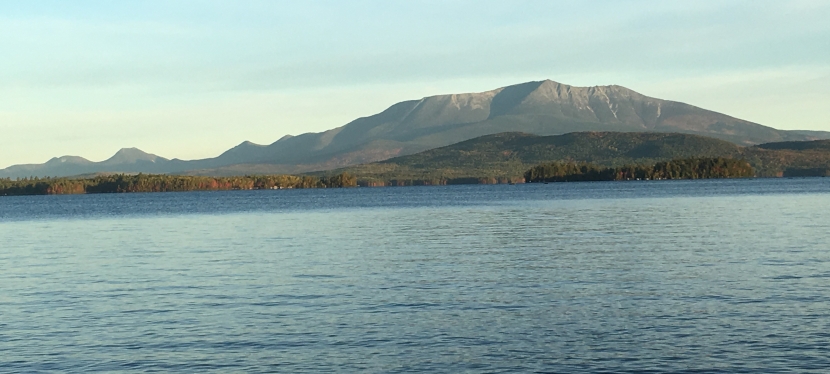
How about a small town in Northern Maine called Millinocket? The name means “the land of many islands” in the language of the native Penobscot people. It is surrounded by lakes and rivers and sits in the shadows of Katahdin, the “greatest mountain”. It is about as stunning a setting as one could imagine or even invent.
Pond from Golden Rd
Loon
Katahdin from Millinocket Lake
In the early 1900’s, the town of Millinocket sprung practically fully formed from the depths of the dense, wild woods to become a thriving paper mill town. Because of its virtually spontaneous creation and rapid growth it came to be known as the Magic City.
Little Italy Neighborhood and Mill
Katahdin from Millinocket, Associated Press Photo by Michael C. York
The views of Katahdin from Millinocket and the natural wonders and wilderness setting of the Katahdin region are enough to earn it the magic moniker. For a time, the bounty afforded by the papermaking world of the Great Northern Paper (GNP) Company was also magical. For years, Millinocket boasted the highest per capita income in the state. There were papermakers balls, an opera house and movie theatre, open access to GNP land for hunting and fishing, and the guarantee of a lucrative job waiting for high school graduates. At its peak, GNP was the largest landowner in Maine.
Historic picture of Millinocket, 1908, Portland Press Herald Article February 28, 1999
Historic Picture of Mill Workers, Portland Press Herald Article February 28, 1999
If you have heard of Millinocket at all, chances are you’ve mainly read the dire headlines about how tough they’ve had it there since the paper industry, the one industry in town for a century, foundered and eventually closed in 2008. U.S. Census data reveals that Millinocket’s population increased rapidly through the 1970s and has declined each decade since. The balls and opera house were long gone by the 1990s when I first showed up there. Now so too are the jobs and the tax base. And, swiftly, the hope, many of the young people, and much of the magic have drained from the region.
For Sale Signs (3 here) abound
Vacant Storefront
Appalachian Trail Cafe and Quiet Main Street, 2014
But this is a story about finding hope in unexpected places. And the Millinocket of the past decade, with its bleak headlines, empty storefronts, vacant homes, and abundant for sale and for rent signs, surely is a place where hope has been more difficult to find.
However, in 2015, Gary Allen, a Mainer from the coast, had an idea. And that idea was to hold a Marathon. In Millinocket. In December.
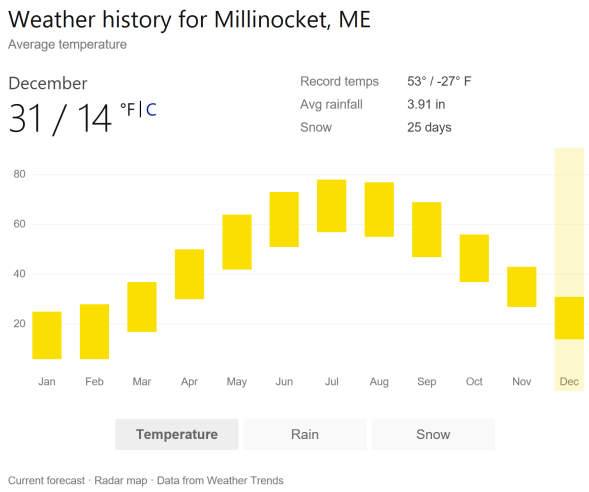
That’s right. 26.2 miles in a relatively remote part of Northern Maine where the weather graph looks like this:
Because of Allen’s connections in the running world, 50 people ran in 2015. But it wasn’t only runners who showed up that day. The people of Millinocket did, too. And with that, a new connection, a new relationship, was formed, and Gary Allen’s idea became a spark that has transformed in the intervening years to become one of the small wins this region, this town, desperately needed.
The Millinocket Marathon and a Half is now a certified USATF course. The race will take place on Saturday, December 8, 2018, for the fourth consecutive year. It is the only marathon that takes place in New England during the winter and it is fully subscribed with over 2,400 people registered to run. No entry fee is charged for this Boston Marathon qualifying event. Race organizers hope that instead racers and their fans will spend money in the town. The concept is: “Don’t Run Millinocket for What You Get; Run Millinocket for What You Give”.
Meanwhile, being the Mainers that they are, the locals dove right in to welcome the runners. They have organized an Artisan Fair with over 45 crafters. There are spaghetti and pancake dinners planned, a variety show, and a pre-marathon breakfast. Multiple local establishments are hosting parties after the marathon as well. If you want to see Millinocket and northern Maine hospitality shine brightly, this is an amazing opportunity to do so.
This marathon is a vote of support and an influx of interest and money just when the town needs it most. It’s a remarkable demonstration of what a little idea, some hope and determination, and a few connections can make happen. Kind of like magic. Just think what could happen if we all thought, every day, about what we could give versus what we could get.
Thanksgiving is a holiday that is all about gratitude, giving thanks, coming together with family and friends to break bread and re-connect. I could write entire individual blog posts on each item I have to be thankful for: my family, my friends, my health, a roof over my head, feeling safe, the ability to travel freely. I’ll start right away with a THANK YOU. I am so grateful for each of those things and more.
For the sake of this not becoming a dissertation, I am going to limit my list to some of the basics that I don’t believe many of us in the U.S. spend much time thinking about. I am thankful for: clean water that is readily available and inexpensive; ample supplies of food; toilets that flush and plumbing that works; clean and functional hospitals; libraries (FREE books that you can just take at will!); public education for all through 12th grade; a postal service that efficiently gets correspondence, bills, and packages from point A to point B (yes some countries – Guatemala being one – don’t have that).
Of course there are exceptions to even those examples – residents of Flint, MI, surely would not highlight their water system; food insecurity is real and healthy food can be very expensive and unaffordable on many budgets; some people live off the grid without flush toilets and plumbing; we all know the U.S. healthcare system has its issues; libraries and public education are free but widely variable in quality depending on the local tax base; and the postal service is having trouble keeping up with the times.
Yes, there are haves and have nots, there will always be people with more and those with less (see Desiderata poem), and corruption and inequity exist here, too. But, overall, damn we are lucky. It’s not that there aren’t problems or that it’s perfect; but we have a basic standard of living in the U.S. that exceeds the norm in many places. And that’s something I want to acknowledge and say thank you for.
As I traveled through Guatemala, I was simultaneously reminded about all that I take for granted while being struck by the contrasts that so often exist within a developing country. There is such beauty and yet such poverty. It’s a compelling place to visit, but such a challenging place to live. There are resources available to travelers from afar that people who live in the country couldn’t dream of accessing (due to the vast difference in the value of a dollar against local currencies).
The issues facing disenfranchised communities in the U.S. and abroad are big and overwhelming. The scope of the problems and the sense of hopelessness can be paralyzing. I have spent a lot of time on the sidelines wondering how I could possibly help, worrying that my involvement as a “helper” could be counter-productive, and generally so caught up in not knowing which direction to head that I headed nowhere.
Recently, though, I have changed my mindset. I am choosing gratitude over guilt. I am choosing to face into problems and be part of the solution, versus doing nothing because it all feels too big or uncomfortable.
So what will I do? What can we do? Champion. Invite. Invest. Find people doing good work and shine the light on them. In the Quaker faith, they “hold someone in the light” to bring attention to a person’s suffering. Essentially the concept is to shine a light on hard times. Hold people and communities up to the light in their time of need. Bring attention to the issues that matter to you and be an ally to positive change. Invite others to join you, to see these places and people, to face into the problems and be part of the solution. And, if you have some money to spare, invest in the good work that is happening and the real changemakers doing it.
Thanksgiving is about inviting everyone to the table for a meal and saying thank you. It is not always easy, it can be stressful, and it also has a conflicted history. But the concept is right on. As I enjoy the bounty of good food and the company of family, I will be conscious of my good fortune, I will be saying thank you, and I will be holding those who are struggling in the light.
Thank you for reading and Happy Thanksgiving! Gobble gobble.













 Put Your Own Oxygen Mask on First